List Of Neighbouring Countries Of Italy With Boundaries and Names
Italy's northern borderland is a unique landscape shared by four European nations. These international borders foster cultural exchange, economic trade and uninterrupted cross-border travel. Let’s check out the countries that border Italy.
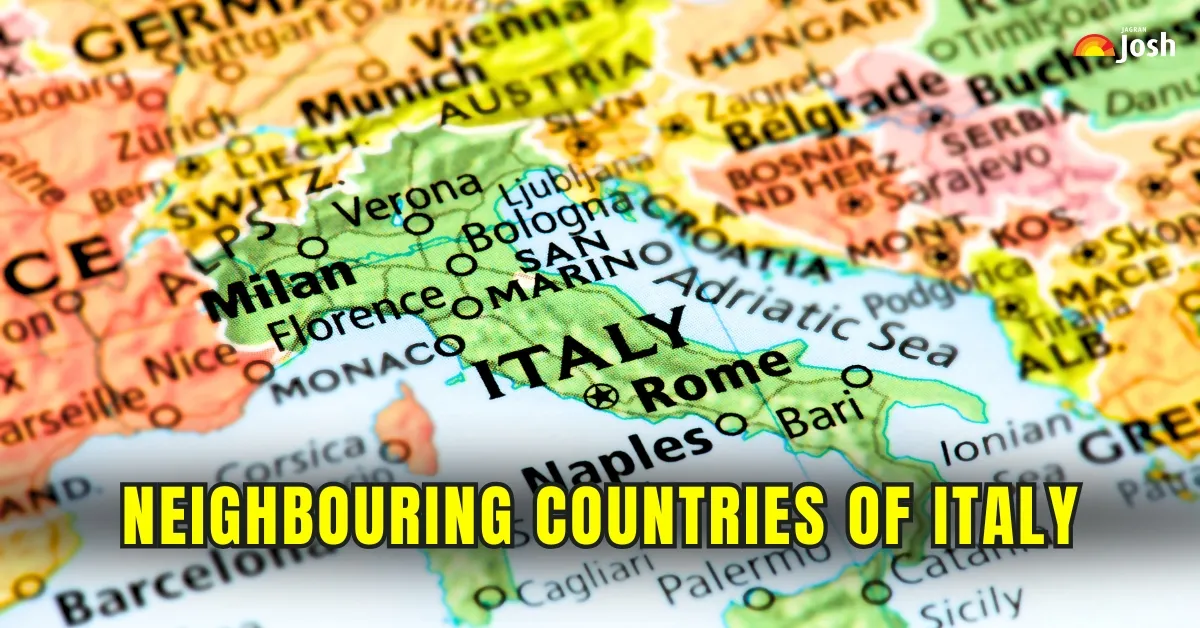
Italy is one of the most fascinating countries whose geography is quite similar to that of a boot. Italy lies in the southern region of Europe. The capital of Italy is Rome which is known as the ‘Eternal City’. Italy has around 59-60 million people living in it. Italian is the official language spoken in Italy. However, do you know which countries border Italy?
List Of Countries That Share Borders With Italy
Italy is a country in southern Europe which has its northern boundaries adjacent to four sovereign nations. Let’s discuss the geographical positioning and important features of the adjoining countries on the northern boundary of Italy.
| Country | Direction | Border Length | Official Language | Currency |
| Switzerland | North / Northwest | 744 km | German, French, Italian, Romansh | Swiss Franc (CHF) |
| France | West / Northwest | 488 km | French | Euro (€) |
| Austria | North / Northeast | 430 km | German | Euro (€) |
| Slovenia | East / Northeast | 232 km | Slovenian | Euro (€) |
Apart from these four main countries, Italy entirely surrounds two other microstates, namely San Marino and Vatican City. All these neighbours work together and create effective cooperation, similar to alpine ecosystems, and trade paths through the European Union system.
What Are The Physical Features Of Italy?
Italy is a country that is extremely beautiful and has a very distinctive shape because it resembles a huge boot that kicks a football (Sicily). Due to its location, the country has extremely diverse landscapes, which are among the most interesting in all of Europe. Here are some of the physical characteristics of Italy:
The Massive Mountains
The Alps protect the northern border of Italy. This is a chain of enormous, snow-covered mountains which acts as a barrier between Italy and the rest of Europe. The next mountain range to consider is the Apennines. It runs along the centre of Italy, dividing it into eastern and western halves.
Active Volcanoes
Italy is one of the few countries in Europe where there are active volcanoes. In the South, there is Mount Vesuvius, which is located near the city of Naples. It is well known for the long-ago burial of the city of Pompeii. Also, there is Mount Etna, which can be found in Sicily.
Endless Coastlines and Islands
As Italy is a country that exists in the form of a peninsula, it is surrounded by the sea on three sides, and the seawater is very clear. It has hundreds of kilometres of beaches and caves along with cliffs. The two largest islands of Italy are situated in the Mediterranean Sea.
Fertile Plains and Rivers
Just south of the Alps lie the Po Valley regions. These are huge and flat regions which host the flow of the Po River. This river is considered to be the largest river in Italy. With plenty of water and fertile soil, these regions are the major food-producing regions for Italy.

Kriti Barua is a skilled digital journalist and communications professional with 4+ years of experience, currently writing for the General Knowledge section at Jagran New Media. She has established herself as a subject matter expert in History, Geography, Trending National and International News, Sports, Science, and Defence, producing clear, reliable, and search-optimised content that connects with readers worldwide.
Kriti holds a BA degree from Delhi University and a one-year diploma in TV Production and Journalism, an academic background that adds research depth and strong storytelling instincts to her writing. Her experience spans brand writing, content marketing, and digital media, giving her a sharp understanding of what makes content both helpful to readers and visible in search.
At Jagran New Media, she applies this expertise to national and international news coverage, query-based articles, and in-depth pieces across her specialist subject areas. Her content is defined by easy language, factual accuracy, strong keyword strategy, and reader-friendly storytelling.


-1783077067176_t.webp)

-1783075081790_t.webp)