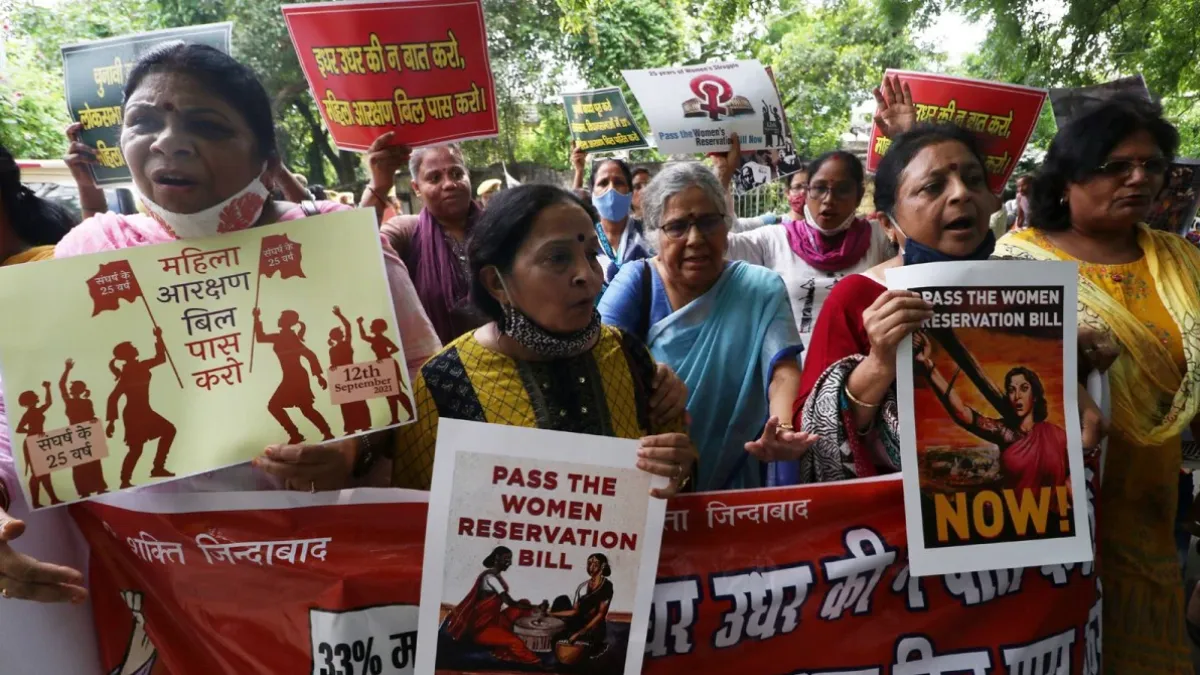
The Union Ministry of Home Affairs has enabled quota of women in the legislative assemblies of Jammu and Kashmir and Puducherry, which is an important step towards ensuring more women representation in Indian politics. This is after notification on April 16 and 17, 2026, which have brought in force the 2023 constitutional amendment and associated UT laws.
Legal Foundation of the Quota
The Constitution (106th Amendment) Act, 2023, has allocated one-third of seats to women in Lok Sabha, state assemblies and the assembly of Delhi.
In the case of Union Territories such as J&K and Puducherry that have legislatures, different acts are applicable: the J&K Reorganisation (Second Amendment) Act, 2023, and the Government of Union Territories (Amendment) Act, 2023.
In these acts, there are reservations of women (33% women reservation), seats of Scheduled Castes and Tribes. Both provisions state that it starts with a central government announcement in the official Gazette as passed by Parliament in December 2023.
Recent Notifications
On April 16, 2026, the 106th Amendment commenced nationwide. The following day, April 17, 2026, the MHA informed about the activation of the UT-specific acts, operationalizing the quotas of women after delimitation.
These dates are attested by official gazettes, and are connected to the parent J&K Reorganisation Act, 2019, and Government of Union Territories Act, 1963. The reservation is 15 years, which can be renewed by Parliament.
Implementation Timeline
The reservation then comes into effect following the first delimitation according to the following census (projected Census 2027, April 2026–March 2027). This postpones application until post-delimitation elections, probably not on immediate cycles.
Bills to roll out earlier (e.g., Constitution 131st Amendment, Delimitation Bill), which had been pending earlier, failed in Lok Sabha, keeping the original framework based on the census. Delimitation will re-draw constituencies to give one-third of the seats to women.
This gives women in the 90-seat J&K assemblies and 30-seat Puducherry assemblies immense political power, enhancing their involvement in politics in these two UTs. It is in line with national objectives according to Nari Shakti Vandan Adhiniyam, which discusses gender disparities in representation.