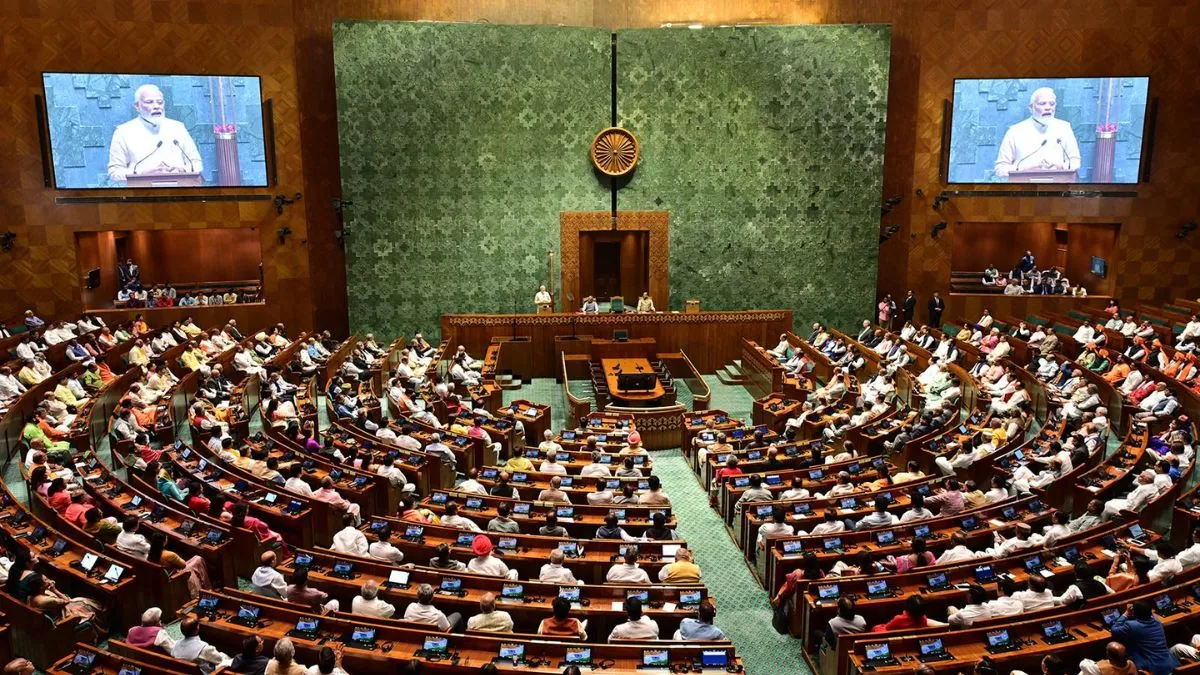
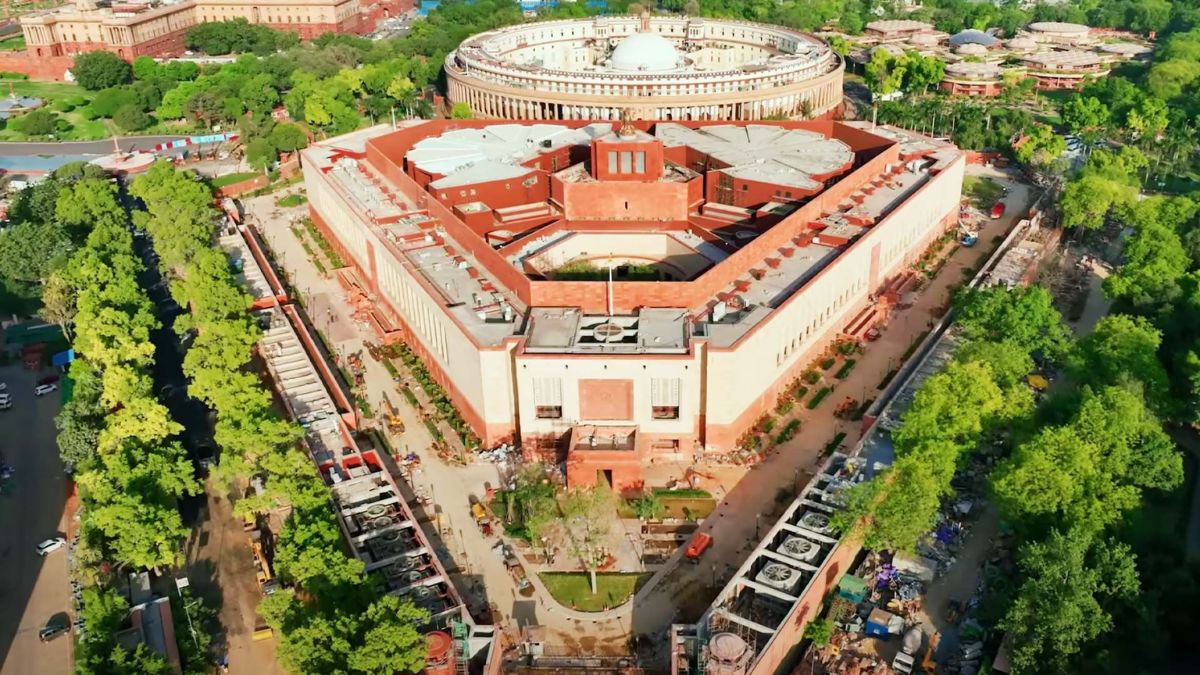
Parliament is the supreme legislative body of the government (it makes laws for the country). There have been 17 Lok Sabhas since the first one in 1952. The 18th Lok Sabha was constituted in June 2024.
The Indian Parliament is composed of the President and two houses: the Lok Sabha (House of the People/Lower House) and the Rajya Sabha (Council of States/Upper House). This structure with two houses is called a ‘bicameral’ system.
The people of India choose their representatives for the Lok Sabha through a direct election. The maximum number of members of this House envisaged by the Constitution is 550. The Members of Parliament (MPs) in the Rajya Sabha are elected indirectly by the electoral college.
Did you know? Both the number of Rajya Sabha seats allocated and the number of MPs represented in the Lok Sabha are based on the population of each state.
The Union Executive consists of the following members: the President, the Vice President, and the Council of Ministers headed by the Prime Minister. The Union Legislature (Parliament) comprises the President and the two Houses – the Lok Sabha (Lower House) and the Rajya Sabha (Upper House).
Polity and Governance MCQs on Union Executive and Legislature, President, Vice President, Prime Minister, and Parliament
1. Consider the following former Presidents of India:
i. Dr. Sarvepalli Radhakrishnan
ii. Dr. Zakir Hussain
iii. Neelam Sanjiva Reddy
How many of the above Presidents has/have also served as Vice-President of India?
(a) None
(b) 1
(c) 2
(d) 3
Answer: (c) 2
Explanation: Two of the former Presidents of India in the list above served as Vice-President. Dr. Sarvepalli Radhakrishnan (1952-1962) and Dr. Zakir Hussain (1962-1967) served as Vice-President.
2. Consider the following statements:
i. The Constitution of India classifies the ministers into four ranks viz. Cabinet Minister, Minister of State with Independent Charge, Minister of State and Deputy Minister.
ii. The total number of ministers in the Union Government, including the Prime Minister, shall not exceed 15 percent of the total number of members in the Lok Sabha.
Which of the statements given above is/are correct?
(a) i only
(b) ii only
(c) Both i and ii
(d) Neither i nor ii
Answer: (b) ii only
Explanation: The 91st Amendment Act of 2003 added a clause to Article 75 stating that the total number of ministers, including the Prime Minister, in the Council of Ministers shall not exceed 15% of the total number of members of the Lok Sabha.
3. Who among the following holds his/her office at the pleasure of the President?
(a) The Chairman of a Public Service Commission
(b) The Attorney General of India
(c) The Speaker of the Lok Sabha
(d) The Comptroller and Auditor General of India
Answer: (b) The Attorney General of India
Explanation: According to Article 76(4) of the Constitution of India, the Attorney General shall hold office during the pleasure of the President.
4. When the President of India is impeached for the violation of the Constitution, the charge shall be preferred by:
(a) the Lok Sabha
(b) the Rajya Sabha
(c) either House of the Parliament
(d) the Lok Sabha followed by the Rajya Sabha
Answer: (c) either House of the Parliament
Explanation: According to Article 61 of the Constitution of India, either the Lok Sabha or the Rajya Sabha can move the charge of violating the Constitution to impeach the President can be preferred by either House of Parliament.
5. The Vice President of India, who is also the ex-officio Chairman of the Council of States, is elected by the Members of an Electoral College consisting of the Members of:
(a) the Rajya Sabha only
(b) both the Houses of the Parliament
(c) both the Houses of the Parliament and the Upper House of the State Legislatures
(d) both the Houses of the Parliament and the Members of the Legislative Assemblies of States and UTs
Answer: (b) both the Houses of the Parliament
Explanation: According to Article 66 of the Constitution of India, the Vice President is elected by an Electoral College consisting of the members of both Houses of Parliament (the Rajya Sabha and the Lok Sabha).
6. The Election Commission of India holds election for:
(a) the Parliament of India, State Legislatures and for the posts of the President and Vice President of India
(b) the Parliament, State Legislative Assemblies and State Legislative Councils only
(c) the Parliament of India only
(d) the Parliament of India and State Legislatures only
Answer: (a) the Parliament of India, State Legislatures and for the posts of the President and Vice President of India
Explanation: The Election Commission of India (ECI) holds elections for the Parliament of India (Lok Sabha and Rajya Sabha), State Legislatures (Legislative Assemblies and Legislative Councils), and for the offices of the President and Vice-President of India under Article 324 of the Indian Constitution.
7. Who among the following was the 16th Lok Sabha Speaker?
(a) Somnath Chatterjee
(b) Manohar Gajanan
(c) Sumitra Mahajan
(d) Meira Kumar
Answer: (c) Sumitra Mahajan
Explanation: The 16th Lok Sabha Speaker was Sumitra Mahajan. She served as the Speaker from June 5, 2014, to June 19, 2019, representing the Bharatiya Janata Party and holding the position during the 16th Lok Sabha term, making her the second woman to hold this office.
8. With reference to the Indian Parliament, consider the following statements:
i. A bill pending in the Lok Sabha lapses on its dissolution.
ii. A bill passed by the Lok Sabha and pending in the Rajya Sabha lapses on the dissolution of the Lok Sabha.
iii. A bill in regard to which the President of India notified his/her intention to summon the Houses to a joint sitting lapses on the dissolution of the Lok Sabha.
Which of the statements given above is/are correct?
(a) i only
(b) i and ii
(c) ii and iii
(d) iii only
Answer: (b) i and ii
Explanation: Statement iii is incorrect: As per Article 108, if the President has notified a joint sitting to resolve a deadlock, the bill does not lapse upon dissolution.
9. Which one of the following is NOT a category under which the President of India nominates Members of Parliament?
(a) Literature
(b) Science
(c) Art
(d) State Service
Answer: (d) State Service
Explanation: Under Article 80(3) of the Constitution of India, the President is authorized to nominate 12 members to the Rajya Sabha (Council of States). State Service is not a constitutionally recognized category for Presidential nominations.
10. Consider the following statements regarding the exclusive power(s) of Lok Sabha?
i. To ratify the declaration of Emergency
ii. To pass a motion of no-confidence against the Council of Ministers
iii. To impeach the President of India
Which of the following statements are correct?
(a) i and ii
(b) ii only
(c) i and iii
(d) iii only
Answer: (b) ii only
Explanation: Statement ii is correct: A no-confidence motion can only be introduced and passed in the Lok Sabha. If passed, the entire Council of Ministers, including the Prime Minister, must resign.
Statement i is incorrect: The power to ratify a declaration of Emergency (National, State, or Financial) is a joint power shared by both the Lok Sabha and the Rajya Sabha.
Statement iii is incorrect: Under Article 61, the process to impeach the President of India can be initiated by either House of Parliament.
Also read: Polity and Governance MCQs on Articles, Schedules, and the Indian Constitution