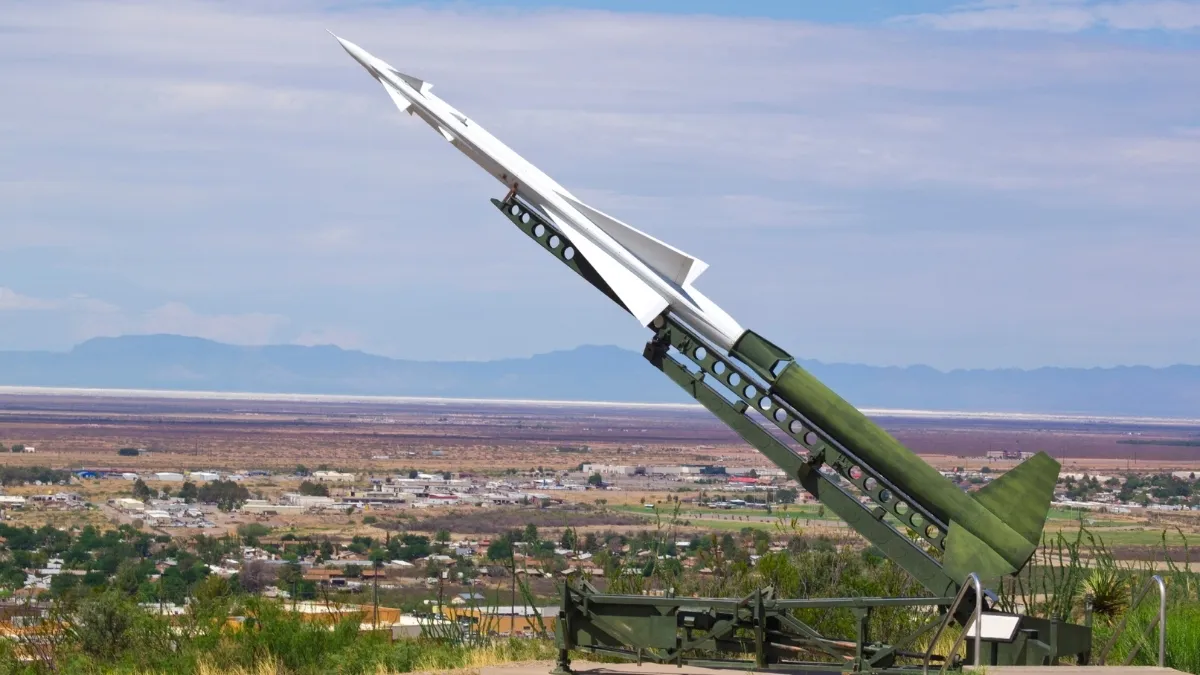
Indian Defence Research and Development Organisation (DRDO) has achieved a major milestone with the Astra Mk2. This next-generation Beyond-Visual-Range Air-to-Air Missile (BVRAAM) represents a massive technological leap over its predecessor. the missile is now transitioning into integrated user trials, set to arm India's frontline fighter fleet, including the Su-30MKI and Tejas Mk-1A.
Astra Mk2 Missile Key Features
Astra Mk2 is a next-generation indigenously developed Beyond-Visual-Range Air-to-Air Missile (BVRAAM) featuring a dual-pulse rocket motor and an indigenous AESA seeker, it offers a range of 200–240 km, significantly enhancing the Indian Air Force's ability to engage adversaries from safe distances Its advanced technical specifications include:
-
Extended Operational Range: Capable of engaging targets at distances between 200 and 240 kilometres under high-altitude conditions.
-
Dual-Pulse Solid Rocket Motor: its propulsion system allows the missile to conserve energy during coasting phase and provides a second boost of speed during the terminal approach to ensure high manoeuvrability.
-
Indigenous AESA Seeker: Equipped with an active electronically scanned array (AESA) seeker featuring robust Electronic Counter-Countermeasures (ECCM).
-
Two-Way Datalink: This feature enables real-time mid-course guidance updates, allowing the missile to receive targeting corrections from the launch aircraft or other networked assets.
-
Stealth-Ready Design: DRDO is currently developing a folding-fin variant, specifically designed to fit within the internal weapons bays of next-generation stealth aircraft like the Advanced Medium Combat Aircraft (AMCA) and the Ghatak UCAV.
Significance
The induction of the Astra Mk2 is a strategic game-changer for the Indian Air Force (IAF) for several reasons:
-
Strategic Deterrence: it has capabilities to meet the PL-15, the Astra Mk2 acts as a credible deterrent to ensure the India air superiority in a complex.
-
Network-Centric Warfare: it can function seamlessly within a collaborative digital battlefield allowing one aircraft to launch the weapon while another platform guides .
-
Self-Reliance (Atmanirbhar Bharat): it highlights India's shift away from foreign imports, demonstrating the nation’s ability to design, develop, and produce world-class, cost-effective aerial munitions domestically.
-
Multi-Platform Versatility: Its integration across diverse platforms from the Su-30MKI and Tejas Mk-1A to potential future fits like the Mirage 2000provides the IAF with unprecedented flexibility in fleet management and tactical deployment.
DRDO's Astra Mk2 missile, a next-gen BVRAAM, is entering user trials for India's frontline fighters like Su-30MKI and Tejas Mk-1A. It boasts a 200-240 km range, dual-pulse motor, and indigenous AESA seeker. This strategic game-changer enhances India's air superiority, promotes self-reliance, and offers multi-platform versatility, including future stealth aircraft integration.