Which City Is Known As The Silk City Of India?
Do you know which city is known as the silk city of India? This textile powerhouse boasts a century-old heritage, producing incredible natural, flame-resistant fabrics on thousands of active handlooms. Let’s discover the history, facts, and culture of the silk capital of India.

Silk is a luxurious, natural fibre made by silkworms. These little worms are pretty picky; they thrive in warm, tropical spots, ideally soaking up temperatures between 20°C and 28°C. Because of that, farmers usually rear them during the sweet spot of the year, from April to September. Now, here is a fun fact: India is the number one consumer of silk in the world, consuming over 30,000 metric tonnes of it every single year. But do you actually know which specific town owns the title of the official silk city of India? In this article, we'll take a look at the incredible history and deep-rooted culture of the silk capital of India.
Silk City of India
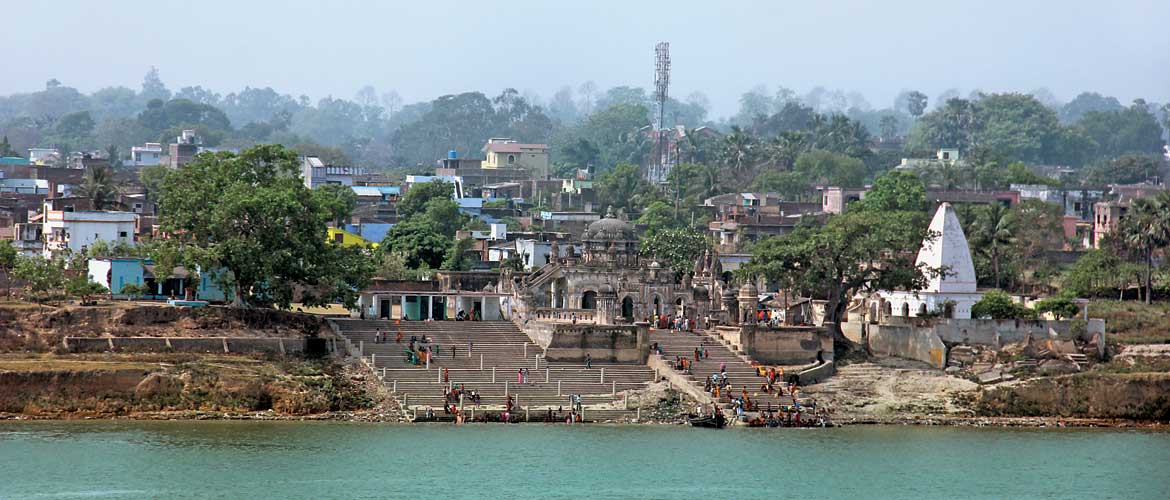
If you head over to Bihar and trace the banks of the Ganges, you'll run right into Bhagalpur, the undisputed 'Silk City of India' or the 'Silk Capital of India'. This place didn't just stumble into the title; its famous Tussar silk trade goes back well over a century. Today, it's a massive operation keeping over 25,000 skilled weavers busy on roughly 10,000 clacking looms.
Now, India is a bit of a show-off when it comes to silk, being the only country that harvests all four commercial types: Mulberry, Eri, Muga, and Tussar. But Bhagalpur? They chose their lane and mastered Tussar.
The local climate hits a sweet spot between 22°C and 35°C, which is perfect for production. The result is a booming ₹500 crore ($60+ million) economy that sends nearly half of its gorgeous, high-grade fabrics straight to global fashion runways.
5 Fascinating Facts About the Silk City of India
- Under a microscope, this silk has tiny holes that act like insulation. It blocks out summer heat but traps your body warmth in winter.
- Instead of boiling silkworms alive inside their cocoons, Bhagalpur weavers wait for the moths to hatch and fly away before harvesting the threads.
- The city sits on thick Gangetic river silt. This unique soil acts like a giant shock absorber, dampening minor earthquake waves.
- Made of pure fibroin protein, the silk is naturally fire-resistant. It burns incredibly slowly and snuffs itself out if pulled from a flame.
- Raw, unbleached Tussar contains natural gum and dark pigments that act like sunscreen, physically blocking harmful UV-B rays from your skin.
Why is Bhagalpur Called the Silk Capital of India?
Bhagalpur's handwoven fabrics might look like pure art, but there's a whole world of numbers and know-how woven in. This city didn't just stumble into being India's silk capital.
It got there thanks to generations of skilled hands, a climate that's just right for silkworms, and an industry that's big enough to make waves far beyond India.
| Key Factor | Key Data | Why It Matters |
| Active Workforce | 25,000+ weavers operating over 10,000 active looms. | Sustains the largest concentrated cluster of skilled Tussar artisans in India. |
| Market Valuation | Annual silk trade turnover exceeding ₹500 crore ($60+ million USD). | Anchors the regional economy and establishes Bhagalpur as a high-value commercial hub. |
| Global Export Share | 40% to 50% of all locally produced high-grade silk is exported. | Feeds international fashion houses across the US, Europe, and Japan, minimising reliance on domestic import substitution. |
| Climate Advantage | Sustained regional temperatures averaging between 22°C and 35°C. | Creates the precise, stable climate required for optimal Antheraea mylitta silkworm rearing. |
| Biodiversity Monopoly | India harvests 100% of the 4 commercial silks; Bhagalpur dominates the premier Tussar sector. | Gives the city a distinct, natural competitive edge that machine-made synthetics cannot replicate. |
How Many Types Of Silk Are Made In India?
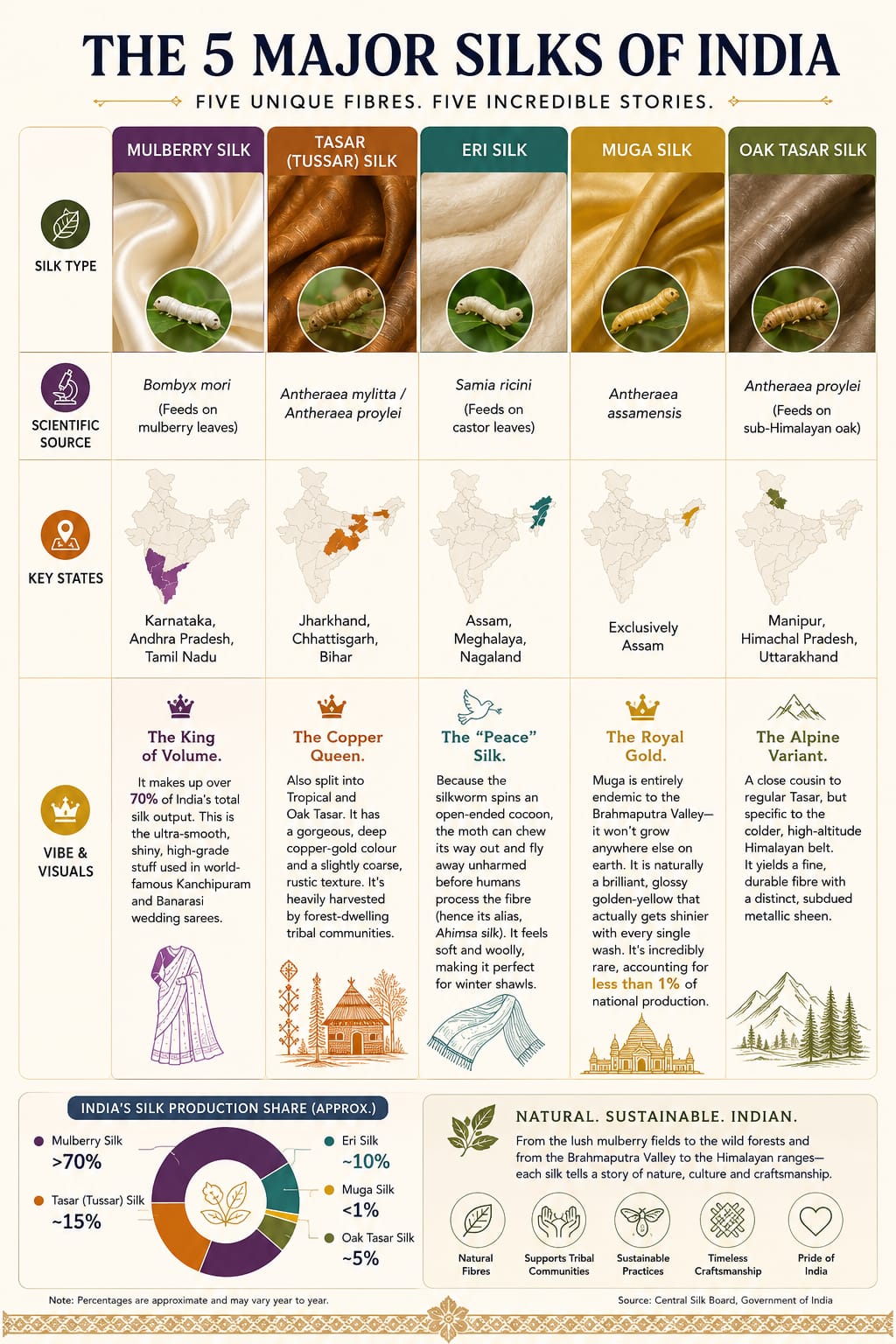
Here's something you probably didn't know: India is the only place on Earth where you can find all five types of natural silk being made for real, not just in some lab or museum.
Most countries churn out the usual, factory-made silk, but India's wild mix of landscapes and weather means you get a whole buffet of styles. The numbers are pretty staggering: over 41,000 metric tonnes of silk every year, and nearly 10 million rural folks weaving, farming, and keeping the tradition alive.
If you want to get technical, there are two main types of silk: Mulberry silk, which is the classic, tamed stuff, and Vanya silks, which are the wild ones straight out of the forests.
Which State Is The Largest Producer Of Silk?
Hands down, it is Karnataka. They produce about 32% to 35% of all the raw silk in India, which is crazy if you think about it. Most of what they grow is Mulberry silk—the super smooth kind. They churn out around 11,000 to 12,000 metric tonnes a year, thanks to great weather and big markets in places like Mysuru and Ramanagara.
Which Country Is The Largest Producer Of Silk?
China is the absolute king here, making over 65% to 70% of the world's raw silk. They produce a massive 100,000 metric tonnes every single year, mostly because their farms are heavily automated. India is second, but China beats everyone by a huge margin.
Which Country Is The Largest Exporter Of Silk?
Again, it’s China. Since they make so much of it, they ship raw silk, yarn and expensive fabrics all over the globe to luxury fashion brands. India makes a lot, too, but we keep most of ours for ourselves. China capitalises on that and makes billions of dollars a year just from exporting.
Which Country Is The Largest Consumer Of Silk?
v
India takes the crown for this one. We absolutely love silk, and we go through over 30,000 to 35,000 metric tonnes of it every single year. Between weddings, big festivals and traditional sarees, the demand is so high that our own farms can't keep up. So, we actually have to import a lot of premium raw silk to match the demand.
Which Silk Is Known As The Queen Of Silks?
Globally, Mulberry Silk is called the "Queen of Silks" because it's incredibly smooth, shiny and strong. But if you ask anyone in India, they'll probably say Kanchipuram (Kanjeevaram) silk is the real queen. Woven with pure mulberry threads and real gold-dipped silver zari, it's pretty much the ultimate wedding heirloom.

Kriti Barua is a skilled content writer with 4+ years of experience in creating clear, engaging, and informative content. She began her writing journey as a Creative Writer Intern at Wordloom Ventures. She holds a BA degree from Delhi University and has completed a one-year diploma in TV Production and Journalism, which adds depth to her research and reporting style.
Kriti has worked across brand writing, marketing content, and digital media, building strong expertise in articles that connect with readers and perform well online. At Jagran New Media, she writes for the GK section, covering national news, international stories, and query-based articles that answer what people actively search for. Her work focuses on easy language, reliable information, strong keywords, and reader-friendly storytelling, making her content both helpful and search-friendly.


