Why in news? A report by the Goldman Sachs Group noted that the oil output from Persian Gulf nations has been running 14.5 million barrels per day (mbd), or 57 per cent, below pre-war levels in April 2026.
In its report, Goldman Sachs said a full recovery to pre-war levels of production is possible within months, given the safe reopening of the Strait of Hormuz and no renewed strikes on energy infrastructure.
According to reports as of April 2026, Iraq's daily oil production plunged from roughly 4.9 million barrels per day to 1.6 million barrels per day due to disruptions caused by the closure of the Strait of Hormuz.
In this article, we will learn about the location, bordering countries, key waterways, and geopolitical importance of the Persian Gulf for India.
Where is the Persian Gulf located?
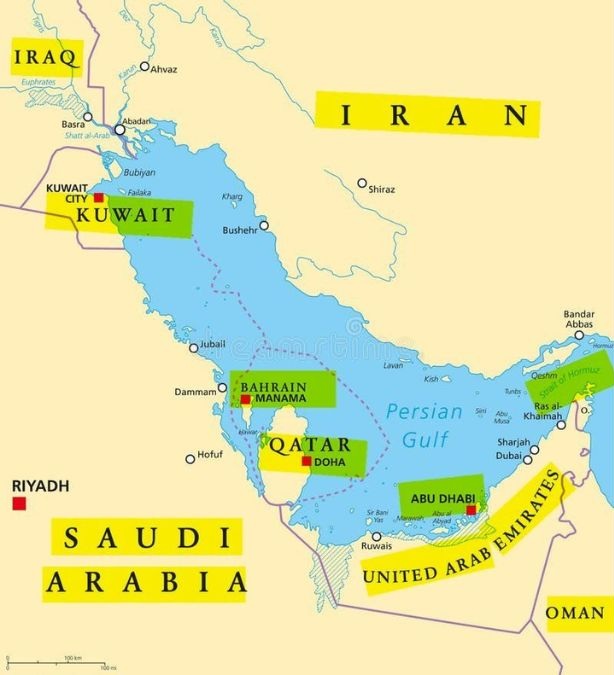
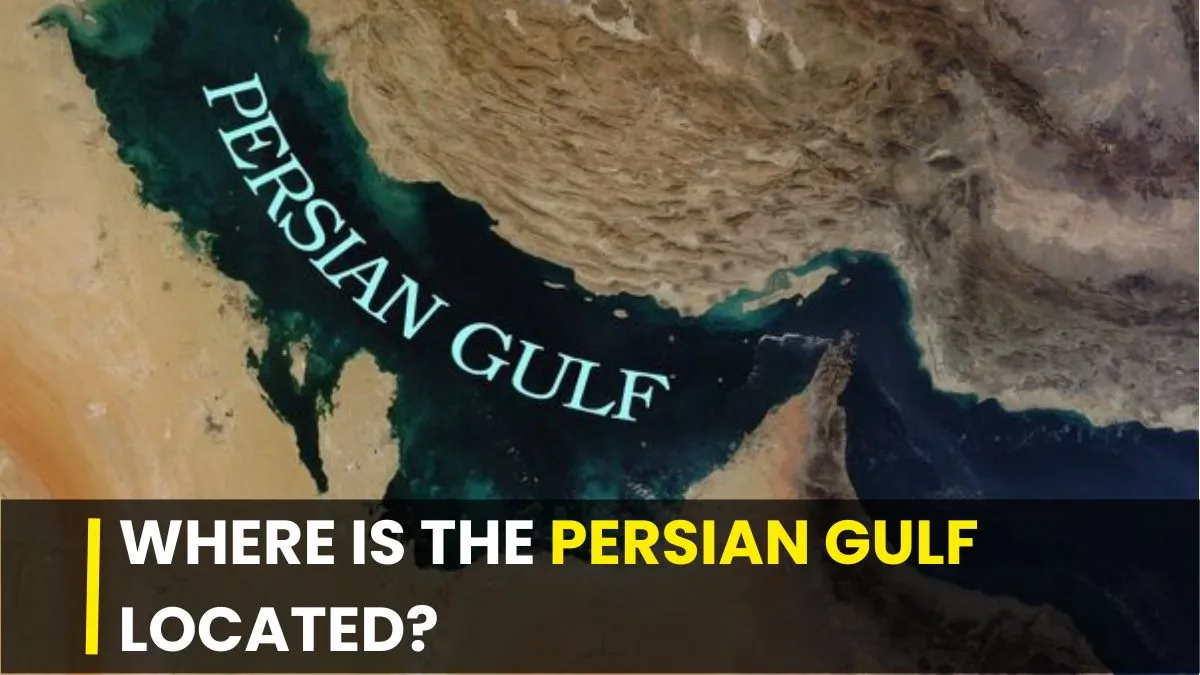
The Persian Gulf, also called the Arabian Gulf, is a shallow marginal sea of the Indian Ocean in West Asia. The Persian Gulf lies between the Arabian Peninsula and southwestern Iran. It connects the Gulf of Oman and the Arabian Sea through the Strait of Hormuz.
With an area of about 241,000 square km, the Persian Gulf is about 990-km long and about 55 km wide at its narrowest in the Strait of Hormuz to 340 km wid at its maximum. The Gulf is shallow, with a maximum depth of about 300 feet.
Often, the term 'Persian Gulf' is used broadly to refer to the Strait of Hormuz and the Gulf of Oman, both of which connect to the Arabian Sea. However, geographically, the Persian Gulf is a shallow sea.
Bordering Countries
The bordering countries of the Persian Gulf include Iran, Iraq, Kuwait, Saudi Arabia, Bahrain, Qatar, United Arab Emirates (UAE), and Oman.
On a map, the Persian Gulf shares borders with following Middle Eastern countries:
Northeast: Iran
Southwest: Iraq, Kuwait, Saudi Arabia, Bahrain, Qatar, the United Arab Emirates (UAE), and Oman.
Of the eight bordering countries of the Persian Gulf, following are the GCC and OPEC members. These countries are major oil and natural gas producers.
GCC Members: Six of these nations—Kuwait, Saudi Arabia, Bahrain, Qatar, UAE, and Oman—are members of the Gulf Cooperation Council (GCC).
OPEC Members: Iran, Iraq, Kuwait, Saudi Arabia, and the UAE are members of OPEC
Key Waterways
The Tigris, Euphrates, and Karun rivers—converging into the Shatt al-Arab before entering the Persian Gulf—are indeed the primary source of freshwater for the northern Gulf.
- Strait of Hormuz: Located between Iran and Oman, this 33 km wide passage is a critical, narrow chokepoint, connecting the Gulf to the Arabian Sea. Over 20 to 21 million barrels of oil per day (20 per cent of global oil and LNG supply) passes through this passage.
- Shatt al-Arab: Also known as Arvand Rud in Iran, Shatt al-Arab is a 200-km river in southeastern Iraq formed by the Euphrates and Tigris rivers at Al-Qurnah, flowing into the Persian Gulf. It is a key maritime channel for oil exports and international trade from Iraqi and Iranian ports.
The Persian Gulf is a major hub for oil, natural gas, and fertiliser exports, accounting for 30 to 35 per cent of global urea.
Why is the Persian Gulf important for India?
The Persian Gulf is vital to India for energy security. The region is a primary supplier of India's oil and LNG, supplying nearly 40 to 60 per cent of its crude oil and gas imports.
Six Gulf Cooperation Council (GCC) countries and Iran and Iraq, are India’s primary oil and gas suppliers, contributing nearly 55-60 per cent of total oil and gas imports.
The Strait of Hormuz in the Persian Gulf region is a critical global chokepoint. Nearly 50 per cent of India's crude oil imports, over 90 per cent of its LPG import, and about 50 per cent òf LNG imports pass through this strait.
Recent geopolitical tensions due to the Middle East conflict led to India's fertiliser supply disruption. India is highly dependent on the Gulf region for fertilisers, with import dependency for urea (~18-25 per cent), phosphatic/DAP (~50–60 per cent), and total reliance on imported potash (100 per cent).
Also read: Which Middle East countries are part of the BRICS?


-1777190103493_t.webp)

