Major Indian River Systems of Himalayan and Peninsular Drainage
The drainage systems of India can be broadly divided based on their origin, orientation towards the sea, and the size of the catchment area. Based on the origin, Indian river systems are classified into two broad categories: the Himalayan river system and the Peninsular river system. In this article, we will learn about these drainage and river systems in detail.

Water flowing through well-defined channels is known as 'drainage', and the network of such channels is called a 'drainage system'. The drainage systems of India can be broadly divided based on their origin, orientation towards the sea, and the size of the catchment area.
Based on the origin, Indian river systems are classified into two broad categories: the Himalayan river system and the Peninsular river system. Whereas, on the basis of orientation to the sea (discharge of water), the Indian drainage system may be grouped into (i) the Arabian Sea drainage and (ii) the Bay of Bengal drainage.
To be noted, about 77 per cent of drainage of Indian river systems is oriented towards the Bay of Bengal, while 23 per cent of river systems discharge their water into the Arabian Sea.
Drainage System and Drainage Patterns: Important Terms You Must Know |
|
The Himalayan Drainage System
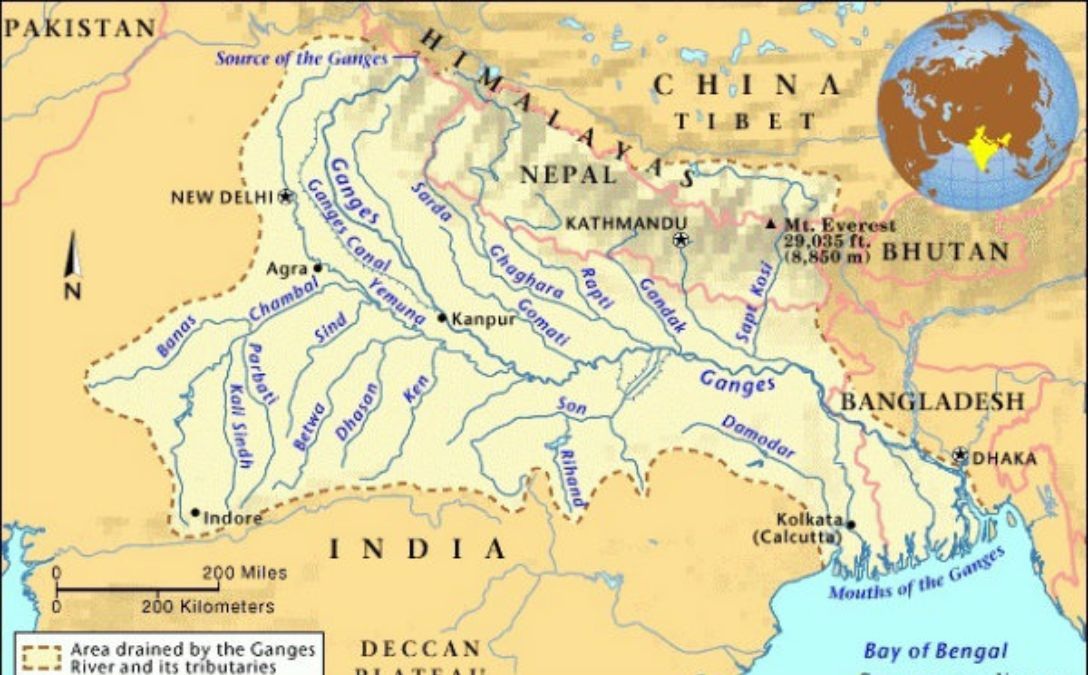
The Himalayan drainage system primarily includes the Ganga, the Indus, and the Brahmaputra river basins. These rivers are perennial in nature and are fed by melting of snow and percipitation and season rainfall.
Geologists believe that the evolution of the Himalayan drainage system came to be after a mighty river called Shiwalik or Indo-Brahma got dismembered into three main draingage systems.
This river system traversed the extent of the Himalaya from Assam to Punjab and finally discharged into the Gulf of Sin during the Miocene period some 5 to 24 millions years ago.
The disjoining of the river system is owed to the Pleistocene upheaval in the western Himalayas, including the uplift of the Potwar Plateau (Delhi Ridge), which led to three main drainage systems: (i) the Induas and its five tributaries in the western part; (ii) the Ganga and its Himalayan tributaries in the central part; and (iii) the Brahmaputra in Assam and its Himalayan tributaries in the eastern part.
Ganga River System
- The Ganga river system rises near the Gangotri glacier near Gaumukh in the Uttarkashi district of Uttarakhand. Here, it is known as the Bhagirathi.
- The Bhagirathi meets the Alaknanda at Devprayag, and hereafter, it is known as the Ganga.
- The major left bank tributaries of Ganga are Gomati, Ghaghara, Ramganga, Gandak, Kosi, and Mahananda. River Kosi, also known as the ‘sorrow of Bihar’.
- The right bank tributaries of Ganga are the Yamuna (longest tributary of Ganga), Son, and Damodar.
- The total length of river Ganga is 2,525 sq.km, running across the states of Uttarakhand (110 km), Uttar Pradesh (1,450 km), Bihar (445 km), and West Bengal (520 km).
- Covering about 8.6 lakh sq.km basin area in India, Ganga river system finally discharges into the Bay of Bengal near the Sagar island.
Indus River System
- It is one of the largest river basins in the world, covering an area of 11,65,000 sq.km (in India it is 321,289 sq.km) with a total length of 2,880 km (in India 1,114 km).
- The Indus, also known as the Sindhu, is the westernmost of the Himalayan rivers in India. Originating from a glacier near Bokhar Chu in the Tibetan region in the Kailash Mountain range, the Indus river in Tibet is known as 'Singi Khambharr' or Lion's mouth.
- The Indus river flows in the northwest direction between the Ladakh and Zaskar ranges, passing through Ladakh and Baltistan.
- Important tributaries of the Indus river system are Sutlej, Ravi, Jhelum, Chenab, and Beas. Chenab is the largest tributary of Indus.
Brahmaputra River System
- One of the largest rivers of the world, the Brahmaputra has its origin in the Chemayungdung glacier of the Kailash range near the Mansarovar lake.
- From here, it flows eastward for about 1,200 km in the flat region of southern Tibet, where it is known as the Tsangpo, which means 'the purifier'.
- The Brahmaputra river has a total length of 2,480 km, out of which 1,346 km is in India. It covers a total drainage area of 5,80,000 sq.km, out of which 2,58,008 sq.km lies in India.
- The major left bank tributaries of the Brahmaputra are the Burhi Dihing and Dhansari whereas the important right bank tributaries are the Subansiri, Kameng, Manas, and Sankosh.
- Originating from the Kailash ranges of the Himalayas under the name of Siang or Dihang, it flows through Tibet and enters India through Arunachal Pradesh. Further flowing southwest, it is joined by its main left bank tributaries, the Dibang or Sikang and Lohit, and hereafter, it is known as the Brahmaputra.
- The Brahmaputra enters Bangladesh near Dhubri, where it joins the Tista and here it is known as the Jamuna. It finally merges with the river Padma and finally discharges into the Bay of Bengal.
The Peninsular Drainage System
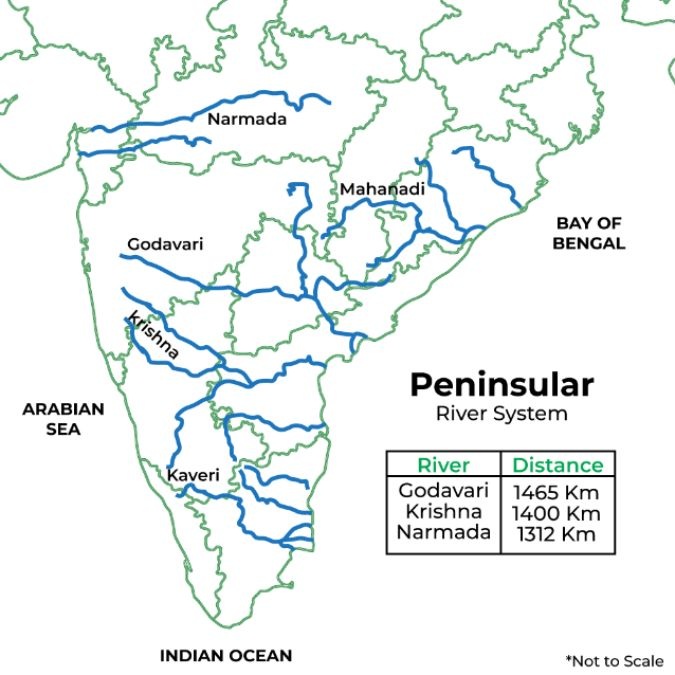
Older than the Himalayan drainage system, the Peninsular drainage system includes a large number of major river systems. Important rivers of Peninsular drainage system include the Godavari, Narmada, Tapi, Sabarmati, Mahanadi, Brahmani, Subarnarekha, Krishna, Penner, Cauvery, and Luni.
The peninsular rivers are characterised by broad, largely-graded shallow valleys, absence of meanders, and non-perennial flow of water.
The river system of Peninsular drainage is also classified on the basis of its direction of flow: the East-flowing river system and the West-flowing river system. The East-flowing rivers of Peninsular river system drains into Bay of Bengal, while the West-flowing river system drains into Arabian Sea.
The major East-flowing rivers are: Godavari, Krishna, Cauvery, Mahanadi, Pennar, Brahmani, and Subarnarekha.
The major West-flowing rivers are: Narmada, Tapi, Sabarmati, Luni, Mahi, and Sharavati.
Godavari
- The Godavari river is the largest Peninsular river system. It is also called the Dakshin Ganga. It has a total catchment area of 3,12,812 sq.km.
- Originating near Trimbak plateau in Nasik districk of Maharashtra, it flows for a total length of 1,465 km across the states of Maharashtra, Chhattisgarh, Odisha, Madhya Pradesh, Telangana, and Andhra Pradesh.
- Major tributaries of the Godavari River are Pranhita, Purna, Penganga, Pravara, Wainganga, Manjra, Wardha, Maner, Indravati Sabari and Pench.
Narmada
- Originating from the Amarkantak plateau in Madhya Pradesh, the Narmada river flows for a total length of 1,312 km. It has a catchment area of about 98,795 sq.km.
- The Narmada, flowing in a rift valley with Satpura in the south and Vindhyan range in the north, forms a pictersque marble rock gorge and Dhuandhar waterfall near Jabalpur.
- The Narmada drains into the Arabian Sea and forms 27 km long estuary. The Sardar Sarovar Project is built on this river.
Mahanadi
- Rising near Sihawa in Raipur district of Chhattisgarh, the Mahanadi river is 851 km long with a catchmment area of 1.42 lakh sq.km.
- 53 per cent of the Narmada drainage basin lies in Madhya Pradesh and Chhattisgarh, while 47 per cent in Odisha.
- The major left bank tributaries of Mahanadi river are Ib, Hasdeo, Mand, and Seonath, whereas its right bank tributaries are Tel, Jonk, and Ung.
Krishna
- Krishna river is the second-largest east-flowing Peninsular river. It rises near Mahabaleshwar (Satara district) in Maharashtra. It is 1,400 km long with a drainage basin of 2,58,948 sq.km.
- The major tributaries of the Krishna river are Musi, Bhima, Tungabhadra, Dhudhganga, Ghatprabha, Koyna, Yerla, Varna, Panchaganga, and Malprabha.
- The river Krishna flows through Andhra Pradesh, Telangana, Karnataka, and Maharashtra.
Cauvery
- The Cauvery river rises in Brahmagiri hills of the Kogadu district in Karnataka. It is 800 km long with a drainage basin of 81,155 sq.km., of which 56 per cent falls in Tamil Nadu, 41 per cent in Karnataka, and 3 per cent in Kerala.
- Unlike the other Peninsular rivers, the Cauvery rivers carries water throughout the year as the upper catchment area of the Cauvery receives rainfall during the southwest monsoon season (summer) and the lower part receives during the northeast monsoon season (winter).
- The western tributaries of the Cauvery are Srimsha, Lokpavani, Herangi, Arkavati, and Hemaati, whereas, the southern tributaries include Amravati, Lakshmatirtha, Suvarnavati, Bhawani, and Kabana.
Tapi
- About 724 km long, the Tapi (Tapti) river originates from Multai in the Betul district of Madhya Pradesh. It is one of the important westward flowing rivers.
- With a catchment areaof 65,145 sq.km., nearly 79 per cent of its basin lies in Maharashtra, 15 per cent in Madhya Pradesh, and the remaining 6 per cent in Gujarat.
Luni
- The Luni river orginates at Pushkar valley of Aravali Range in two branches, i.e., the Saraswati and the Sabarmati, which join each other at Govindgarh. From here, it is known as Luni. It is the largest river system of Rajasthan.
- Running for a total length of 495 km and covering a drainage area of 37,363 sq.km., the Luni river system is an ephemeral river meaning it only flows during the monsoon and dries up for the rest of the year.
- Luni river runs towards the west till Telwara and ends near the marshy land of the Rann of Kuchchh. It does not reach the sea making it a classic example of inland drainage.

Roopashree Sharma is a seasoned content writing professional with over 5 years of experience in digital journalism, specialising in writing explainers and IQ quizzes across geopolitics and strategic affairs, and international affairs and trade. She holds a degree in Journalism and Mass Communication and has contributed to leading media houses, including Zee, Times, and India TV. Currently serving as Deputy Manager – Editorial at Jagran New Media, she writes and produces videos for the General Knowledge (GK) section of the Jagran Josh (English) portal. For inquiries, contact her at roopashree.sharma@jagrannewmedia.com.

-1780659356759_t.webp)

