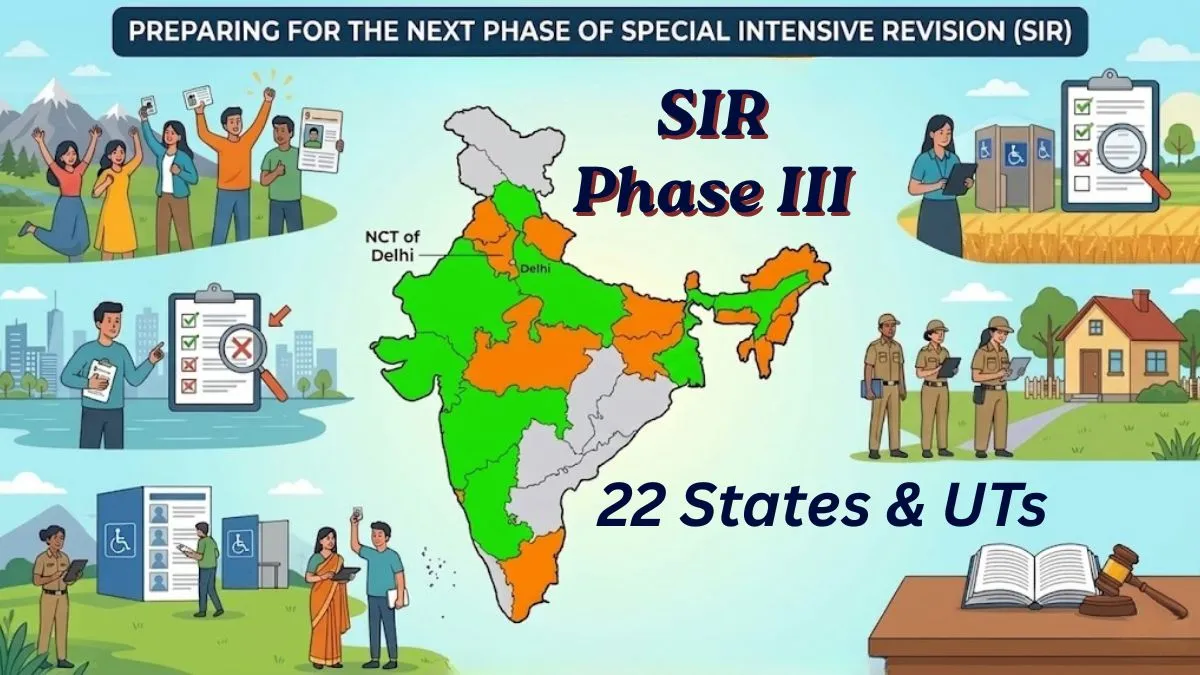
The second phase of SIR has already been published as the Final Roll Publication (Phase-II) on February 7, 2026, and now the Election Commission of India (ECI) is currently advising 22 States and Union Territories to finish all groundwork preparations towards the next phase of the Special Intensive Revision (SIR) for Electoral Rolls. This stage will go into a formal start by April 2026, and these 22 States and UTs are preparing for the Next Phase of Special Intensive Revision (SIR). Let’s explore this article more thoroughly with key statistics, which 22 States & UTs are preparing for the Next Phase of SIR.
Also Read: What is the SIR Electoral Roll and Why is it Important?
Key Statistics at a Glance
| Parameter | Figure |
| States/UTs in Next Phase (Phase-III) | 22 |
| States/UTs Covered in Phase-II | 12 |
| Total Electors Covered in Phase-II | ~51 Crore |
| Assembly Constituencies in Phase-II | 1,843 |
| Districts Covered in Phase-II | 321 |
| Booth Level Officers (BLOs) Deployed | 5.3 lakh+ |
| Qualifying Date (Phase-II) | January 1, 2026 |
| Final Roll Publication (Phase-II) | February 7, 2026 |
What is the Special Intensive Revision (SIR)?
The Special Intensive Revision (SIR) is an intensive voter verification that is done by the Election Commission of India (ECI), on a large scale, ground-up. In contrast to regular annual updates, the SIR would make all registered voters in the address states confirm their information again, whose express objectives are:
-
Eliminating duplicate, deceased, migrated and ineligible voters.
-
Onboarding all new eligible citizens who have reached 18 years of age.
-
Removing the names of foreign nationals or illegitimate immigrants from the lists.
-
Accessibility of the polling booths can be rationalised.
This scale has only been revised intensively 13 times since independence; the last significant revision would have been done in 2002-2004. The present countrywide SIR is one of the largest verification procedures of an election in Indian history.
On the Constitutional basis, the power of the SIR is on two main provisions:
-
Article 324, Constitution of India — Grants ECI superintendence, direction, and control over elections nationwide.
-
Section 21(3), Representation of the People Act, 1950 — Authorises "special revision" of electoral rolls at any time, without prior permission from any authority.
-
Registration of Electors Rules, 1960 — Prescribes the procedural framework for enrolment and revision.
Also Read: SIR Online Form: Official Website Link, Process and FAQs You Need to Know
Phase-wise Timeline of SIR Across India
The nationwide SIR was formally announced on October 27, 2025, by Chief Election Commissioner Gyanesh Kumar from Vigyan Bhawan, New Delhi.
Phase I — Bihar (June–September 2025) — COMPLETED
The pilot phase was conducted in Bihar ahead of the 2025 state assembly elections. Over 8 crore voters were subject to enumeration, with 4 lakh volunteers mobilised alongside Booth Level Officers. The process was challenged in the Supreme Court in Association for Democratic Reforms v. Election Commission of India (WP Civil 640/2025), where the Court directed ECI to publish district-wise, booth-level lists of deleted voters with reasons.
Phase II — 12 States/UTs (November 2025 – February 2026)
Formally launched on November 4, 2025, covering 9 states and 3 Union Territories. According to the official PIB press release (Release ID: 2186480), the enumeration phase ran through December 2025, with final electoral rolls scheduled for publication on February 7, 2026.
Phase III — 22 States/UTs (April 2026 Onwards) — PREPARATION UNDERWAY
On February 19, 2026, the ECI directed the Chief Electoral Officers of 22 states and UTs to complete all preparatory activities at the earliest for the next phase, expected from April 2026
How Many States & UTs are Preparing for the Next Phase of Special Intensive Revision (SIR)?
There are 22 States & UTs that are preparing for the Next Phase of Special Intensive Revision (SIR). On February 19, 2026, the ECI formally directed the Chief Electoral Officers of the following 22 states and Union Territories to complete all preparatory work ahead of the next SIR phase, expected from April 2026. Here is the complete list of all 22 States & UTs given below in the table format:
| ~ | State / UT | Type |
| 1 | Andhra Pradesh | State |
| 2 | Arunachal Pradesh | State |
| 3 | Chandigarh | UT |
| 4 | Dadra & Nagar Haveli and Daman & Diu | UT |
| 5 | Haryana | State |
| 6 | Himachal Pradesh | State |
| 7 | Jammu & Kashmir | UT |
| 8 | Jharkhand | State |
| 9 | Karnataka | State |
| 10 | Ladakh | UT |
| 11 | Maharashtra | State |
| 12 | Manipur | State |
| 13 | Meghalaya | State |
| 14 | Mizoram | State |
| 15 | Nagaland | State |
| 16 | NCT of Delhi | UT |
| 17 | Odisha | State |
| 18 | Punjab | State |
| 19 | Sikkim | State |
| 20 | Telangana | State |
| 21 | Tripura | State |
| 22 | Uttarakhand | State |
Which 12 States Were Covered in Phase II?
According to the PIB, these are the 12 states that were covered in SIR Phase II:
| ~ | State / UT | Type |
| 1 | Chhattisgarh | State |
| 2 | Goa | State |
| 3 | Gujarat | State |
| 4 | Kerala | State |
| 5 | Madhya Pradesh | State |
| 6 | Rajasthan | State |
| 7 | Tamil Nadu | State |
| 8 | Uttar Pradesh | State |
| 9 | West Bengal | State |
| 10 | Andaman & Nicobar Islands | UT |
| 11 | Lakshadweep | UT |
| 12 | Puducherry | UT |
Note on Assam: Assam was excluded from Phase-II despite the upcoming 2026 assembly elections, due to the ongoing National Register of Citizens (NRC) exercise in the state.
Why is the ECI Conducting Nationwide SIR?
Chief Election Commissioner Gyanesh Kumar outlined four primary drivers at his October 2025 press conference, as reported by DD News (Doordarshan):
"Migration, voters registered at more than one place, names not deleted after death, or a foreign national's name being included in the voter list — these are four factors that led the Election Commission to decide on a phase-wise nationwide SIR." — CEC Gyanesh Kumar, DD News, October 2025
Beyond these four reasons, the ECI has also cited:
-
Rapid urbanisation leading to outdated addresses in voter rolls
-
Demographic changes since the last major revision in 2002–04
-
High levels of migration, particularly within large states like UP and Bihar
-
Addition of new eligible voters who turned 18 since the last SIR
How Does the SIR Process Work? (Step-by-Step)
Step 1: Notification and Qualifying Date
ECI issues a formal notification specifying a qualifying date. For Phase II, the qualifying date was January 1, 2026 — all citizens turning 18 on or before this date are eligible for enrollment.
Step 2: Enumeration Form Distribution
Each elector receives a unique, partially pre-filled Enumeration Form (EF). Booth Level Officers (BLOs) visit households at least three times to distribute and collect forms. Voters can also submit forms online atvoters.eci.gov.in or through the ECINet App.
Step 3: Legacy Linkage and Document Verification
Voters must trace their name or a parent's/relative's name to the previous SIR electoral roll. Those who cannot be linked through legacy data may submit one of 13 approved documents, including Aadhaar card — a provision introduced after reforms during the Bihar SIR.
Step 4: Draft Roll Publication and Claims & Objections
Draft electoral rolls are published at the district and constituency level. Citizens get a window to file claims and objections. For Phase II, this period ran from December 9, 2025, to January 8, 2026. Appeals can be filed with the District Magistrate, and a second appeal with the State's Chief Electoral Officer within 15 days.
Step 5: Final Roll Publication
Final electoral rolls are published after all claims are adjudicated. New electors can still be added via Form 6 even after the draft stage. According to the PIB release (Release ID: 2196502), ECI extended relevant dates by one week to ensure no eligible elector was left behind.
Booth Rationalisation Under SIR
A key reform alongside SIR is the rationalisation of polling stations. The ECI has mandated:
-
No polling booth shall have more than 1,200 electors on its list
-
New polling stations will be created in high-rise buildings, gated colonies, and slum clusters
-
Over 1,200 polling stations are being rationalised nationally
What to Expect Next: April 2026 and Beyond
With the February 19, 2026, directive, Phase-III of SIR will be the most expansive yet, covering geographically and demographically diverse states — from large states like Maharashtra, Karnataka, and Andhra Pradesh to smaller states like Sikkim, Mizoram, and Nagaland.
NCT of Delhi is among the most significant inclusions, given its dense urban population and very high migration rates — two of the four core factors cited by the ECI as justification for this nationwide exercise.
While no formal schedule has been released for Phase-III, the February 2026 preparatory directive signals that the enumeration phase could begin as early as April–May 2026.
How to Check Your Voter Name and Status
Voters in SIR-covered states can take the following actions:
-
Check enrollment status: Visitvoters.eci.gov.in
-
New enrollment: Submit Form 6 online or through your BLO
-
File objection: Submit Form 7 for deletion of an ineligible voter
-
Correct details: Submit Form 8 for changes to name, address, or photo
-
Contact your BLO: Use the "Book-a-call with BLO" feature on the ECINet App
-
Helpline: Dial 1950 (with your STD code) for the ECI toll-free helpline



Comments
All Comments (0)
Join the conversation