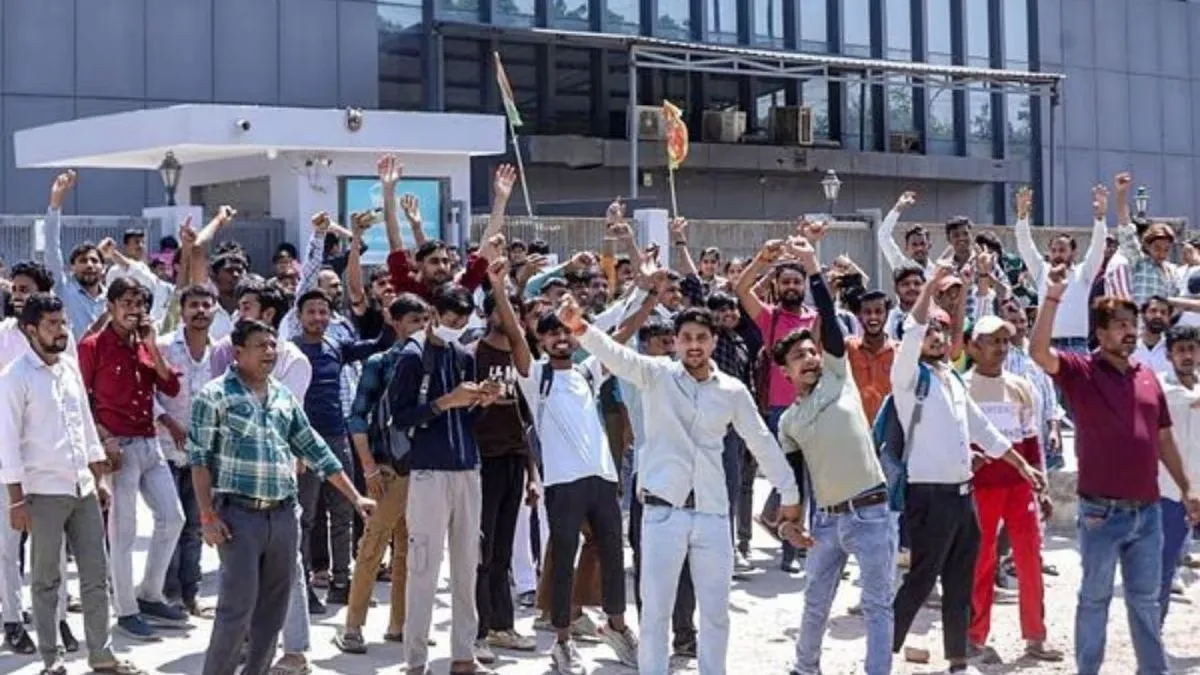
The recent announcement of a substantial increase in minimum wage in Uttar Pradesh is a landmark in responding to the growing labor unrest in the National Capital Region (NCR).
Following violent demonstrations in Noida on April 13, 2026, the state government agreed on an interim rise of up to 21 percent in different classes of workers retrospectively starting April 1, 2026.
What was the Cause of the Noida Protest?
The riots broke out when thousands of factory workers in Noida and Greater Noida went to the streets because of their frustrations with stagnant wages in the face of increasing living expenses and comparisons with wages in the nearby state of Haryana.
Protesters blocked key highways, damaged cars, and burnt down houses, which resulted in serious traffic jams throughout the Delhi-NCR region.
To manage the crowds, security forces used tear gas, lathi charges and other paramilitary forces leading to the arrest of over 350 people, detention of over 100 and seven FIRs on rioting and damage.
Labour Minister Anil Rajbhar branded the violence as a premeditated conspiracy, and inquiries on possible external instigation were made with regards to the wider security interests in the area.
What are Wage Revisions?
The administration of Chief Minister Yogi Adityanath gave the green light to the increase suggested by a high-level committee after a frenzied consultation with the labor unions, industry representatives, and district officials. This temporary provision is a tentative measure to await the complete revision of state Wage Boards next month and to accord with the national Labour Codes that are being implemented.
The graded increases are based on skill level, region, and the urban classification with the main focus on the industrial hotspots in Uttar Pradesh such as Noida and Ghaziabad and taking into consideration the economic differences in Uttar Pradesh.
| Worker Category | Noida/Greater Noida/Ghaziabad (₹/month, new/old) | Municipal Areas (₹/month) | Rural/Other Districts (₹/month) | Maximum % Increase |
| Unskilled | 13,690 (from 11,313) | 13,006 | 12,356 | 21% |
| Semi-skilled | 15,059 (from 12,445) | 14,306 | 13,591 | 21% |
| Skilled | 16,668 (from 13,940) | 16,025 | 15,224 | 20% |
| Graduate/Technical | Higher slabs up to ₹20,000+ in key zones | Adjusted proportionally | Scaled regionally | Up to 18% |
These are values of monthly basic rates, without allowances, and are used in such sectors as manufacturing, construction, and commercial establishments.
Denials and Denial Background
The government strongly refuted social media rumors that the minimum wage would be cut flat to ₹20,000 across the board, claiming it was the result of the exaggeration of the protest. There is no standard approach; changes are made according to the statutory biannual standards in the Minimum Wages Act.
Governments stressed that employers should pay on time, overtime, occupational safety, and deductions to the provident funds and warn against additional agitation.\
This action is part of the national process of standardizing wages according to the four Labour Codes, with the intention of the adjustments being inflation-based and less interstate differences.
Broader Economic Impact
The wage increase would be beneficial to more than 2 crore workers in the unorganized sector in Uttar Pradesh and add liquidity to the local economies and put the small industries under strain. In Noida, which is a destination for electronics, automobiles, and IT hardware, companies can experience a squeeze in margins but benefit by having operations stabilized after the unrest.
It highlights the long term problems such as labor migration of UP to better paying states, which calls on skills training programs and infrastructure to retain talents.
In the long-term, the imminent Wage Board might also implement variable dearness allowances (VDA), and sector-based rates, which will help achieve a sustainable growth in the most populous Indian state.


-1776083851403_t.webp)

