Show Key Points
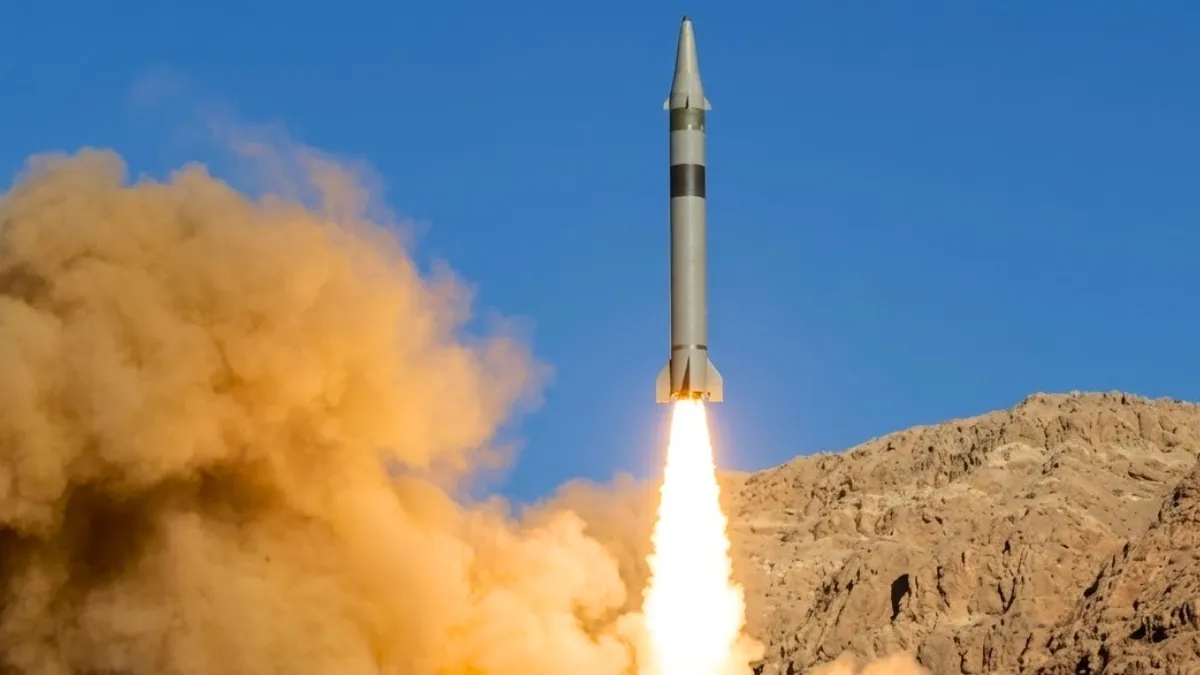
Sejjil Missile: The Sejjil Ballistic Missile also known as Sajjil or Ashura is an indigenous, two-stage, solid-fuel Medium-Range Ballistic Missile (MRBM). It is historically significant for transitioning Iran away from liquid-fueled designs.Iran has officially deployed its most sophisticated and powerful weapon the Sejjil Ballistic Missile during Wave 54 of recent military operations.
The Sejjil missile is also called "The Dancing Missile" for its high-altitude evasive maneuvers. It has officially transitioned from a deterrent to an active combat tool in regional conflicts in between Iran-US-Israel.
What is a Sejjil Ballistic Missile?
The Sejjil is an indigenously built Iranian MRBM that marked a technological revolution for the country's aerospace program. It is based on a solid fuel advantage system, uses solid propellant which allows it to be stored fully fueled and launched almost instantly from mobile launch vehicles.
Why is it called the "Dancing Missile"?
The Sajjial Ballistic missile named as "Dancing Missile" refers to the weapon's terminal phase maneuverability. It has an evasive maneuvering property and the Sejjil can adjust its trajectory at high altitudes.
It can bypass the defense system by zig-zagging or shifting its path during re-entry, confuses radar systems and interceptors such as the Arrow-3 or Iron Dome, which cannot lock onto a shifting target. It essentially dances away from incoming interceptor missiles.
Key Features of the Sejjil Missile:
The Sejjil is Sejjil-2 variant Ballistic Missile which has the following capabilities:
-
Two-Stage Design: Uses two separate solid-propellant motors to achieve massive thrust and reach the upper atmosphere quickly.
-
Range: Its operational range is approximately 2,000 kilometers which can cover the whole Levant region and Southeastern Europe within its strike distance.
-
Speed: It has hypersonic speed, can exceed speed of Mach 13 during its descent after leaving defense systems.
-
Payload: Sejjil carries a high-intensity warhead weighing roughly 700 kilograms.
-
Advanced Guidance: the missile is integrated with the features like GPS and Inertial Guidance Systems, significantly improving its terminal accuracy.
| Feature | Specification |
| Fuel Type | Solid-Propellant (Instant Launch) |
| Stages | 2-Stage Multi-Motor |
| Range | 2,000 km+ |
| Speed | Mach 13+ |
| Nickname | The Dancing Missile |
| Combat Status | Active Deployment (as of March 2026) |
Global Significance and Impact
The Iranian deployment of the Sejjil in 2026 ongoing conflict marks a turning point in modern warfare because it is a road-mobile and solid-fueled ballistic missile and Iran’s most survivable asset. Sejjil is nearly impossible to destroy on the ground before it launches.
Experts note that the Sejjil proves Iran's missile force has moved from theoretical threats to functional and high-tech combat reality.
The "Dancing Missile" technology forces global powers to rethink the effectiveness of the current Air defence system and its radar and interception technology, as the Sejjil is specifically designed to render traditional shields obsolete.
The Sejjil Ballistic Missile, Iran's advanced two-stage, solid-fuel MRBM, has been deployed in recent military operations. Known as "The Dancing Missile" for its evasive maneuvers, it boasts a 2,000 km+ range and Mach 13+ speed. This indigenous weapon, a technological leap for Iran, challenges traditional air defense systems like Iron Dome and Arrow-3, marking a significant shift in modern warfare and regional dynamics.
Also Read: DRDO's ADC-150: India's Indigenous Air Droppable Container


Comments
All Comments (0)
Join the conversation