Public Examinations Amendment Bill 2026 Tabled Today in Lok Sabha: Key Provisions and Stricter Penalties Explained


Public Examinations Amendment Bill 2026: The Union Government introduced the Public Examinations (Prevention of Unfair Means) Amendment Bill, 2026, in the Lok Sabha to eliminate exam malpractices. The legislation enhances penalties up to 10 years imprisonment and ₹10 crore fines, mandating 60-day investigations, fast-track special court trials, and strict judicial timelines.

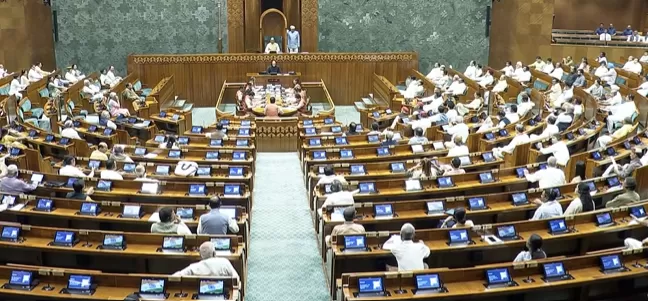
The Union Government is set to present the 'Public Examinations (Prevention of Unfair Means) Amendment Bill, 2026' in the Lok Sabha on Monday, July 27, 2026, as one of the steps taken to prevent leakage of question papers in competitive examinations. The Union Minister of State for Personnel, Public Grievances and Pensions, Dr. Jitendra Singh, will table the Bill in the Lower House. As per the official parliamentary legislative programme, Dr. Singh will also make a motion seeking immediate consideration and passing of the Bill after introduction.
The new law, which has been made with the objective of eliminating malpractices and ensuring people's trust in recruitment tests and entrance exams in the country, contains stringent provisions such as imposition of rigorous jail terms of up to ten years, fines of up to ten crores rupees, mandatory period of investigation of two months and setting up of fast track courts to decide cases in three months. Meanwhile, the Opposition leaders in both the Lok Sabha and Rajya Sabha have arranged to meet at 10:00 AM on Monday in the office of the Rajya Sabha Leader of Opposition.
What Are The New Provisions and Strict Penalties
These are the 7 key new provisions and stricter penalties introduced under the Public Examinations (Prevention of Unfair Means) Amendment Bill, 2026:
-
Individual Offender Punishments: The punishment for individual offenders indulging in examination cheating is five to ten years in jail along with fines of up to fifty lakh rupees.
-
Service Provider Punishment: Service provider companies indulging in examination cheating have to face a fine of five crore rupees along with an eight-year prohibition.
-
Organized Crime Punishment: Syndicates indulging in organized cheating of papers are liable to face a seven to ten years imprisonment along with a fine of ten crore rupees.
-
Investigation Time Line: Police and special investigation teams along with central agencies shall complete all investigations within a period of sixty days mandatorily.
-
Fast Track Special Courts: Sessions courts of fast track will conduct trials continuously every day to pronounce judgment within a period of three months.
-
Restrictions on Trial Adjourning: No trial adjournments can be allowed for more than one day without mentioning any exceptional reason.
-
Appeal to High Court: Appeals against the judgement or bail shall go before the Division Bench within three months.
Key Revisions: 2024 Act vs. 2026 Amendment Bill
| Parameter | Existing Provision (2024 Act) | Proposed Provision (2026 Amendment Bill) |
| General Offenses (Individual) | 3 to 5 years jail; fine up to ₹10 lakh | 5 to 10 years jail; fine up to ₹50 lakh |
| Service Providers (Firms/Agencies) | Fine up to ₹1 crore; 4-year ban | Fine up to ₹5 crore; 8-year ban |
| Directors / In-Charge Personnel | 3 to 10 years jail; fine of ₹1 crore | 5 to 10 years jail; fine up to ₹5 crore |
| Organized Crime Syndicates | Min. 5 years jail; min. fine of ₹1 crore | Min. 7 years jail (up to 10 years); min. fine of ₹10 crore |
| Investigation Window | No fixed statutory timeline | 60-day mandatory deadline for police / STF / central agencies |
| Trial Framework | Regular Sessions Courts | Dedicated Special Fast-Track Courts completing trials in 3 months |
Siddhi Sharma is an education journalist at Jagran Josh. A Journalism and Mass Communication graduate from IP University, she brings sharp newsroom instincts developed during her previous stint at Zee News. At Jagran Josh, Siddhi specializes in decoding the educational updates. Her coverage is highly exam-centric, ranging from curated news blogs for competitive exams to crucial school board and university news. Combining her strong media foundations with a research-driven approach, she creates reliable, high-utility content that helps students and aspirants stay ahead of the curve. Her writing is factual, engaging, and tailored to meet the fast-paced needs of modern learners and exam aspirants.