World's Oldest Living Sponge: Scientists Discover 2,300-Year-Old Giant Caribbean Sea Sponge
World's Oldest Living Sponge: Recent scientist report have identified a large Caribbean sponge that is considered to be older than the Roman Empire around 2300 years. Read more about the world's oldest living sponge.
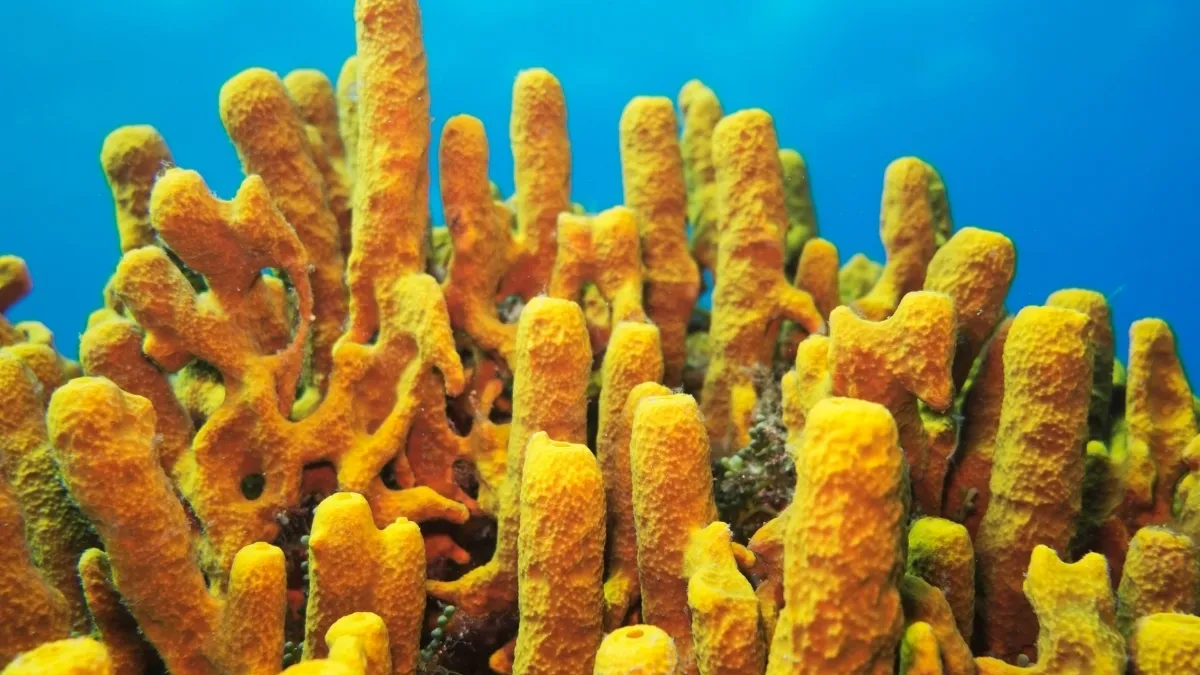
World's Oldest Living Sponge: Recent Marine Scientific reports have identified the world’s largest Giant Barrel Sponge (Xestospongia muta), considered the world’s oldest living sponge or animal. It is estimated that a deep-sea marvel is around 2300 years old making it older than the Roman Empire itself.
The world’s largest sponge lies deep beneath the surface of the Caribbean Sea. It is a colossal organism that has quietly witnessed the entire history of human civilization. Marine scientists referred to it as Redwood of the Reef which stands as a towering, barrel-shaped monolith.
Sponges are among the Earth's earliest multicellular organisms because they grow at a slow pace often just a few centimeters in a year so their large volume serves as a living timeline of our planet's history.
Why is it called the Redwood of the Reef?
Sponges are multi cellular animals on Earth that do not have tissues, organs and nervous systems like humans. Instead they rely on a constant flow of water through their porous bodies to filter out microscopic food and oxygen because they are stationary and grow at a very slow rate. Their large size is a direct indicator of their huge age.
Giant Barrel Sponge often referred to as the Redwood of the Reef by the marine biologists. It is famous for its large size and longevity. These sponges are complex stony structures shaped like giant barrels.
How do Scientists know Sponges are older than Rome?
To determine the age of the sponge of the Caribbean Sea researchers used advanced growth-modeling techniques. It measures how much a sponge’s volume expands over several years and functioning changes in water temperature and environmental conditions where scientists can project backwards to determine when sponge first settled or grew on the seafloor as a tiny larva.
The large sponge has crossed the two millennium mark when Julius Caesar was alive so this proves that the sponge was already centuries old when it began filtering ocean water in total darkness.
Why do they live so long?
Sponges have evolved several survival mechanisms to withstand thousands of years in the ocean because the sponges produce toxic or foul-tasting chemical compounds that deter predators like fish and sea turtles.
Large Sponges lack cellular aging and have good regenerative capacity to heal broken pieces simply and keep growing. The deep-sea environment provided a slow-paced temperature-stable habitat with a steady food supply, allowing a slow metabolism to run indefinitely.
The world's oldest living sponge is considered the ecological superhero of the Caribbean Sea and the Atlantic Ocean.
These ancient sponges are essential for the health of the entire coral reef ecosystem, where a single sponge filters thousands of liters of water daily, clearing away bacteria and recycling nutrients to keep the water clear for the surrounding corals.
The hollow structure of the giant sponge is a habitat for hundreds of species of fish, crabs, and shrimp.

Manisha Waldia is a distinguished content strategist with 5 years of experience crafting premium educational content for UPSC and State PCS, with a focus on deep conceptual analysis across Polity, Geography, History, and Environment. She currently brings this expertise to Jagran Josh, where she covers major national and international events, current affairs, and static general knowledge. Over her career, Manisha's specialized insights have led her to curate high-impact materials and serve as a UPSC Mains answer-evaluator for India’s top institutes—including Drishti IAS, Shubhra Ranjan IAS, Study IQ, GS Score, and PWonlyIAS. She has also worked alongside leading NGOs like Oxfam India and Avani Kumaon.
Contact: manisha.waldia@jagrannewmedia.com


