Show Key Points
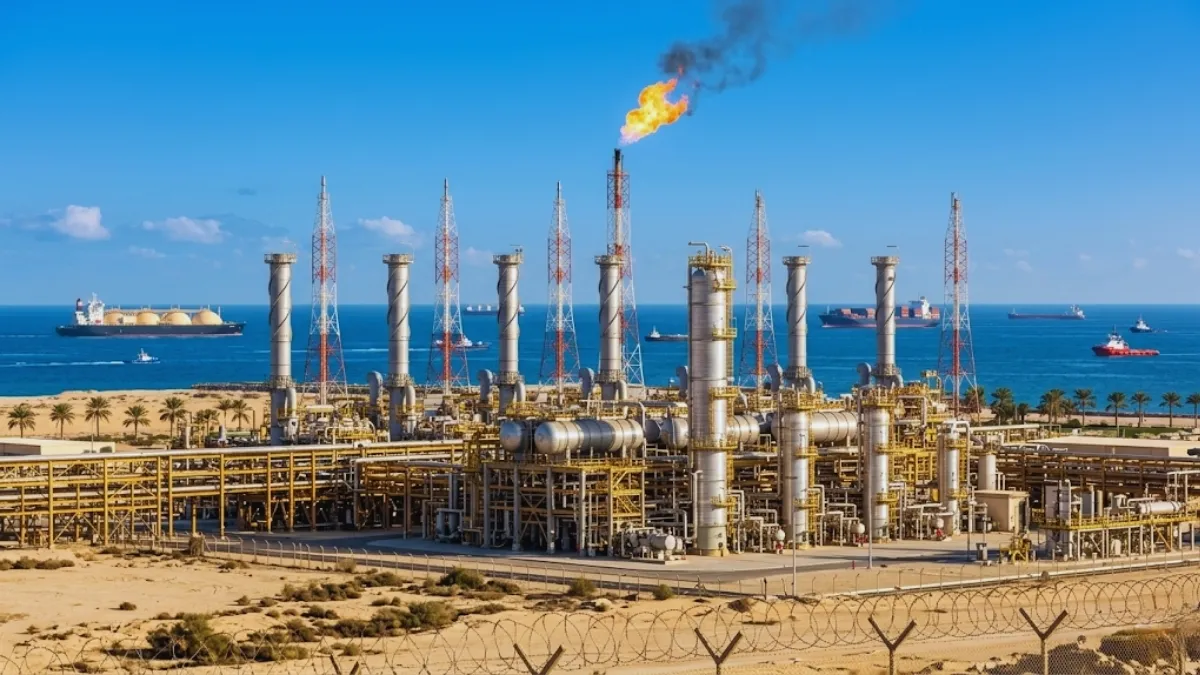
In the present world global energy security, Liquefied Natural Gas (LNG) has emerged as the most critical bridge fuel for a sustainable future. At the centre this natural gas filled world’s largest LNG plant: the Ras Laffan Industrial City in Qatar and managed largely by QatarEnergy.
Ras Laffan Industrial City is a massive liquefaction hub responsible for a staggering portion of the planet's clean energy supply with the ongoing North Field expansion project, this facility is setting new records for LNG export capacity, making it the most influential site in the global gas market.
What is the World’s Largest LNG Plant?
The world’s largest LNG plant is the Ras Laffan Industrial City, Qatar, a massive natural gas industrial hub containing multiple trains, the massive mechanical units used for cooling gas.
-
It is operated by QatarEnergy in partnership with global giants like Shell and ExxonMobil.
-
Ras Laffan LNG Complex currently produces approximately 77 million tons per annum (MTPA), with a trajectory to reach 126 MTPA by 2027 through the North Field East (NFE) and North Field South (NFS) expansions.
-
The plant utilizes advanced refrigeration cycles technology to transform gas into a liquid state for high-efficiency shipping.
Where is the World’s Largest LNG Plant?
The World's largest LNG Plant is located in Ras Laffan Industrial City which is situated on the Northeast coast of Qatar which is directly adjacent to the North Field Projects world's largest non-associated natural gas field. This proximity allows for a seamless pipeline-to-plant workflow, making Qatar the global leader in low-cost LNG production.
Important Facts about the World’s Largest LNG Plant
| Feature | Educational Key Facts |
| Primary Operator | QatarEnergy (The world's leading LNG exporter) |
| Current Output | Approximately 20% of global LNG supply. |
| Expansion Status | The North Field expansion is the largest project in the history of the LNG industry. |
| 2026 Impact | Recent operational pauses at Ras Laffan have caused a 30% spike in global gas prices. |
| Environmental Goal | Integration of Carbon Capture and Storage (CCS) to make it the cleanest mega-plant on Earth. |
Impact on Global Energy Supply
The Ras Laffan LNG Complex is a central pillar of the global energy trade and most significant natural gas liquefaction hub. Its operational status is very important to run the household to industrial manufacturing speeds and
-
Ras Laffan produces nearly 20% of the world's LNG supply, acts as a price anchor or stabilize the world energy market, prevents massive price spikes in the Southeast Asia
-
Marker (JKM) and Dutch TTF markets, keeping energy affordable for billions of people.
-
A Lifeline for European Energy Security, following the shift away from pipeline gas, the world’s largest LNG plant has become the primary source for EU energy imports. Cargoes from Qatar are the safety net that prevents winter energy shortages in nations like Germany, Italy, and France.
-
Powering Asia’s Industrial Growth: Giant economies including China, India, and Japan rely on Qatari LNG to fuel their power plants and factories from the North Field expansion is essential for maintaining the production of electronics, steel and chemicals globally.
-
Leading the Transition to Low-Carbon LNG: the plant is a pioneer in Carbon Capture and Storage (CCS) by integrating green technology into the liquefaction process, to decarbonize gas.
-
Global Food Security: natural gas is a raw material for fertilizer production, the output from Ras Laffan directly affects the agricultural sector.
The Ras Laffan complex in Qatar is a backbone of the international energy market by leveraging the massive reserves of the North Field which ensures that households and industries from Europe to Asia remain powered and playing its key role in energy transition and decarbonization.



Comments
All Comments (0)
Join the conversation