Show Key Points
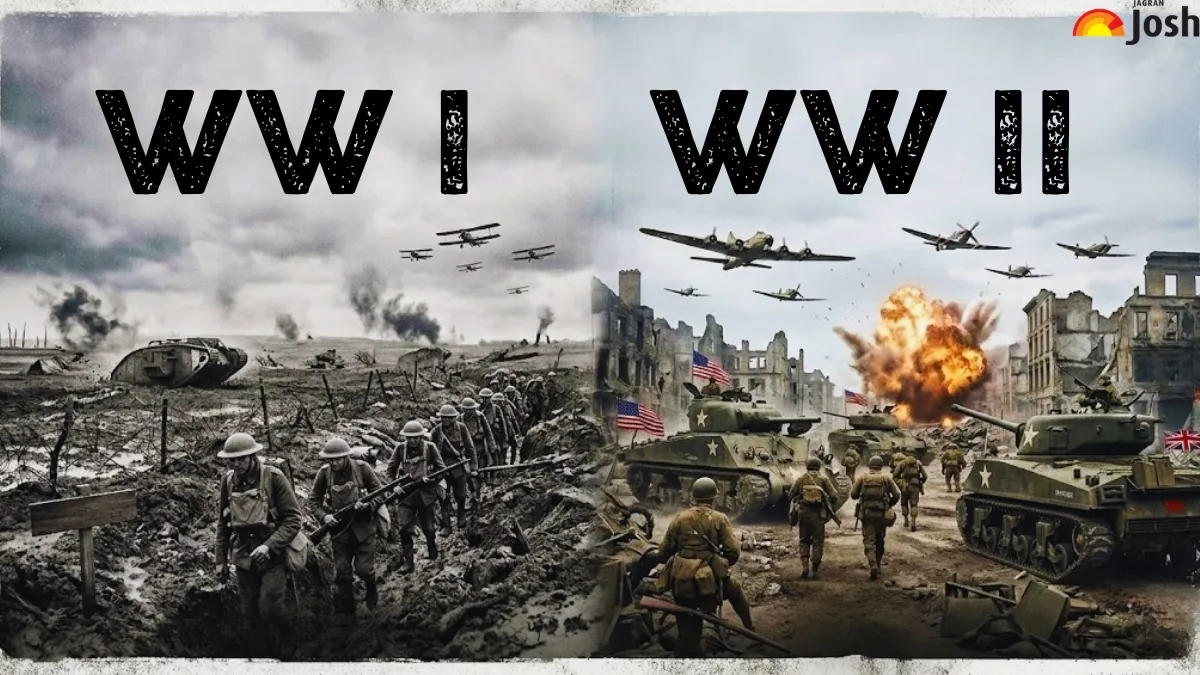
WWI and WWII: The two World Wars were among the most devastating events in human history fought in the first half of the 20th century, World War I (1914–1918) and World War II (1939–1945) reshaped nations, redrew borders, and changed the course of global politics forever. What began as regional conflicts in Europe soon escalated into worldwide wars involving dozens of countries across continents.
Both WWI and WWII were struggles for power, security, and ideology. World War I largely emerged from deep-rooted rivalries, militarism, and alliance politics, while World War II was driven by aggressive expansionism, fascism, and unresolved tensions from the first war millions of soldiers and civilians lost their lives and entire societies were transformed by the scale of destruction.
What Was World War I?
World War I (WW1) was a global war fought from 1914 to 1918 mainly in Europe. It began after assassination of Archduke Franz Ferdinand, the heir to the throne of the Austro-Hungarian Empire. On June 28, 1914, while visiting Sarajevo, Bosnia, he and his wife, Sophie, were shot and killed by Gavrilo Princip, a Serbian nationalist.
Causes of World War I:
The Immediate Trigger was the assassination of Archduke Franz Ferdinand in Sarajevo served as the final spark, activating the existing alliances and escalating a localized crisis into a full-scale world war. The War was actually the result of decades of mounting tension. Historians often use the acronym M.A.I.N. (Militarism, Alliances, Imperialism and Nationalism) causes of the war
-
Nationalism: Intense pride in one's own country and the desire for independence among groups like the Slavs in Austria-Hungary created a volatile atmosphere.
-
Imperialist: European powers engaged in a fierce competition for global colonies, resources, and economic supremacy, which created deep-seated diplomatic friction.
-
Militarism: The rapid expansion of armies and navies, particularly Germany’s challenge to British naval dominance, destabilized the European balance of power.
-
Alliance System: A rigid web of secret treaties and mutual defense pacts meant that a conflict involving one nation would automatically pull its allies into the fray.
-
Rising Nationalism: Ethnic groups within the Austro-Hungarian and Ottoman Empires aggressively sought independence, leading to intense volatility in the Balkan region.
-
The Balkan Power Vacuum: The decline of the Ottoman Empire created a power void, triggering regional wars that primed the continent for a larger confrontation.
Between Which Countries Was World War I Fought?
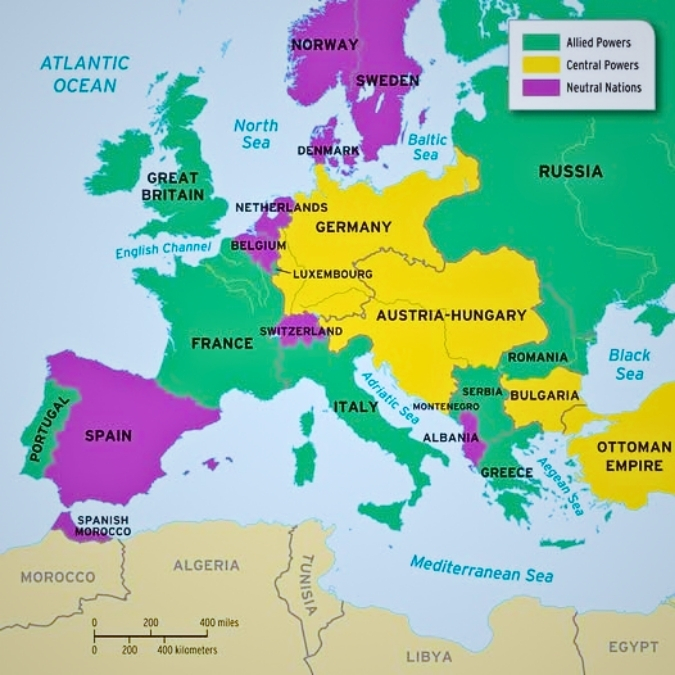
The war was fought between two coalitions because these nations held vast colonial empires, the fighting eventually spread to Africa, the Middle East, and Asia.
The Allied Powers (The Triple Entente):
This group initially formed to counter the growing power of Germany.
-
France: Motivated by a desire to reclaim lost territory (Alsace-Lorraine) from Germany.
-
Great Britain: Joined to protect Belgium’s neutrality and maintain its naval supremacy.
-
Russia: Entered to protect its Slavic allies in the Balkans (like Serbia).
-
Italy: Originally allied with Germany, Italy switched sides in 1915 after being promised land.
-
United States: Remained neutral until 1917, joining the Allies after German submarines sank American merchant ships.
The Central Powers (The Triple Alliance):
This bloc was geographically located in the heart of Europe.
-
Germany: The primary military powerhouse of the group, led by Kaiser Wilhelm II.
-
Austria-Hungary: A multi-ethnic empire that sought to crush Serbian nationalism.
-
Ottoman Empire: Joined in 1914 to reclaim lost glory and territory in the Caucasus.
-
Bulgaria: Joined in 1915 to gain territory from its neighbor, Serbia.
Key Battles of World War I
-
Battle of the Marne (1914): The battle was a "miracle" that halted Germany's push into France. It crushed German hopes for a rapid triumph and caused both sides to dig in, announcing the start of trench warfare.
-
Battle of Gallipoli (1915): A disastrous attempt by the Allies including many Australian and New Zealand troops to knock the Ottoman Empire out of the war by seizing the Dardanelles strait.
-
Battle of Verdun (1916): One of the longest and costliest battles in history. It lasted nearly a year, as France and Germany fought over a small piece of land.
-
Battle of the Somme (1916): Famous for being one of the deadliest days in British military history. It was the first time tanks were used in combat.
What Was World War II?
World War II (1939–1945) was the largest and deadliest conflict in history while World War I was largely confined to Europe, WWII was a truly global struggle fought on land, at sea, and in the air across Europe, the Pacific, Africa, and Asia. It is remembered for its unprecedented scale of destruction, the mobilization of entire civilian populations, and the horrifying atrocities of the Holocaust which ended in 1945 with the total surrender of the Axis powers.
Causes of World War II
The World War II was the result of several boiling points such as:
-
The Treaty of Versailles: The harsh penalties placed on Germany after WWI caused deep resentment and economic ruin.
-
Rise of Fascism Regime: Leaders like Adolf Hitler and Benito Mussolini promised to restore national pride through military force.
-
The Great Depression: Global poverty led people to support radical dictators who promised jobs through war and expansion.
-
Appeasement: For years, other nations tried to avoid war by letting Hitler take over small territories, which only emboldened him.
Between Which Countries Was World War II Fought?
The war was a clash between two massive military alliances involving more than 70 nations:
-
The Allied Powers: The primary leaders were the United Kingdom, the United States (joined in 1941), the Soviet Union, and China. Free France also played a critical role in the resistance.
-
The Axis Powers: The three main aggressors were Germany(Nazi regime), the Empire of Japan, and Italy (Fascist regime)
Key Battles and Events of World War II
-
Invasion of Poland (1939): The official start of the war, showcasing Germany's "Blitzkrieg" (lightning war) strategy.
-
Battle of Britain (1940): A massive air campaign where the UK successfully defended its skies against the German Luftwaffe.
-
Pearl Harbor (1941): Japan's surprise attack on the U.S. Navy, which pulled America into the fight.
-
D-Day (1944): The Allied invasion of Normandy, France, which opened the path to liberating Europe.
-
Hiroshima & Nagasaki (1945): The use of atomic bombs that forced Japan’s surrender and ended the war.
How the World Wars Shape the World Orders?
The aftermath of the World Wars fundamentally dismantled the old imperial order and replaced it with a complex, modern global structure.
The Creation of the United Nations (1945): After the failure of the League of Nations to prevent WWII, the world needed a more robust system for global cooperation. The UN was established based on diplomacy, international law, and human rights, aiming to prevent another global catastrophe.
The Rise of the Superpowers: The wars left the traditional European empires Britain, France, Germany economically and militarily exhausted. This power vacuum was filled by the United States and the Soviet Union emerged as the world's dominant "superpowers,".
The Cold War Division: The ideological friction between the U.S.(Capitalist/Democratic) and the Soviet Union (Communist) split the world into two opposing orders which led to the creation of military alliances like NATO and the Warsaw Pact, and a global arms race fueled by the fear of nuclear destruction.
Decolonisation: The world wars shattered the myth of European invincibility due to the burden of debt and facing rising nationalist movements in colonial countries. European powers could not hold the power over overseas colonies which sparked a massive wave of independence across Africa, Asia, and the Middle East.
Globalized Economic Order: To prevent the economic instability that fueled the rise of Hitler and Mussolini during the Great Depression, the Allied powers created institutions like the World Bank and the International Monetary Fund (IMF) to stabilize the global economy and encourage interconnected trade, forming the foundation of our modern globalized market.
The Advancement of Technology and Science: The "Total War" nature of both conflicts forced an unprecedented acceleration in research and advancements in aviation, rocketry (leading to the Space Race), medicine (penicillin), and computing were all fast-tracked by military necessity, leaving a legacy of technological progress that powers our world today.
The World Wars were two seismic global conflicts that spanned the first half of the 20th century, fundamentally dismantling the old imperial order and claiming over 100 million lives. Starting with the regional tensions of 1914 and evolving into the total, industrialized warfare of 1939–1945.
These events redrew the global map and shifted power toward the United States and the Soviet Union. The aftermath birthed the United Nations, ignited the Cold War, and accelerated the collapse of European colonial empires, ultimately shaping the modern political and economic landscape we navigate today.
Also Read: The Gulf War (1990–1991) Explained: History, Causes, Military Operations, and Lasting Impact



Comments
All Comments (0)
Join the conversation