They say, 'Necessity is the mother of invention,' and in many ways, that's true. There are many motivations to invent, some to make money and some because of curiousity. But all inventions have only been successful because they satisfied a need.
What is an invention? Firstly, invention and innovation are two different things. One should not confuse them. An invention is the discovery of a new thing that didn't exist before, like a new product, device, process, or concept. Example include printing press, electricity, telephone, etc.
Discoveries, on the other hand, are something that exists in nature but is observed or recognised for the first time. Humans discovered fire but invented the means to light a fire.
People have been inventing things since prehistoric times. Inventions have made lives easier, enhanced the quality of life, and had a remarkable impact on human civilisation.
Let's travel back a bit in time. Today, we will explore the world of inventions and discoveries. Take this quiz to see if you know these interesting facts about the inventions that make your life easier today.
True or False: The first alarm clock could only ring once?

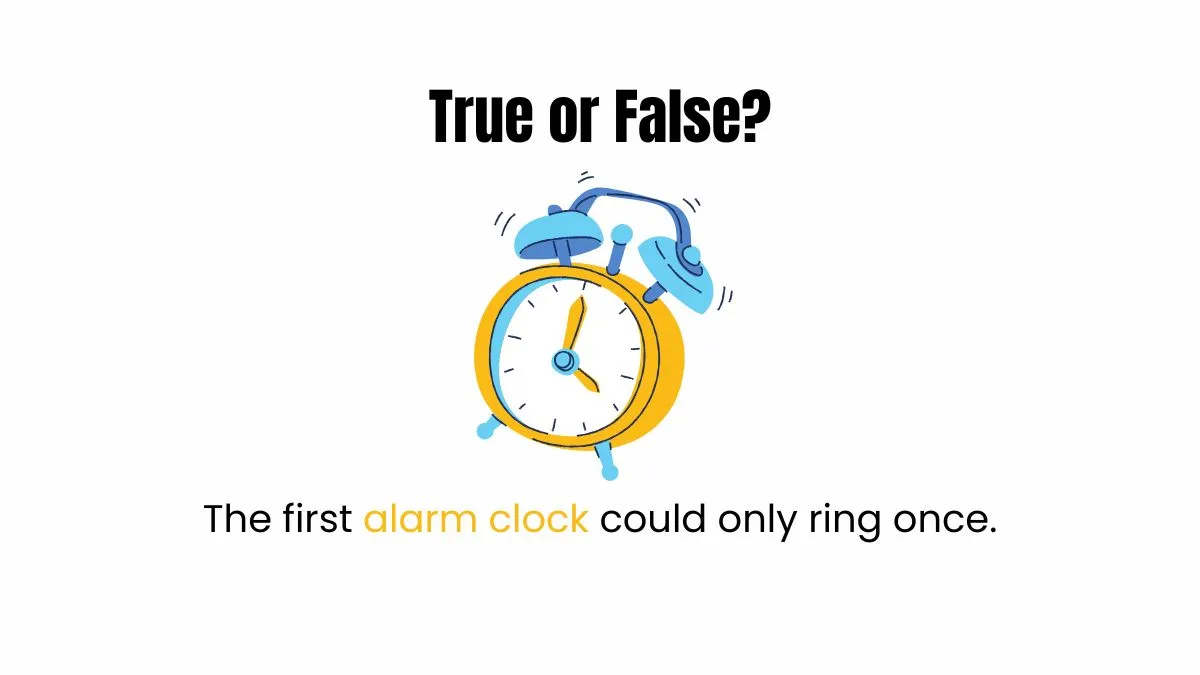
1. The first alarm clock could only ring once. True or False?
True. The first alarm clock was designed in such a way that it could only ring once in the entire day, only at 4 AM. The first alarm clock was invented by Levi Hutchins in 1787.
2. Paper was invented in Egypt. True or False?
False. Paper was invented in China. Cai Lun in China invented paper around 105 AD. Egyptians had invented a writing material called papyrus around 3000 BCE, but it was not considered true paper.
3. Pencillin was discovered accidentally. True or False?
True. In 1928, Alexandar Fleming, a Scottish bateriologist, accidentally left petri dishes with Staphylococcus bacteria before going on vacation. When returned, he noticed mold on one of the dishes and noticed it had killed the nearby bacteria. He identified the mold as Pencillium, leading to invention of penicillin, the first antibiotic.
4. X-rays were discovered in 1895. True or False?
True. Wilhem Conrad Roentgen discovered X-rays in 1895 and named them 'X' because of their unknown nature.
5. The periodic table was discovered by an Indian chemist. True or False?
False. A Russian chemist named Dmitri Mendeleev created the periodic table in 1869. He is often referred to as the 'father of the periodic table'. He arranged the elements based on how they acted and how heavy they were.
6. Nikola Tesla deveoped the atomic bomb during World War II. True or False?
False. An American scientist, J. Robert Oppenheimer, played a key role in the making the atomic bomb. During the Manhattan Project, he was responsible for the research and design of the atomic bomb. He is often referred to the 'father of the atomic bomb'.
7. The Wright Brothers invented the airplane. True or False?
True. The Wright Brothers, Orville and Wilbur Wright, invented the airplane on 17th December 1903, in Kitty Hawk, North Carolina.
8. Windshield wiper blades were invented by a woman. True or False?
True. Mary Anderson designed a lever-operated mechanism with a rubber blade in 1903.
9. Thomas Edison developed the first alternating current (AC) power system. True or False?
False. Nikola Tesla, a Serbian American inventor and electrical engineer, is credited with developing the first practical alternating current (AC) electrical system. Thomas Edison was against the AC system.
10. The World Wide Web was invented in 1989. True or False?
True. Tim Berners-Lee, a British computer scientist, is credited with inventing the World Wide Web in 1989. He created the WWW by connecting documents and resources on the internet using hypertext.



Comments
All Comments (0)
Join the conversation