Word of the Day: This 400-Year-Old Shakespearean Term Haunted the Witches in ‘Macbeth’
Word of the Day: 'Dwindle' is the featured word of the day. Comprehending the definition of 'dwindle' is crucial for acquiring advanced English vocabulary commonly encountered in international news and competitive examinations.
-1782286423656.webp)
"As the clock struck midnight, the fairy's glittering trail of pixie dust began to dwindle, leaving behind only the faint scent of bluebells and starlight."
Imagine you open a brand new bag of potato chips. It is completely full. You eat a few while watching television. Then you eat a few more. Soon, you look down and notice only a few crumbs are left at the bottom. The chips did not vanish instantly; they steadily disappeared. This slow, gradual shrinking is exactly what the word "dwindle" is all about.
If you want to enrich your vocabulary or you are preparing for English exams like TOEFL or IELTS, then this article serves the purpose. Every day, we bring a new word that you can add to your daily conversation, increasing your chances of becoming fluent and confident when speaking English like a native.
Today, we will learn about the word ‘Dwindle’, which has a broader meaning originating in Old Norse. In this article, we will take a look at the meaning, history, and usage of this incredibly expressive word.
What is the Meaning of Dwindle?
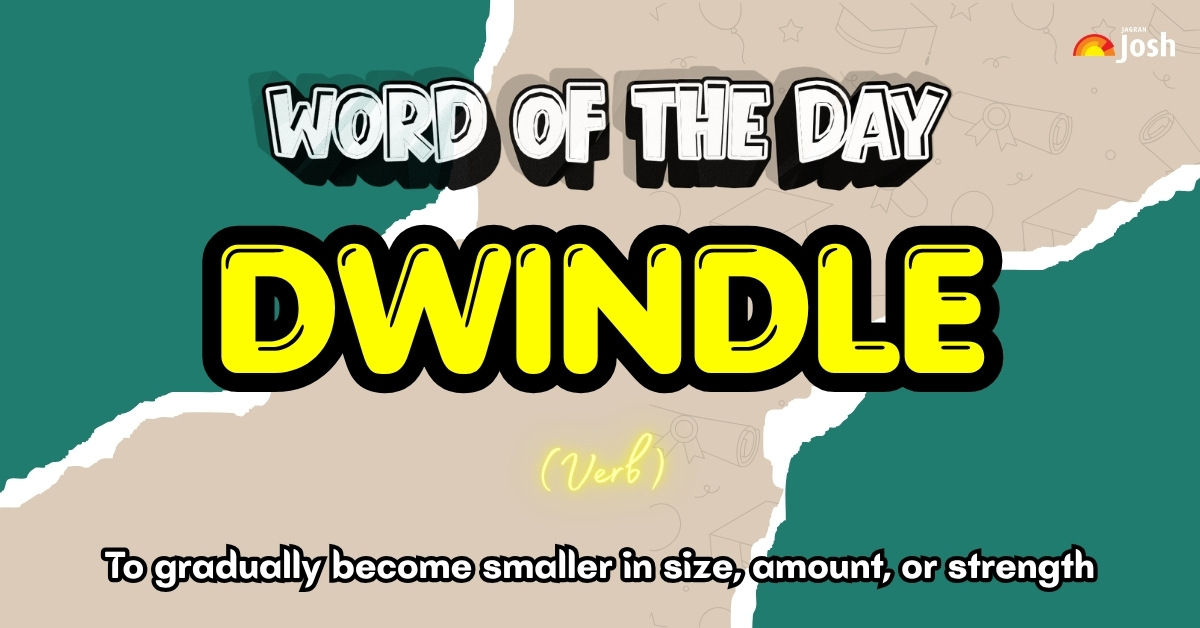
'Dwindle' means to slowly disappear or become smaller or weaker over a period of time. Since there is an action involved [an activity is going on], it is a verb. However, be careful when using this word, as it specifically describes an action that happens slowly, bit by bit, rather than all at once.
Let's understand it with a simple example: Have you ever seen a candle burning? At first, the candle stands tall. Pure tough wax. But as the hours pass, the wax melts, and the candle grows shorter and shorter until almost nothing remains. The candle wax dwindles.
Feature Details
| Feature | Details |
| Type | Verb |
| Pronunciation | Dwin-duhl |
| Root | Old English (dwinan) |
What is the origin of the word "Dwindle"?
So, basically, the word ‘Dwindle’ has a fascinating history that dates back to the late 16th century. It developed within the English language from an older, now-forgotten Middle English word, dwinen, which meant "to waste away, fade, or decline". Going back even further, it connects to the Old English word 'dwinan' and the Old Norse word 'dvina', which both meant 'to vanish or pine away'. Interestingly, famous playwright William Shakespeare helped make the word popular. He used it in his well-known play, Macbeth, to describe characters fading away into thin air.
How To Use Dwindle In A Sentence
Here are 10 very simple sentences using the word 'dwindle':
- Our water supply began to dwindle during the hot summer.
- The campfire started to dwindle as the wood burned away.
- My savings will dwindle if I keep buying expensive toys.
- The crowd began to dwindle after the main event ended.
- As the sun went down, the daylight started to dwindle.
- The cookies in the jar dwindle every time Sam walks by.
- Her fear began to dwindle once she turned on the light.
- The ice cream began to dwindle as the kids ate it quickly.
- Winter is coming, so the warm days are starting to dwindle.
- The teacher watched the students' energy dwindle at the end of the day.
Dwindle - Synonyms and Antonyms
Learning similar and opposite words helps students understand a new term deeply.
Synonyms (Similar Words):
- Diminish: To make or become less in size or importance.
- Shrink: To become smaller in size or amount.
- Decrease: To grow less in number or intensity.
- Fade: To lose brightness, strength, or freshness gradually.
Antonyms (Opposite Words):
- Grow: To increase in size or develop over time.
- Increase: To become greater in size, amount, or degree.
- Flourish: To grow or develop quickly and strongly.
- Multiply: To increase greatly in number.
Did You Know?
The words "dwindle" and "dwindling" have the exact same meaning. It's the present participle of dwindle. Today, scientists and news reporters use the word 'dwindling' to talk about nature. For example, they might say the ice at the North Pole is dwindling or that the number of endangered pandas and honeybees is dwindling.

Kriti Barua is a skilled digital journalist and communications professional with 4+ years of experience, currently writing for the General Knowledge section at Jagran New Media. She has established herself as a subject matter expert in History, Geography, Trending National and International News, Sports, Science, and Defence, producing clear, reliable, and search-optimised content that connects with readers worldwide.
Kriti holds a BA degree from Delhi University and a one-year diploma in TV Production and Journalism, an academic background that adds research depth and strong storytelling instincts to her writing. Her experience spans brand writing, content marketing, and digital media, giving her a sharp understanding of what makes content both helpful to readers and visible in search.
At Jagran New Media, she applies this expertise to national and international news coverage, query-based articles, and in-depth pieces across her specialist subject areas. Her content is defined by easy language, factual accuracy, strong keyword strategy, and reader-friendly storytelling.


