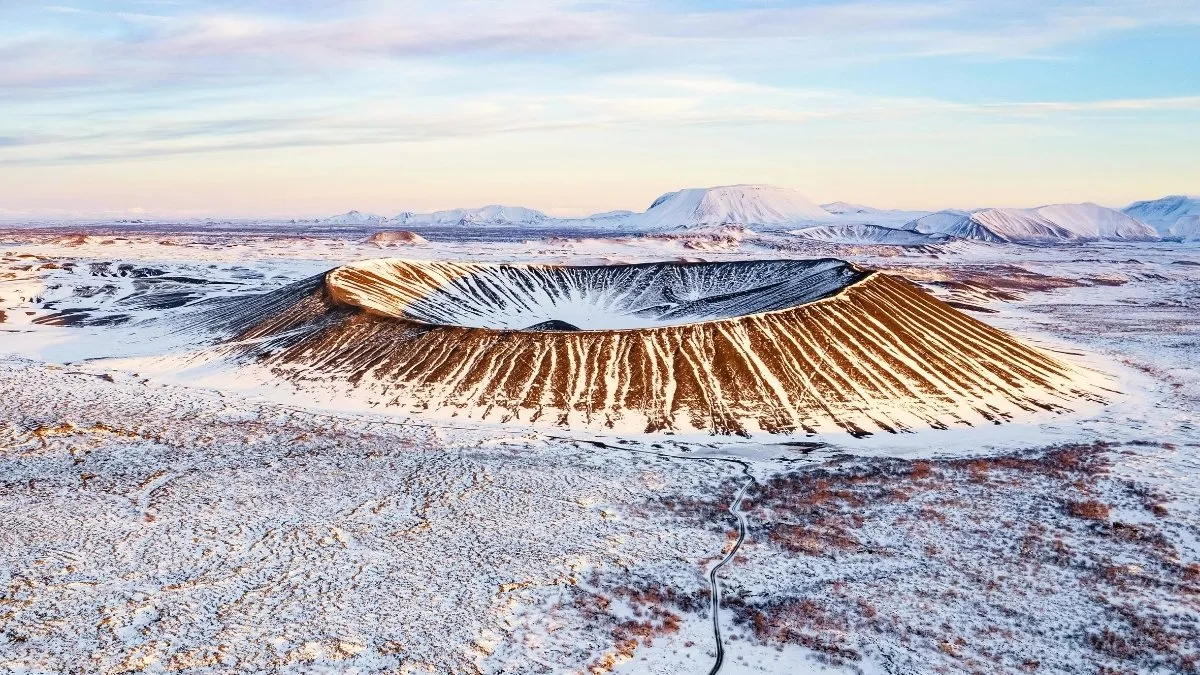
Iceland was given the nickname “Land of Fire and Ice” due to the natural spectacle where volcanoes and enormous glaciers fight over Iceland’s harsh landscapes.
Land of Fire and Ice is a tiny country with unique geological characteristics where the fire that burns below merges with icy coldness from the Arctic.
Iceland also has black sand beaches, hot springs, and ice caves which attracts thousands of tourists to the country every year.
According to the Meteorological Office of Iceland, more than 30 volcanoes erupted after 2021 at the Reykjanes Peninsula.
In this article, find the real reason behind the “Land of Fire and Ice” nickname, exact glacier/volcano counts, naming myths, and stunning facts behind Europe's adventure capital.
Why is Iceland Called the Land of Fire and Ice?
"Land of Fire and Ice" refers to Iceland, as there are active volcanoes erupting lava, representing "fire" and extensive glaciers covering 11 percent of its landmass, representing "ice".
As Iceland lies between the North American and Eurasian plates, which are moving apart along the Mid-Atlantic Ridge, the magma flows out of the Earth during volcanic eruptions.
This unique combination determines the landscape from fertile volcanic soil to thermal springs.
Melting glaciers can cause massive flooding known as jökulhlaups, creating spectacular river valleys.
This dual nature attracts tourists who can visit glaciers during the daytime and observe volcanoes erupting lava at night.
The term originates from early explorers' observations that although the highlands were lush green, the coast was covered in ice.
Check: Quote of the Day by John F. Kennedy: "A man may die, nations may rise
Why is Iceland called Iceland if there's no Ice?
Iceland has ice in its name because it has plenty of ice. The country is rich with over 269 glaciers covering more than 11,000 km2, the highest amount in Europe besides polar regions.
The Norse settler Flóki Vilgerðarson coined the name "Iceland" around 860 CE after seeing fjords filled with drift ice, while inland temperatures were milder.
Although Icelanders used exaggerated tales of the icy environment to entice Vikings from overcrowded Norway to settle in Iceland.
Ironically, Iceland is more verdant than Greenland, which has more ice.
Major glaciers like Vatnajökull, the largest in Europe, have remained influential, providing water for rivers and carving fjords.
Climate change is rapidly reducing their sizes, but the glaciers continue to exist, supporting Iceland's name.
Read: Who are the Seven Sisters of Petroleum?
How Many Glaciers and Volcanoes Does Iceland Have?
Iceland has about 269 glaciers and more than 30 active volcanoes, giving it the best environment on Earth for both fire and ice.
Vatnajökull covers an area of 7,900 sq km, while glaciers such as Langjökull provide ice adventures above dormant volcanoes.
The volcanoes experience frequent eruptions – Eyjafjallajökull disrupted flights in 2010, while Fagradalsfjall erupted in 2021. The ring road circles many, blending lava fields with ice caps.
Key stats:
-
Glaciers: 269 total; top 3 hold 90% ice volume.
-
Volcanoes: 30+ active; 200+ total systems.
-
Coverage: Glaciers = 11% land; geothermal zones = 20% energy source.
This combo powers 100% renewable electricity via magma heat and glacial melt hydropower.
Know about: Why are Hurricanes Named?
Conclusion
The country Iceland’s nickname, “Land of Fire and Ice,” highlights the volcanic activity that erupts fires, as well as the glaciers that shape their natural beauty in the country’s location on a plate-tectonic hotspot.



Comments
All Comments (0)
Join the conversation