Which Country Has The Largest Mangrove Cover In The World?
Do you know which country has the largest cover of Mangrove forests? Mangroves cover over 140,000 square kilometres globally, protecting shores and trapping massive carbon. Let’s discover the top global hotspot holding the world's largest unbroken, spectacular tidal forest.
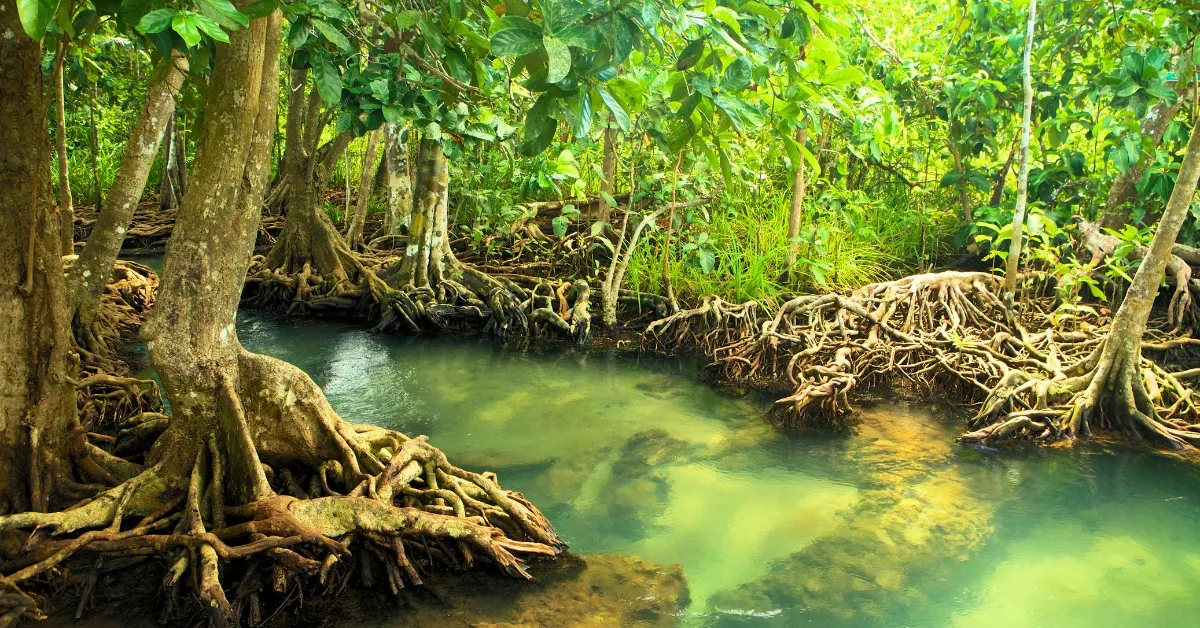
Mangroves are the ultimate survivors. Picture a forest that grows right where the land gives up and the ocean takes over, roots tangled like a pile of driftwood, poking up through salty water just to catch a breath. These trees don't just look wild; they are. You'll find them hugging tropical and subtropical coastlines all over the world, covering a whopping 140,000 square kilometres. That's a lot of green muscle, shielding beaches from storms and quietly sucking up carbon like nature's own air filter. So, who actually has the world's largest mangrove cover? Let's take a look at the planet's top mangrove hotspots and discover the winner.
Which Country Has The Largest Mangrove Cover In The World?'
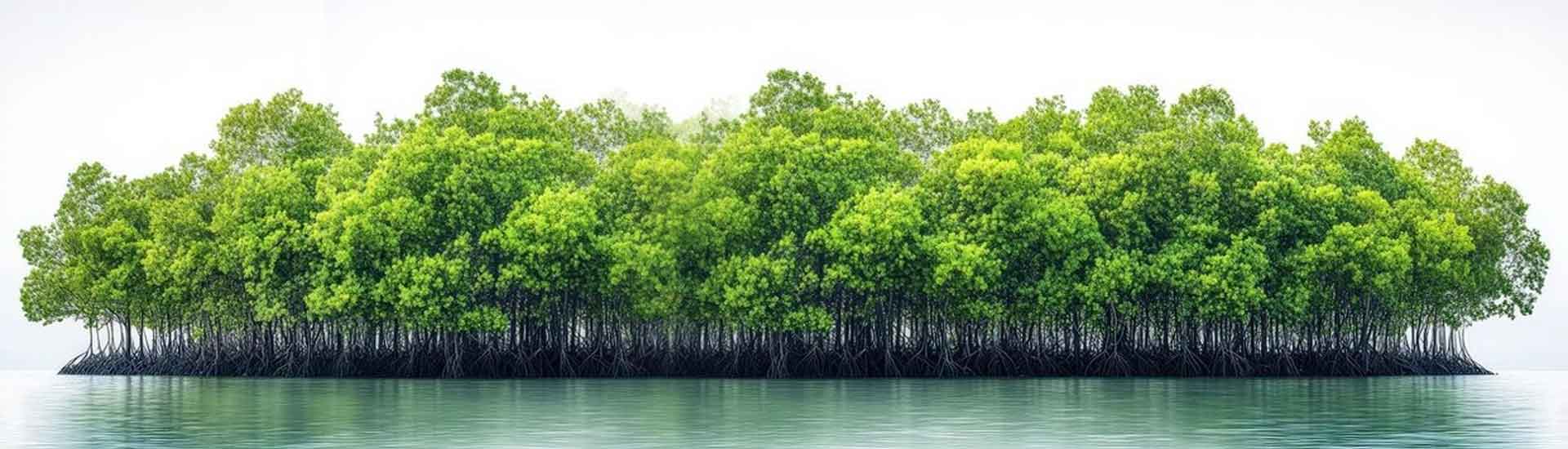
Bangladesh has the world's largest contiguous mangrove forest, called the Sundarbans. This means that the forest is a single, unbroken expanse.
The Sundarbans stretch across the delta where the Ganges, Brahmaputra and Meghna rivers meet, covering around 10,000 square kilometres.
Of this, around 60% to 62% (about 6,017 to 6,200 square kilometres) lies within southwestern Bangladesh, and the rest extends into India.
How Does This Massive Forest Help Bangladesh?
Think of the Sundarbans as Bangladesh's own natural bodyguard. This country sits right in the path of some of the nastiest cyclones the Bay of Bengal can throw at it.
But when those monster storms come barreling in, the mangrove forest steps up. Its thick roots and leafy canopies take the brunt of the wind, slow down the waves, and keep the worst of the chaos away from the villages tucked further inland.
Every year, that wall of green saves thousands of lives and spares countless homes from being wiped out. And it's not just a local hero.
The Sundarbans is a climate heavyweight, too, quietly locking away more than 380 million metric tonnes of carbon dioxide, according to the Bangladesh Forest Department. That's a serious assist for a planet that’s running a fever.
How Do Mangroves Support People's Livelihoods?
For folks living here, the Sundarbans isn't just some patch of trees. It's what puts food on the table. About half a million people rely on this wild, tangled place to get by, think woodcutters, honey hunters (locals call them Mawalis), and fishermen who know every twist in the river.
The forest is a maze of tidal streams and muddy creeks, packed with fish, crabs, and shrimp that end up on dinner plates across the country.
Picture this: 40,000 fishing boats heading out into these waters, day in and day out. The districts hugging the forest? They're the engine behind nearly 80% of Bangladesh's shrimp business.
And every year, right when the heat cranks up between April and June, you'll see honey hunters wading deep into the muck, risking it all to snag wild honey from giant bee nests, a tradition that's been going strong for centuries.
What Unique Flora and Fauna Live Here?
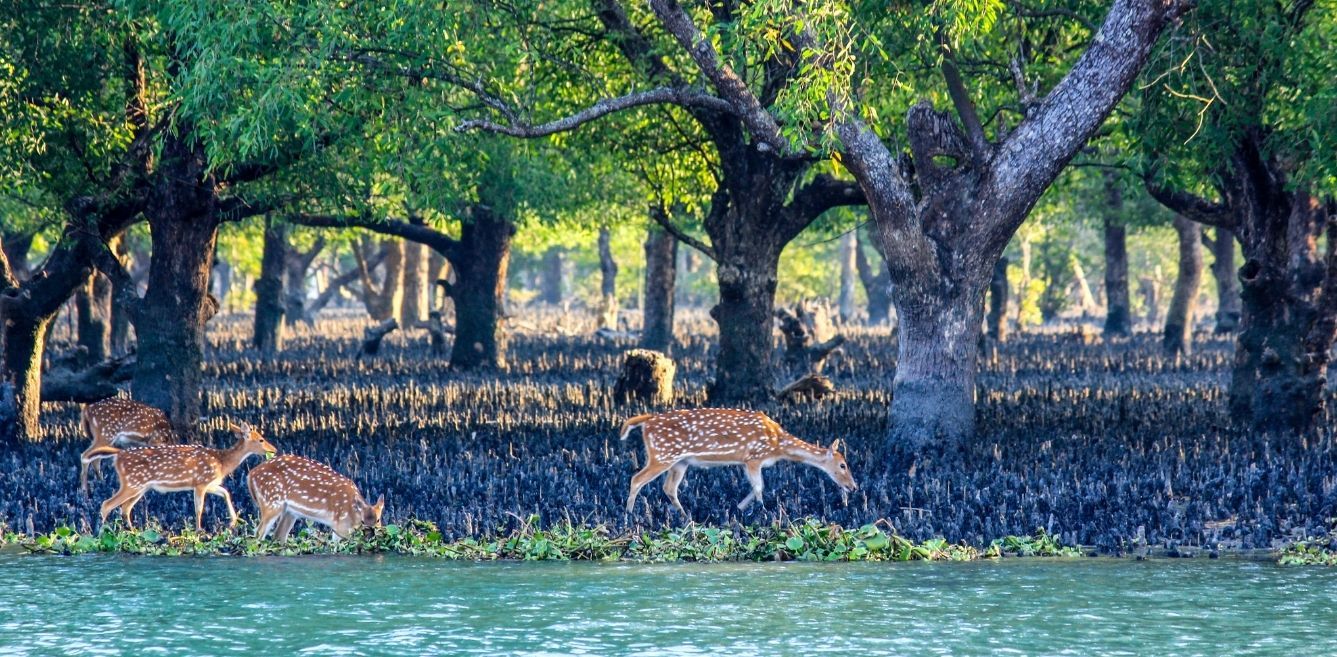
The Sundarbans isn't just a patch of swampy forest; it's a full-blown wildlife blockbuster, home to more than 800 plant and animal species.
The place even gets its name from the Sundari tree, a tough-as-nails mangrove that's prized for its sturdy timber. And if you spot a roof made from palm leaves, chances are it's the Golpata, another local superstar.
Wildlife? The Sundarbans is basically the stuff of legend. It's the only mangrove forest on the planet where you'll find the Royal Bengal Tiger prowling around.
And not just a handful, there are somewhere between 400 and 450 of these big cats calling the place home, making it one of the best spots on Earth to find wild tigers. As you sail through the muddy channels, you can also spot:
- Chital (beautiful spotted deer)
- Rhesus macaques (monkeys)
- Saltwater crocodiles basking on the mudflats
- Endangered Ganges River dolphins are popping out of the water
This vibrant mix of rare animals and unique trees is exactly why UNESCO proudly declared the Sundarbans of Bangladesh a World Heritage Site in 1997.
List of 5 Largest Mangrove Forests in the World
Mangrove forests are like nature's own coastal bodyguards, standing between the land and the sea and giving shelter to some seriously rare creatures.
Sure, you'll find mangrove forests all over the tropics, but a handful of these forests are so huge and so vital, they basically run the show. Let's check out the five biggest mangrove powerhouses on Earth.
| Mangrove Forest | Cover (Approx.) | Where is it found? | Famous For |
| The Sundarbans | 10,000 sq km (~60% in Bangladesh, ~40% in India) | Bangladesh and India (Bay of Bengal) | Being the world's largest unbroken mangrove, hosting the iconic Royal Bengal Tiger, Sundari trees, and saltwater crocodiles. |
| Delta del Orinoco Mangroves | 6,500 sq km | Venezuela (South America) | Rich wetland birdlife (scarlet ibises), unique Warao indigenous communities, and pristine, untamed river delta channels. |
| Niger Delta Mangroves | 5,400 to 7,500 sq km | Nigeria (West Africa) | Being Africa's largest mangrove ecosystem, it has a high concentration of West African manatees, unique fish species, and soft-shelled turtles. |
| Mahakam Delta Mangroves | 1,500 sq km | East Kalimantan, Indonesia | Incredible primate biodiversity, especially the endangered, long-nosed Proboscis monkeys and Irrawaddy river dolphins. |
| Guinean Mangroves | 1,100 to 1,500 sq km | West Africa (Guinea, Guinea-Bissau, Sierra Leone) | Crucial migratory bird flyways, extensive rice cultivation fields integrated into coastal wetlands, and Atlantic humpback dolphins. |
What Is The Second Largest Mangrove Forest In The World?
The Delta del Orinoco Mangroves in Venezuela are around 6,500 square kilometres in size, and they are the second-largest continuous mangrove system in the world. Although Pichavaram in India is often called the second largest because of the density of the trees here, the truth is that it’s a lot smaller in size.
Where Is The Largest Mangrove In The World?
The Sundarbans is the world’s largest continuous mangrove forest. It sits on the wide delta of the Bay of Bengal, with about 60% in southwestern Bangladesh and 40% in West Bengal, India.
Which Is The Third Largest Mangrove Forest In The World?
The Niger Delta Mangroves in Nigeria, West Africa, make up the world’s third-largest mangrove system. Covering about 5,400 to 7,500 square kilometres, they are the largest mangrove ecosystem in Africa.
Which Is The Second Largest Mangrove Cover In India?
State-wise data shows Gujarat has the second largest mangrove cover in India, with over 1,170 square kilometres. But if we look at a single delta ecosystem, the Bhitarkanika Mangroves in Odisha have the second-largest individual mangrove forest in the country.
Which Is The Biggest Mangrove Forest In India?
The Sundarbans in West Bengal is India’s largest mangrove forest. On the Indian side, it covers about 2,112 square kilometres, which is more than 42% of all the mangroves in the country.
Which Is The Largest Mangrove Tree In The World?
The Sundari tree is well known, but some Looking-glass mangrove trees (Heritiera littoralis) and old-growth Rhizophora or Avicennia species can also become giants. In untouched tropical estuaries, they can grow as tall as 40 to 50 meters.

Kriti Barua is a skilled content writer with 4+ years of experience in creating clear, engaging, and informative content. She began her writing journey as a Creative Writer Intern at Wordloom Ventures. She holds a BA degree from Delhi University and has completed a one-year diploma in TV Production and Journalism, which adds depth to her research and reporting style.
Kriti has worked across brand writing, marketing content, and digital media, building strong expertise in articles that connect with readers and perform well online. At Jagran New Media, she writes for the GK section, covering national news, international stories, and query-based articles that answer what people actively search for. Her work focuses on easy language, reliable information, strong keywords, and reader-friendly storytelling, making her content both helpful and search-friendly.


