What was the First Supercontinent to ever exist on Earth?
The first supercontinent to ever exist on Earth is a puzzle geologists are solving using ancient rock layers. Scientists studying ancient cratons in South Africa and Western Australia have uncovered evidence of Vaalbara, a colossal landmass that formed over 3.6 billion years ago, completely redefining our understanding of Earth's early continental drift.

Imagine traveling back in time over three billion years. You wouldn’t recognize Earth. There were no green forests, no roaring dinosaurs, and the atmosphere was a toxic mix devoid of oxygen. But if you looked down from space, you might spot a lonely, massive dark patch surrounded by a global ocean. Long before the famous Pangea supercontinent assembled and broke apart to shape our modern world map, our planet’s intense internal heat was already cooking up the very first supercontinent.
Geologists tracking Earth's earliest history have dug deep into the planetary crust to find out exactly how these ancient landmasses fused. Through radical chemical mapping and paleomagnetic tracking, science has opened a window into the oldest supercontinent setups, revealing that continental drift is a dance that started nearly at the dawn of time itself.
What was the Very First Supercontinent?
According to geological data and peer-reviewed research cited by various scientific reports, the very first supercontinent to ever exist on Earth is widely believed to be Vaalbara.
| Particular | About the First Supercontinent on Earth |
| Name of Supercontinent | Vaalbara |
| Estimated Age | Formed roughly 3.6 billion years ago |
| Surviving Components | Kaapvaal Craton (S. Africa) and Pilbara Craton (W. Australia) |
| Evidence Base | Identical magnetic alignment and rock stratigraphy |
While it was much smaller than modern continents, it earned the "supercontinent" title because it was likely the only major stable landmass built by early plate tectonics at the time. Scientists confirmed its existence by matching identical 3-billion-year-old structural sediments and paleomagnetic signatures across modern South Africa and Western Australia.
What was the First Supercontinent called before Pangea?
Many people assume Pangea was the original mega-landmass, but it was actually just the most recent one. Millions of years before Pangea even existed, multiple generations of supercontinents grew and tore apart.
Before Pangea assembled roughly 336 million years ago, the planet was dominated by Rodinia (about 1.1 billion years ago) and Columbia (also known as Nuna, around 1.8 billion years ago).
Going even further back into the Archean Eon, you find Kenorland and Ur. Ur, which formed around 2.8 billion years ago, holds a record for being one of the longest-lived crustal pieces, eventually joining other rocks to help construct Pangea itself.
Read More about - How did the Supercontinent look like Millions of Years Ago?
List of Other Supercontinents in Order
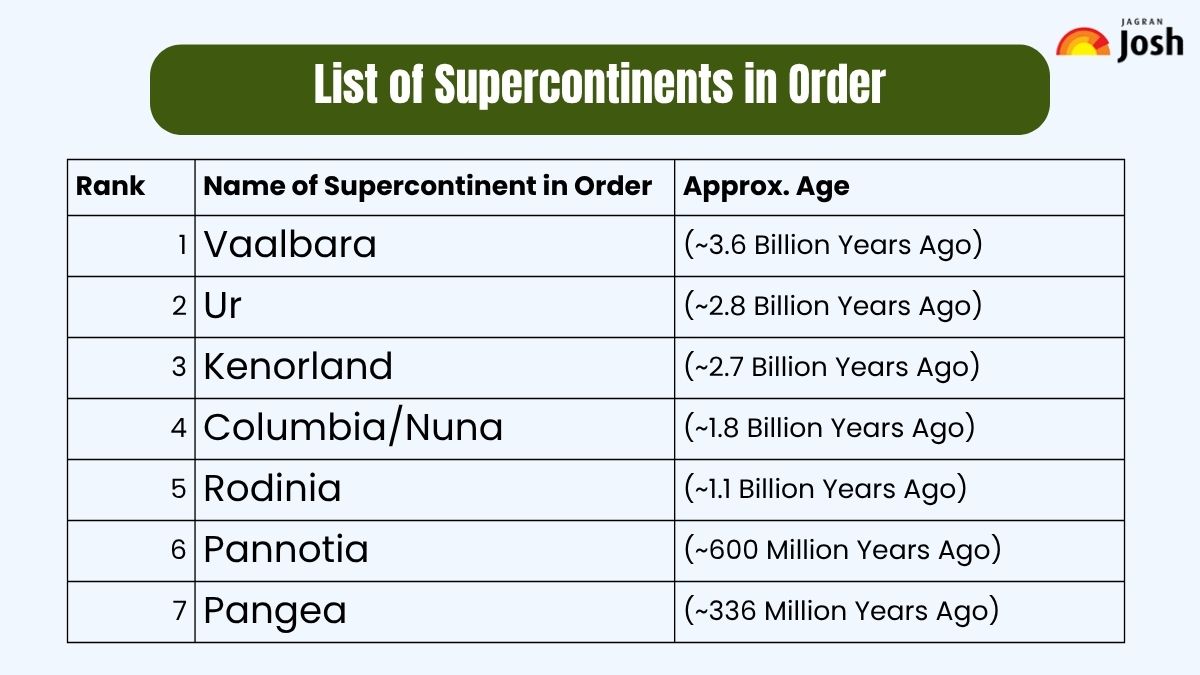
The Earth operates on a giant Supercontinent Cycle, assembling and breaking apart massive landmasses roughly every 400 to 600 million years. According to geological timelines tracked by the USGS and international stratigraphy databases, here is the chronological order of Earth's historic supercontinents from oldest to youngest:
-
Vaalbara (~3.6 Billion Years Ago) – The speculative earliest proto-supercontinent.
-
Ur (~2.8 Billion Years Ago) – A highly stable ancient landmass older than any modern continent.
-
Kenorland (~2.7 Billion Years Ago) – Formed during the Neoarchean era; centered heavily around the equator.
-
Columbia / Nuna (~1.8 Billion Years Ago) – The first massive, planet-spanning global landmass.
-
Rodinia (~1.1 Billion Years Ago) – A massive desert world completely devoid of land life.
-
Pannotia (~600 Million Years Ago) – A short-lived landmass that existed during a global ice age.
-
Pangea (~336 Million Years Ago) – The iconic dinosaur-era supercontinent that split to form our current world.
The secrets of Earth’s oldest continents reveal our planet as a moving jigsaw puzzle. From the ancient shores of Vaalbara to the dramatic breakup of Pangea, supercontinents have shaped global climates, volcanic trends, and the ultimate evolution of life on Earth.

Harshita Singh specializes in US affairs and general knowledge, simplifying intricate geopolitical and historical subjects into clear, digestible insights for learners. Holding a BA (Hons) in English from the University of Delhi and with over three years of experience in educational writing, she produces authoritative, thoroughly researched content that empowers readers to engage confidently with global current affairs. For inquiries, you can reach out to her at harshita.singh@jagrannewmedia.com.


