Show Key Points
IndiaAI Mission 2.0 focuses on AI innovation, strengthening indigenous R&D capabilities and prioritizes the "diffusion" of AI into small businesses via a common digital platform, the development of indigenous chips and models.
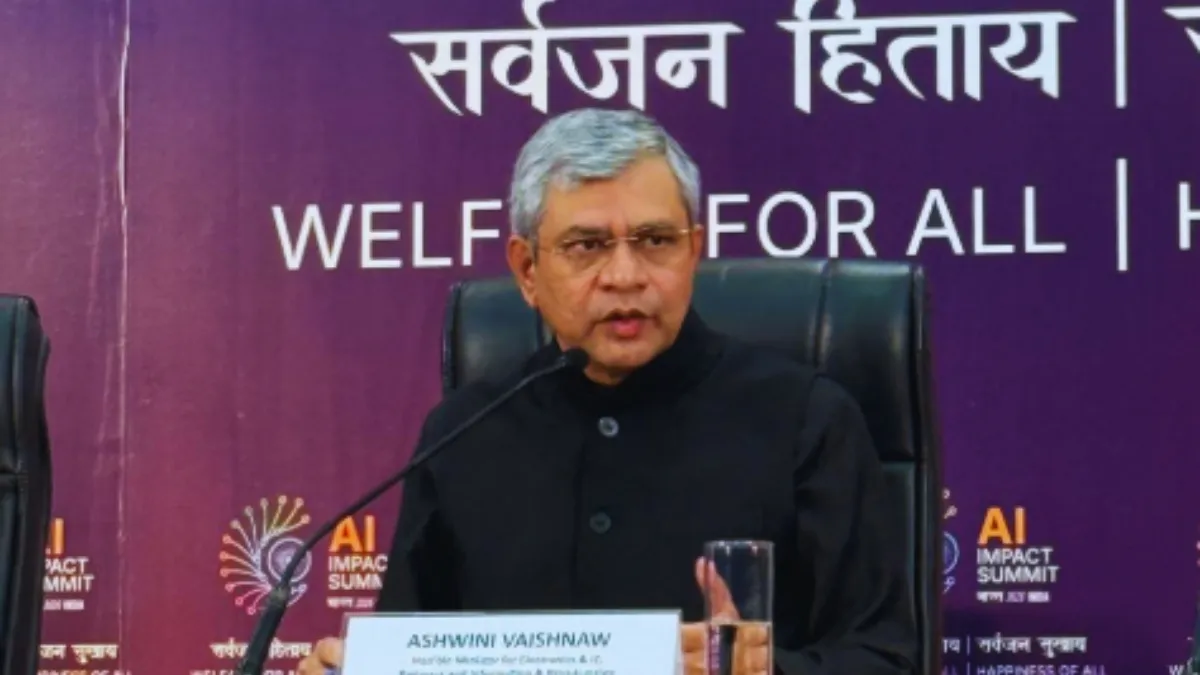
Union Minister Shri Vaishnaw described AI as driving the fifth industrial revolution, impacting every sector of the economy and society. He cited healthcare solutions showcased at the Summit that can make healthcare more affordable and education solutions that enable tailored learning for every student.
Objectives:
-
Universal AI Diffusion to ensure that AI benefits are not concentrated in urban hubs but reach rural communities and teachers democratising AI solutions.
-
Economic Growth to leveraging AI to add an estimated $1.7 trillion to the Indian economy by 2035.
-
Global Leadership: Solidifying India's rank among the top three AI nations (per Stanford rankings) and ver $200 Billion in AI Investments Expected in the Next Two Years.
-
Sovereign AI Models Benchmark Against Global Standards, Rank Among Top Three AI Nations
-
India’s AI Safety Institute Partners with Academic Institutions to Prevent AI Misuse.
Key Features of Mission 2.0
MSME-Focused AI Stack on the lines of UPI (The "UPI for AI"): The hallmark of Mission 2.0 is the creation of a Common Digital AI Platform and diffusion of AI technologies particularly for India;s MSME ecosystem like
-
Ready-to-use Solutions: A curated bouquet of vetted, trusted AI tools for sectors like healthcare, agriculture, and retail.
-
Democratized Access: MSMEs will be able to plug into these AI tools without needing deep technical expertise or massive capital, similar to how they adopted digital payments via UPI.
Compute Expansion and Democratising Access: To sustain the growing demand for AI training and inference, the government is significantly boosting the national "computer bank."
-
GPU Addition: India will scale its compute capacity beyond the existing 38,000 GPUs with the addition of 20,000 GPUs in the coming weeks
-
Affordability: Resources will remain available to startups and researchers at approximately ₹65/hour roughly one-third of the global average cost.
Sovereign AI Beyond the Model: Mission 2.0 redefines "Sovereign AI" as a full-stack capability rather than just a language model.
-
Indigenous Chips: Deep focus on "Semiconductor 2.0," aiming to nurture 50+ deep-tech chip design startups and local fab units.
-
Infrastructure and Control Systems: Ensuring India controls the "control plane" and infrastructure to prevent reliance on foreign technological gatekeepers.
-
Scalable Applications (BharatGen): Strengthening multimodal models trained specifically on Indian datasets and the 22 constitutional languages.
Safe and Trusted AI Under the "Safe & Trusted AI" pillar, the mission introduces MANAV Vision an ethical framework (Moral, Accountable, National sovereignty, Authenticity, Value-based), authenticity labels a proposal to mandate labels for AI-generated content to combat deepfakes and misinformation and AI safety institute a dedicated body to audit algorithms and mitigate bias.
IndiaAI Mission 2.0 aims to drive AI innovation, strengthen indigenous R&D, and diffuse AI benefits, especially to MSMEs, via a common digital platform. Union Minister Shri Vaishnaw highlighted its role in economic growth, targeting $1.7 trillion by 2035, and global leadership. Key features include expanded compute capacity, sovereign AI development, and a focus on safe, trusted AI through initiatives like MANAV Vision and an AI Safety Institute.
Also Read: India-France Strengthening the Special Global Strategic Partnership at AI Summit 2026



Comments
All Comments (0)
Join the conversation