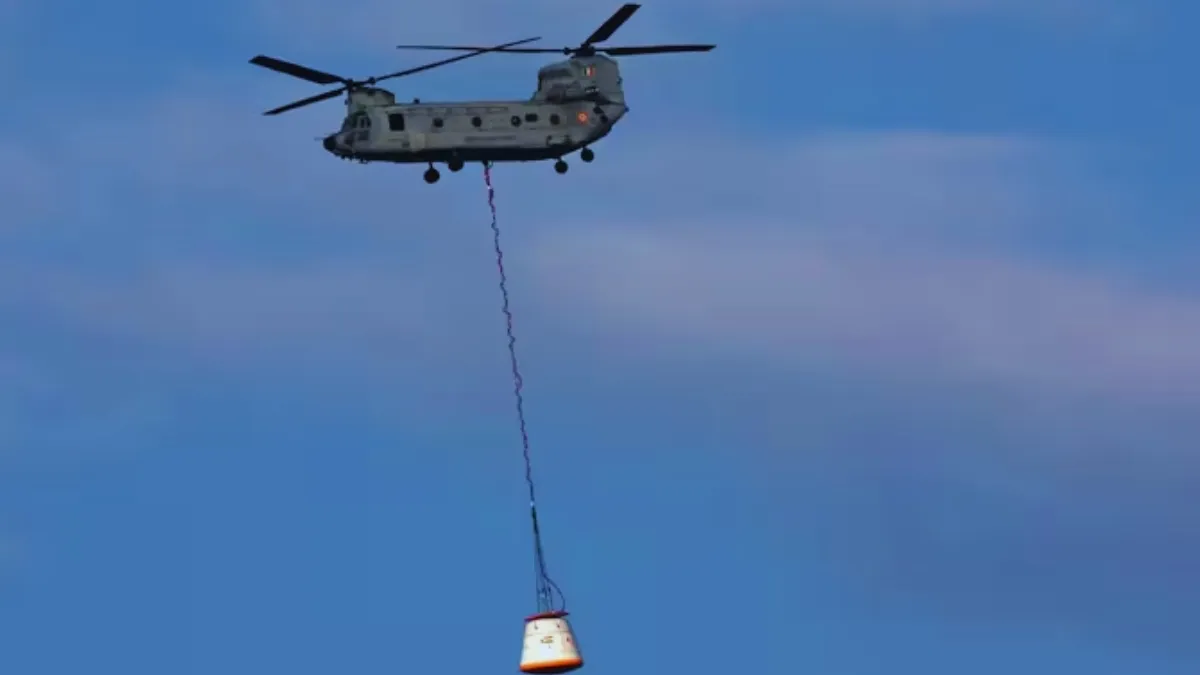
India’s journey to the stars has crossed another significant milestone by conductiong Gaganyaan Second Test. On April 10, 2026, the Indian Space Research Organisation (ISRO) successfully conducted the second Integrated Air Drop Test (IADT-02) at the Satish Dhawan Space Centre in Sriharikota.
Gaganyaan Second Test is a cornerstone of the Gaganyaan mission, India's first human spaceflight program, ensuring that our astronauts can return to Earth safely after their historic journey into orbit.
What is the Air Drop Test ?
The Integrated Air Drop Test (IADT) is a rigorous simulation designed to evaluate the performance of the Crew Module (CM) deceleration system. During an actual mission, when the crew capsule re-enters the Earth's atmosphere at high speeds, it relies on a complex sequence of parachutes to slow down for a safe splashdown in the ocean.
In the IADT-02, a representative crew module was dropped from an Indian Air Force aircraft at a specific altitude. The test monitors the deployment of "drogue" parachutes which stabilize the craft followed by the main parachutes that reduce the landing velocity to safe levels.
ISRO Gaganyaan Second Test: Key Features
The IADT-02 was not just a repeat of the first test, but a more complex validation of the safety systems. Here are the key features
-
Parachute Sequencing: Precise timing of the deployment of the Apex cover separation, followed by the stabilization and main chutes.
-
Load Simulation: The test simulated various "off-nominal" conditions to ensure the system works even if atmospheric conditions are not ideal.
-
Recovery Systems: Validation of the buoyancy and uprighting systems that keep the capsule stable once it hits the water.
-
Real-time Tracking: Use of advanced telemetry and multiple sensors to capture high-fidelity data on the module's descent profile.
Gaganyaan Mission
The Gaganyaan Mission is India’s first human spaceflight program led by the Indian Space Research Organisation (ISRO). Its primary goal is to demonstrate indigenous capability by sending a three-member crew into a 400 km Low Earth Orbit (LEO) for a 3-day mission and safely returning them to Earth via a splashdown in Indian waters.
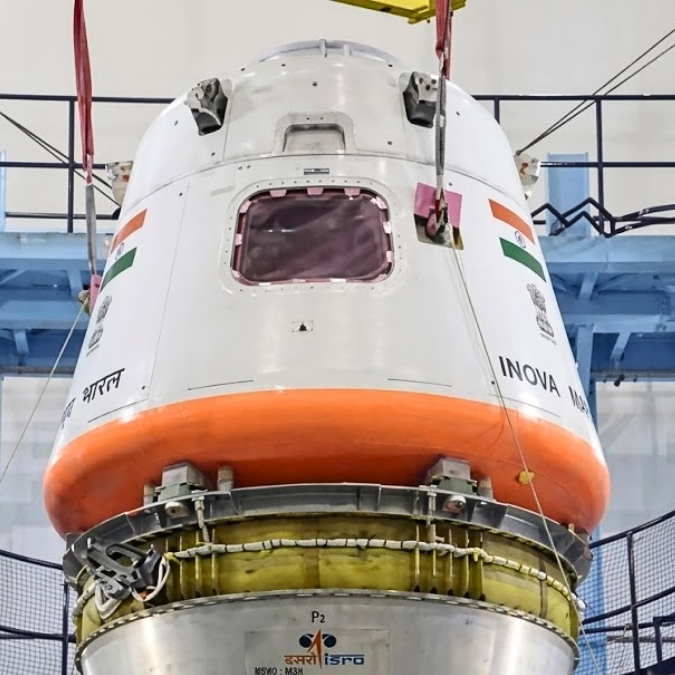
Gaganyaan Mission Launch Date
The maiden crewed Gaganyaan mission launch is officially targeted for late 2026 or early 2027, timeline follows a series of uncrewed test flights (G1, G2, and G3) designed to ensure every component is "human-rated" for safety.
Gaganyaan Mission Launch Vehicle
The powerhouse behind the mission is the Launch Vehicle Mark 3 (LVM3), formerly known as the GSLV Mk III. For the Gaganyaan mission, the LVM3 has been reconfigured into a "Human-Rated" version (HLVM3), featuring enhanced reliability and the crucial Crew Escape System (CES).
Who are the 4 People Selected for Gaganyaan?
In February 2024, Prime Minister Narendra Modi introduced the nation to the four brave pilots from the Indian Air Force who have been selected for this historic mission. They have undergone extensive training in both Russia and at ISRO's Astronaut Training Facility in Bengaluru.
Wing Commander Shubhanshu Shukla has also been selected for a collaborative flight to the International Space Station (ISS) with NASA scheduled ahead of the main Gaganyaan launch.
| Name | Rank |
| Prashanth Balakrishnan Nair | Group Captain |
| Ajit Krishnan | Group Captain |
| Angad Pratap | Group Captain |
| Shubhanshu Shukla | Wing Commander |
ISRO Recent Progress (April 2026)
As of April 10, 2026, ISRO has reached several critical milestones:
-
IADT-02 Success: ISRO successfully completed the second Integrated Air Drop Test (IADT-02) at Sriharikota, validating the complex parachute system required for safe re-entry.
-
Mission MITRA: In early April 2026, astronaut-designates began Mission MITRA, a survival and operability training exercise in the high-altitude wilderness of Ladakh.
-
Ground Testing: Over 8,000 ground tests, including static motor firings and structural qualifications, have been completed to ensure the vehicle is human-rated.
The successful completion of the IADT-02 reinforces ISRO’s reputation for precision and safety. As Union Minister Dr. Jitendra Singh noted, this achievement brings India one step closer to joining the elite club of nations capable of launching humans into space. The eyes of the world—and the hopes of 1.4 billion Indians remain fixed on the horizon as the Gaganyaan mission enters its final phase of preparation.
Also Read: ISRO Conducts Mission MITRA in Ladakh for Astronaut Study



Comments
All Comments (0)
Join the conversation