Election Schedule in India for 2026-2027: Check the Full List of States Here
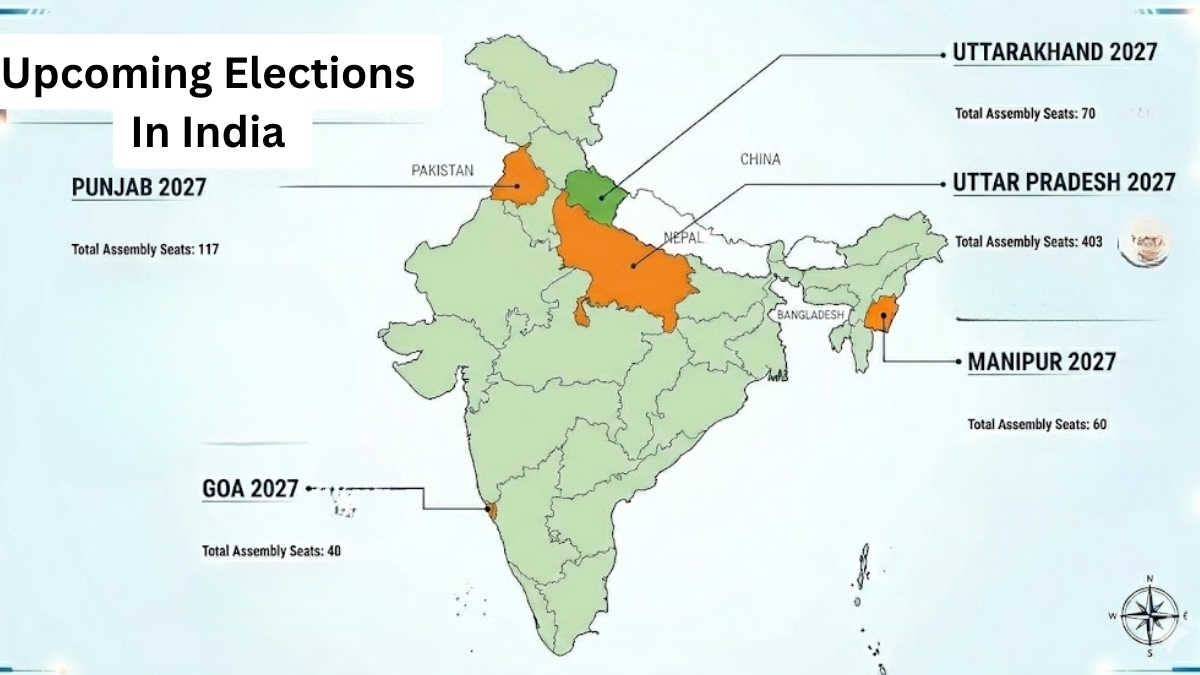
Upcoming Elections in India: Looking ahead after the 2026 State Assembly Elections? Check out the complete list of upcoming State Assembly Elections in India for 2027, featuring seat breakdowns, ruling parties, and election process.
-1780471544269.webp)
India recently had state assembly elections in West Bengal, Tamil Nadu, Kerala, Assam, and Puducherry, and new administrations were formed in each state. The political attention has fully shifted to the 2027 electoral calendar where state assembly elections are going to be held in the major states like Uttar Pradesh.
The year 2027 will see critical battleground states head to the polls to elect their next legislative assemblies. These elections are highly anticipated because they will test the endurance of major political heavyweights and set the definitive momentum leading into the 2029 Lok Sabha general elections.
Upcoming State Assembly Elections in 2027
| State | Expected Election Timeline | Total Assembly Seats | Current Ruling Party/Coalition |
| Goa | February 2027 | 40 | Bharatiya Janata Party (BJP) |
| Manipur | February – March 2027 | 60 | Bharatiya Janata Party (BJP) |
| Punjab | February – March 2027 | 117 | Aam Aadmi Party (AAP) |
| Uttarakhand | February – March 2027 | 70 | Bharatiya Janata Party (BJP) |
| Uttar Pradesh | February – March 2027 | 403 | BJP-led NDA |
Uttar Pradesh
-
Current Chief Minister: Yogi Adityanath
-
Governor: Anandiben Patel
-
Total Assembly Seats: 403
-
Ruling Party: Bharatiya Janata Party (BJP)
-
Opposition Party: Samajwadi Party (SP)
-
Last Election (2022) Breakdown: The BJP-led alliance secured a resounding victory by winning 273 seats (with the BJP alone claiming 255). The Samajwadi Party (SP) saw a significant surge to grab 111 seats, establishing itself as the primary opposition force. Other parties like the BSP and Congress were reduced to single digits.
Punjab
-
Chief Minister: Bhagwant Mann
-
Governor: Gulab Chand Kataria
-
Total Assembly Seats: 117
-
Ruling Party: Aam Aadmi Party (AAP)
-
Opposition Party: Indian National Congress (INC)
-
Last Election (2022): The Aam Aadmi Party (AAP) created history by registering a landslide victory, winning 92 out of 117 seats. The incumbent Congress was pushed to a distant second with 18 seats, while traditional powerhouses like the Shiromani Akali Dal (SAD) were reduced to 3 seats.
Uttarakhand
-
Chief Minister: Pushkar Singh Dhami
-
Governor: Lieutenant General Gurmit Singh(Retd.)
-
Total Assembly Seats:70
-
Ruling Party: Bharatiya Janata Party (BJP)
-
Opposition Party: Indian National Congress (INC)
-
Last Election (2022): The BJP retained power by securing 47 seats. The Indian National Congress finished as the primary opposition with 19 seats by breaking the state's long-standing trend of alternating governments every five years.
Manipur
-
Chief Minister: Yumnam Khemchand Singh
-
Governor: Ajay Kumar Bhalla
-
Total Assembly Seats: 60
-
Ruling Party: Bharatiya Janata Party (BJP) in alliance with Naga Peoples Front (NPF) and others.
-
Opposition Party: National People's Party (NPP) / Indian National Congress (INC)
-
Last Election 2022: The BJP secured an absolute majority on its own by winning 32 seats. The National People's Party (NPP) secured 7 seats, while the Congress party was restricted to just 5 seats.
Goa
-
Chief Minister: Dr. Pramod Sawant
-
Governor: P. S. Sreedharan Pillai
-
Total Assembly Seats: 40
-
Ruling Party: Bharatiya Janata Party (BJP)
-
Opposition Party: Indian National Congress (INC)
-
Last Election 2022: The BJP won 20 seats and successfully formed the government with the support of regional allies and independents. The Congress party finished with 11 seats, and the Aam Aadmi Party (AAP) made its debut in the state with 2 seats.
Constitutional Provisions and Process of Assembly Elections
The execution of democratic elections in India is governed by the Constitution and The Representation of the People Act, 1950 to ensure fairness, transparency, and independence. Here are the key provisions:
-
Article 324: The Election Commission of India (ECI) is given the absolute power of superintendence, direction, and control of all elections to Parliament and to the Legislature of every State under Article 324.
-
Article 172: Every Legislative Assembly of every State, unless sooner dissolved, continues for five years from the date appointed for its first meeting. The expiration of this 5-year period operates as an automatic dissolution of the Assembly, necessitating new elections.
-
Article 326 (Universal Adult Suffrage): Elections to the Legislative Assembly of every state are conducted based on Universal Adult Suffrage. Every citizen of India who is not less than 18 years of age and is not otherwise disqualified by law (on grounds of non-residence, unsoundness of mind, or crime) is entitled to be registered as a voter.
- Election Notification: The Governor of the State issues the official election notification on the recommendation of the Election Commission of India
-
Model Code of Conduct (MCC): ECI issues a set of guidelines for political parties and candidates regarding speeches, polling days, portfolios, and general conduct to ensure a level playing field.
-
Voting Mechanism: Voting in India is conducted via Electronic Voting Machines (EVMs) backed by Voter Verifiable Paper Audit Trails (VVPAT) across designated polling booths.
India is preparing for crucial State Assembly elections in 2027 across major states like Uttar Pradesh, Punjab, and Uttarakhand. These elections are highly anticipated because they will test the endurance of major political heavyweights and set the definitive momentum leading into the 2029 Lok Sabha general elections
FAQ’s for Competitive Exams in India
Q1: What is the minimum age required to contest a State Legislative Assembly (Vidhan Sabha) election?
Ans: According to Article 173(b) of the Indian Constitution, a person must be at least 25 years of age to contest an assembly election.
Q2: Can a state assembly's 5-year term be extended?
Ans: Yes, if the country is facing a proclamation of Emergency (National Emergency under Article 352) in that situation Parliament may by law extend the term of the State Legislative Assembly for a period not exceeding one year at a time, and not extending beyond a period of six months after the Proclamation has ceased to operate.
Q4: Who appoints the Chief Electoral Officer (CEO) of a State?
Ans: The Election Commission of India appoints the Chief Electoral Officer of a state in consultation with the respective State Government.
Q5: What is the difference between Vidhan Sabha and Vidhan Parishad?
Ans: The Vidhan Sabha is the Legislative Assembly/Lower House whose members are directly elected by the public where the Vidhan Parishad is the Legislative Council/Upper House which is a permanent body present in only 6 Indian states, whose members are indirectly elected or nominated.

Manisha Waldia is an accomplished content writer with 4+ years of experience dedicated to UPSC, State PCS, and current affairs. She excels in creating expert content for core subjects like Polity, Geography, and History. Her work emphasises in-depth conceptual understanding and rigorous analysis of national and international affairs. Manisha has curated educational materials for leading institutions, including Drishti IAS, Shubhara Ranjan IAS, Study IQ, and PWonly IAS. Email ID: manisha.waldia@jagrannewmedia.com

-1780482348447_t.webp)

-1780473932336_t.webp)