Revolt of 1857 Short Notes for SSC, UGC, Railways and Other Government Examinations with PYQs
Known as the First War of Independence, the Revolt of 1857 remains a key topic in competitive exams. Get concise notes, important points, and PYQs here.
-1780482348447.webp)
The Revolt of 1857 is one of the most important events in the history of India. This is also among the important topics which are always asked in competitive exams. This topic might appear in any of your papers such as UPSC, SSC CGL, RRB NTPC, UGC NET or State PSC. If you master it, you will face no issues with your marks.
The revolt began in Meerut on 10 May 1857 when the Indian sepoys mutinied against the British. The immediate reason for revolt was the cartridges of animal fat greased cotton. The revolt was soon joined by many people from various parts of India who had been angry with British policies for years, and spread throughout large areas of northern and central India.
The sepoys marched to Delhi, proclaimed the last Mughal emperor, Bahadur Shah Zafar, their leader and for a short time the British Empire in India suffered its most challenging period.
The rebellion led to some of the greatest names in Indian history. Martyrs like Rani Lakshmibai, Nana Sahib, Tantia Tope, Begum Hazrat Mahal, and Kunwar Singh fought against the British in their own regions. The uprising was brought to an end by 1858.
The revolt was not spontaneous. It emerged from a long history of British policies which had systematically eroded the political, economic, social and military structures in India nearly over a century.
Every section of Indian society ranging from sepoys, zamindars, peasants, artisans, rulers, religious leaders, had a problem. The article below mentions everything you need to know about the Revolt of 1857.
Causes of 1857 Revolt
A. Political Causes
1. Doctrine of Lapse (Lord Dalhousie, 1848 - 1856)
It was one of the major reasons for the revolt. Under Doctrine of Lapse, the death of an Indian ruler, without a natural male heir would result in the British annexing the kingdom.
States annexed under Doctrine of Lapse
| State | Year Annexed |
| Satara | 1848 |
| Jaitpur and Sambalpur | 1849 |
| Baghat | 1850 |
| Udaipur (in Chhattisgarh) | 1852 |
| Jhansi | 1853 |
| Nagpur | 1854 |
Note: Awadh (1856) was not annexed under the Doctrine of Lapse, as it was annexed due to misgovernance but the result was the same.
2. Subsidiary Alliance (Lord Wellesley) Indian states had to pay for the maintenance of British troops in their state and could not have independent foreign policies. This gradual erosion of sovereignty contributed majorly to the revolt.
3. The annexation of Awadh (1856) Awadh (Oudh) was the biggest political blunder. Charges against the popular Nawab Wajid Ali Shah for misgovernance exiled him to Calcutta. This outraged the people and the Bengal Army which drew a large number of sepoys from Awadh.
4. Policy of Racial Discrimination Indians were systematically barred from senior administrative jobs. The entire ICS (Indian Civil Service) was British.
B. Economic Causes
The British economic policies systematically drained India's wealth:
-
Destruction of Indian handicraft industries: With the introduction of cheap British manufactured goods in Indian markets, the livelihood of weavers, artisans and craftsmen was destroyed.
-
Land Revenue Systems: Permanent Settlement (1793), Ryotwari, Mahalwari systems heavily taxed peasants and if they were not paid then people lost their land.
-
Drain of Wealth: Exhaustion of resources, raw materials and revenues were transferred to Britain.
C. Military Causes
Indian sepoys had several issues:
1. General Service Enlistment Act, 1856: A new recruit signing up for the Bengal Army was required to sign a contract to go anywhere the army needed them, including overseas. In the case of high caste Hindus, crossing the sea (kala pani) was an act of loss of the caste. This was interpreted to be an attack on religion.
2. Racial Discrimination in Army
-
Indian soldiers were paid less than the British soldiers of equivalent rank
-
Maximum promotion for an Indian was the position of Subedar so no Indian could become an officer
3. Greased Cartridges (Immediate Military Cause): The new Enfield P-53 rifle was equipped with cartridges that the soldier had to bite before loading. There were rumors that the oil was produced from cow fat and pig fat. This united Hindu and Muslim soldiers in common outrage.
D. Social and Religious Causes
-
Christian missionaries were spreading Christian faith in America and British support was being offered.
-
Western education was believed to be a means of conversion.
-
Indians were discriminated against in all aspects of public life.
1857 Revolt: Sequence of Events
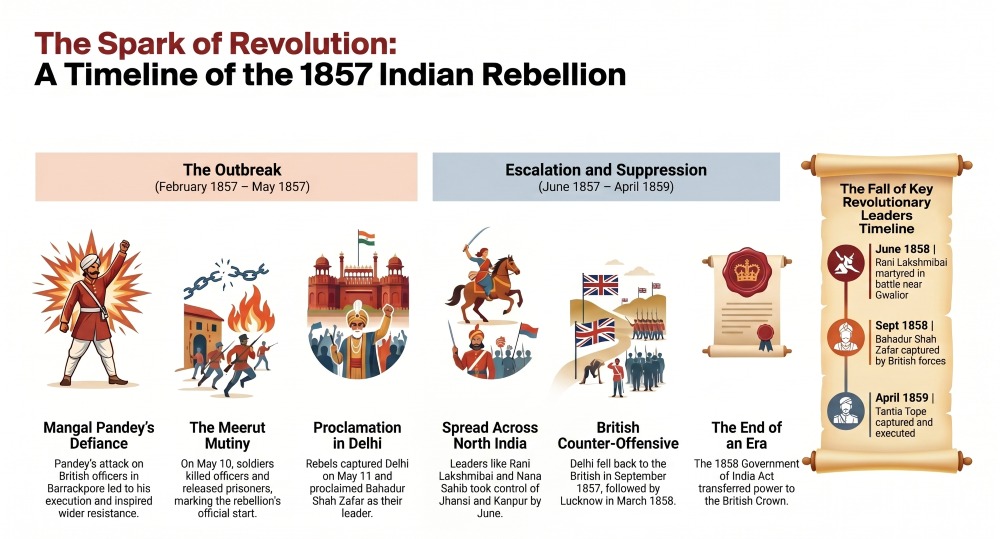
Here is the complete sequence of events of 1857 Revolt:
| Date | Event |
| 26 February 1857 | In the 19th century, Sepoys at Berhampore stopped firing their rifles as part of training. |
| 29 March 1857 | Mangal Pandey (34th BNI) attacks British officers at Barrackpore. |
| 8 April 1857 | Mangal Pandey hanged |
| 24 April 1857 | 85 soldiers of 3rd Bengal Light Cavalry at Meerut refused to use greased cartridges. |
| 9 May 1857 | 85 sepoys court-martialled and sentenced to 10 years rigorous imprisonment |
| 10 May 1857 | Mutiny starts at Meerut with the release of prisoners, killing British officers. |
| 11 May 1857 | The rebels reached Delhi and proclaimed Bahadur Shah Zafar as a leader. |
| 4 June 1857 | The rebels captured Jhansi and handed it to Rani Lakshmibai. |
| June 1857 | Nana Sahib takes control at Kanpur |
| July 1857 | The revolt spreads across North India and major heat came from Lucknow and Cawnpore |
| August 1857 | Rani Lakshmibai of Jhansi and Tatya Tope try to capture Gwalior |
| September 1857 | Bahadur Shah Zafar captured by the British and Delhi fell into their hands |
| March 1858 | British recapture Lucknow under Colin Campbell |
| June 1858 | Rani Lakshmibai martyred in battle near Gwalior |
| 2 August 1858 | Government of India Act passed |
| 1 November 1858 | Queen Victoria's Proclamation at Allahabad |
| April 1859 | Tantia Tope captured and executed |
1857 Revolt: Major Centres and Leaders
| Centre | Leader(s) of Revolt |
| Delhi | Bahadur Shah Zafar (symbolic) and General Bakht Khan (military) |
| Kanpur (Cawnpore) | Nana Sahib and Tantia Tope |
| Lucknow | Begum Hazrat Mahal and her son Birjis Qadar |
| Jhansi | Rani Lakshmibai |
| Bihar (Jagdishpur) | Kunwar Singh (zamindar of Jagdishpur) |
| Bareilly | Khan Bahadur Khan |
| Faizabad (Awadh) | Maulvi Ahmadullah Shah |
| Allahabad | Maulvi Liyaqat Ali |
| Arrah (Bihar) | Kunwar Singh |
Major Key Individuals
-
Mangal Pandey: 34th Bengal Native Infantry of Indian Army who was attacked by British officers on 29 March 1857 and captured. He was put to death by hanging on 8 April 1857.
-
Bahadur Shah Zafar: Last Mughal emperor who was exiled to Rangoon after the 1857 Revolt. He died in 1862 and buried in Rangoon
-
Rani Lakshmibai: She was born in Varanasi (Banaras) and died near Gwalior, while battling General Hugh Rose. Hugh Rose calls her "the best and bravest military leader of the rebel.”
-
Tantia Tope: Real name Ramchandra Pandurang who was betrayed by Man Singh (zamindar of Narwar). Captured and hanged in April 1859.
-
Nana Sahib: Adopted son of Baji Rao II. His pension was stopped by the British and led the revolt at Kanpur.
-
Begum Hazrat Mahal: A wife of exiled Nawab Wajid Ali Shah and she led the revolt from Lucknow. Her son Birjis Qadar was declared as Nawab by her.
-
Kunwar Singh: Zamindar of Jagdishpur, Bhojpur district, Bihar. He led the Revolt of 1857 at the age of approximately 80 years.
-
Bakht Khan: He led Bareilly troops to Delhi and was military commander at Delhi. Bahadur Shah Zafar was only the face.
Why Did the 1857 Revolt Fail?
-
No unified leadership: Rani Laksmibai, Nana Sahib, Kunwar Singh and Tantia Tope led the revolt in their respective areas without any central authority.
-
Limited geographical spread: Mostly North and Central India where South India, Bengal, Punjab remained unaffected.
-
No unified ideology or programme: Only common thread was anti-British sentiment and there was no vision for post-revolt India
-
No support from educated class, merchants, and moneylenders: They had economic interests that were aligned with British trade.
-
Several princely states sided with the British: Scindia, Hyderabad Nizam, Sikh rulers were in favour of the British.
-
British reinforcements from England: Following the revolt, Britain dispatched many European soldiers.
-
Brutal and swift suppression: Mass executions, destruction of towns and many severe actions were taken against the rebels.
Historian’s Views of 1857 Revolt
| Name Given | Who Said It | Key Detail |
| Sepoy Mutiny | British historians (general) | Official British position minimised it as a military mutiny. |
| First War of Independence | V.D. Savarkar | Book: The Indian War of Independence, 1857 (written 1909, banned by British) |
| National Revolt | Benjamin Disraeli | Stated in House of Commons, 27 July 1857 |
| Neither first, nor national, nor a war of independence | R.C. Majumdar | Argued that large parts of India did not feel the impact and it was merely a military revolt |
| Sepoy Mutiny | S.N. Sen | He saw it just as a military outburst in which other groups also participated. |
| Struggle of soldier-peasant democratic combine against foreign and feudal bondage | Marxist historians | Emphasised class character of the revolt |
| Feudal uprising with some nationalistic elements | Jawaharlal Nehru | He acknowledged the nationalist sentiment but also pointed to feudal leadership |
| War against Christianity | Reese | British historian who saw it through a religious lens |
| Clash of civilization and barbarians | R. Holmes | British historian |
Aftermath of 1857 Revolt
A. Government of India Act, 1858
-
East India Company abolished which ended 200 years of Company rule
-
The British Crown directly assumed control of India
-
Governor General became Viceroy of India
-
Lord Canning became first Viceroy of India
-
Doctrine of Lapse formally abandoned
B. Queen Victoria's Proclamation (1 November 1858, Allahabad)
Declared by Lord Canning at a grand Durbar in Allahabad. Key promises:
-
No more annexation of Indian states
-
The rights to adopt of the Indian rulers are to be respected
-
No interference in Indian religion and customs
-
Equal law for all: Indian and British
-
Public service appointments on merit
C. Military Reorganisation
-
The number of European soldiers to Indians was greatly increased, previously 1:6, which changed to 1:2.
-
All Indian artillery units dissolved and Europeans received heavy artillery.
-
New "divide and rule" recruiting policy: Sikhs, Gurkhas, Pathans were given more preference
D. Long-Term Significance
-
Sowed seeds of nationalism where later generations of Indians used 1857 as an inspiration
-
Led directly to the formation of the Indian National Congress in 1885 partly as a safety net by the British
PYQs
Q1. (UPSC Prelims 2000)
"In this instance we could not play off the Mohammedans against the Hindus." To which one of the following events did this remark of Aitchison relate?
(a) Revolt of 1857
(b) Champaran Satyagraha, 1917
(c) Khilafat and Non-Cooperation Movement, 1919-22
(d) August Movement, 1942
Answer: (a) Revolt of 1857. This remark that was made by Aitchison is related to the Revolt of 1857.
Q2. (UPSC Prelims 2000)
The last major extension of British Indian territory took place during the time of?
(a) Dufferin
(b) Dalhousie
(c) Lytton
(d) Curzon
Answer: (b) Dalhousie
Explanation: Under the Doctrine of Lapse, Dalhousie annexed Satara, Jaitpur and Sambalpur in 1849, Udaipur in 1852, Jhansi and Nagpur in 1853, and Awadh on the basis of misgovernance. Lord Dalhousie served as Governor-General from 1848 to 1856.
Q3. (UPSC Prelims 2005)
Which one of the following places did Kunwar Singh, a prominent leader of the Revolt of 1857, belong to?
(a) Bihar
(b) Madhya Pradesh
(c) Rajasthan
(d) Uttar Pradesh
Answer: (a) Bihar
Explanation: Kunwar Singh was from the Ujjaniya clan of Parmar Rajputs of Jagdishpur, currently part of Bhojpur district, Bihar. At the age of 80, he led armed soldiers against the British.
Q4. (UPSC Prelims 2005)
Which one of the following territories was NOT affected by the Revolt of 1857?
(a) Jhansi
(b) Chittor
(c) Jagdishpur
(d) Lucknow
Answer: (b) Chittor
Explanation: Chittor was either neutral or supporting the British. The areas most affected were Jhansi, Jagdishpur, and Lucknow, which were major centres of the revolt.
Q5. (UPSC Prelims 2006)
With reference to the Revolt of 1857, who was betrayed by a friend, captured and put to death by the British?
(a) Nana Sahib
(b) Kunwar Singh
(c) Khan Bahadur Khan
(d) Tantia Tope
Answer: (d) Tantia Tope
Explanation: He was betrayed by Man Singh, Raja of Narwar, who was a feudatory of Scindia of Gwalior. Scindia was not in favour of the revolt. Tantia Tope was executed by the British government at Shivpuri on 18 April 1859. Wikipedia
Q6. (UPSC Prelims 2006)
Who was the Governor-General of India during the Sepoy Mutiny?
(a) Lord Canning (b) Lord Dalhousie (c) Lord Hardinge (d) Lord Lytton
Answer: (a) Lord Canning — Lord Canning was the Governor-General of India during the Sepoy Mutiny. The revolt started in Meerut on 10 May 1857 and was suppressed in 1858. Lord Canning also served as India's first Viceroy and last Governor-General. Wikipedia
Q7. (UPSC Prelims 2014)
What was/were the object/objects of Queen Victoria's Proclamation (1858)?
To disclaim any intention to annex Indian States.
To place the Indian administration under the British Crown.
To regulate East India Company's trade with India.
Select the correct answer using the codes given below:
(a) 1 and 2 (b) Only 2 (c) 1 and 3 (d) All of the above
Answer: (a) 1 and 2 only
Explanation: The Proclamation aimed to disclaim any intention to annex Indian States and to transfer all powers to the British Crown after the Revolt of 1857. Statement 3 is incorrect because the Proclamation was about improving the administrative authority of governance.
Q8. (UPSC Mains GS1, 2019)
The Revolt of 1857 was a cumulative effect of the character and policies of colonial rule in India. Examine.
This question requires examining the character and policies of colonial rule whose cumulative effect led to the revolt, and in conclusion writing about the significance of the revolt. This is the most frequently discussed Mains question on the 1857 topic, covering political, economic, military, social, and religious causes together.
Q9. (UPSC Mains GS1)
The 1857 Uprising was the culmination of the recurrent big and small local rebellions that had occurred in the preceding hundred years of British Rule. Elucidate.
This question expects knowledge of how the Revolt of 1857 was not one movement but many, drawing from a century of preceding local rebellions including peasant revolts, tribal uprisings, and military mutinies that built up to the 1857 outbreak.
Q10. (UPSC Mains GS1)
Explain how the Uprising of 1857 constitutes an important watershed in the evolution of British policies towards colonial India.
This question expects coverage of how the revolt's scale and intensity convinced British policymakers that existing modes of governance were unsafe, leading to a deliberate reorientation of political, administrative, and military policy after 1857.
Q1. (SSC CGL, 2011)
Who among the following British persons admitted the Revolt of 1857 as a national revolt?
(a) Lord Dalhousie
(b) Lord Canning
(c) Lord Ellenborough
(d) Disraeli
Answer: (d) Disraeli
Key point: This is the most repeated historian-view question on the names debate. Disraeli called it a national revolt in the House of Commons on 27 July 1857.
Q2. (SSC CGL, 2010)
Which Governor-General is associated with the Doctrine of Lapse?
(a) Lord Ripon
(b) Lord Dalhousie
(c) Lord Bentinck
(d) Lord Curzon
Answer: (b) Lord Dalhousie
This connects directly to the political cause of the revolt. Dalhousie used the Doctrine of Lapse to annex Satara, Jhansi, Nagpur and Awadh.
Q3. (SSC CGL, 2012)
Who among the following was the First Viceroy of India?
(a) Lord Ripon
(b) Lord Curzon
(c) Lord Mountbatten
(d) Lord Canning
Answer: (d) Lord Canning
Q4. (RRB Group D / RRB NTPC)
Who led the sepoys in Kanpur during the 1857 revolt?
(a) Tantia Tope
(b) Rani Lakshmibai
(c) Nana Sahib
(d) Kunwar Singh
Answer: (c) Nana Sahib
Q5. (RRB Group D / RRB NTPC)
Who referred to the 1857 revolt as the "First National War of Independence"?
(a) Tilak
(b) Savarkar
(c) Aurobindo Ghosh
(d) Ramesh Chandra Majumdar
Answer: (b) Savarkar
Q6. (RRB Group D / RRB NTPC)
Who wrote The Indian War of Independence?
(a) Dadabhai Naoroji
(b) Ramesh Chandra Dutt
(c) Harishchandra Mukherjee
(d) Vinayak Damodar Savarkar
Answer: (d) Vinayak Damodar Savarkar
Q7. (RRB NTPC 2026 / RRB GK)
Which event marked the final collapse of the British policy of annexation?
(a) Quit India Movement
(b) Revolt of 1857
(c) Government of India Act, 1935
(d) Partition of Bengal
Answer: (b) Revolt of 1857
Q 8. (UGC NET History Paper 2 Match List format) Match List I (Leaders of the Revolt of 1857) with List II (Areas of Operation):
| List I | List II |
| Rani Lakshmibai | Jhansi |
| Nana Sahib | Kanpur |
| Kunwar Singh | Bihar |
| Khan Bahadur Khan | Bareilly |
This match-list format question on leaders and their areas of operation is a confirmed pattern in UGC NET History Paper 2, alongside other 1857-related questions.
Answer: All four matches are correct as listed above. Answer: Rani Lakshmibai-Jhansi, Nana Sahib-Kanpur, Kunwar Singh-Bihar, Khan Bahadur Khan-Bareilly.

Nikhil is a dedicated content writer with more than five years of experience, and works for the Jagran Josh General Knowledge section. He likes to create engaging and easy-to-read general knowledge content. He has spent years working on brain teasers, optical illusions, trending stories, and informative listicles that simplify facts for readers. His approach focuses on clarity, creativity, and making information feel effortless to understand.

-1780483832810_t.webp)

