Yoga Day 2026: What are the Eight Limbs of Yoga?
Learn about the Eight Limbs of Yoga explained by Patanjali in the Yoga Sutras. Explore Yama, Niyama, Asana, Pranayama, Pratyahara, Dharana, Dhyana, and Samadhi, along with Yoga Day 2026 facts, theme, and significance.

The Eight Limbs of Yoga are Yama, Niyama, Asana, Pranayama, Pratyahara, Dharana, Dhyana and Samadhi. Sage Patanjali described these Eight Limbs of Yoga in the Yoga Sutras as a complete path for living, not just a set of exercises. These eight limbs serve as a guide for a person’s actions, breath, focus, and inner peace.
Key Takeaways
-
The Eight Limbs of Yoga come from Patanjali's Yoga Sutras, written roughly 2,000 to 2,500 years ago.
-
They are also called Ashtanga Yoga, where "ashta" means 'eight' and "anga" means 'limb'.
-
Only one limb, Asana, deals with physical poses. The rest cover ethics, breath, focus and meditation.
-
They are called limbs, not steps, because they grow together, much like the parts of a body.
-
International Day of Yoga 2026 falls on June 21, and its theme this year is "Yoga for Healthy Ageing".
Who Gave Us the Eight Limbs of Yoga?
Long before yoga studios and Instagram reels existed, an Indian sage named Patanjali sat down and wrote 196 short verses called sutras. Nobody knows his exact dates with certainty, but most scholars place his work somewhere between 2,000 and 2,500 years ago.
What he created, the Yoga Sutras, still guides millions of people today, which says a lot about how solid his ideas were.
In the second chapter of this text, called the Sadhana Pada, Patanjali lists out eight limbs of yoga in verse 2.29. He calls this path "Ashtanga," where "ashta" means "eight" and "anga" means "limb" or "part".
And here's something worth remembering: he says limb, not step. A staircase has steps you climb one after another. A body has limbs that grow and move together. Patanjali clearly wanted us to see yoga the second way, as a whole system rather than a checklist.
The Eight Limbs at a Glance
Here is a quick look at all Eight Limbs:
-
Yama, rules for how we treat others
-
Niyama, rules for how we treat ourselves
-
Asana, physical postures
-
Pranayama, breath control
-
Pratyahara, pulling the senses inward
-
Dharana, concentration
-
Dhyana, meditation
-
Samadhi, a state of deep, quiet awareness
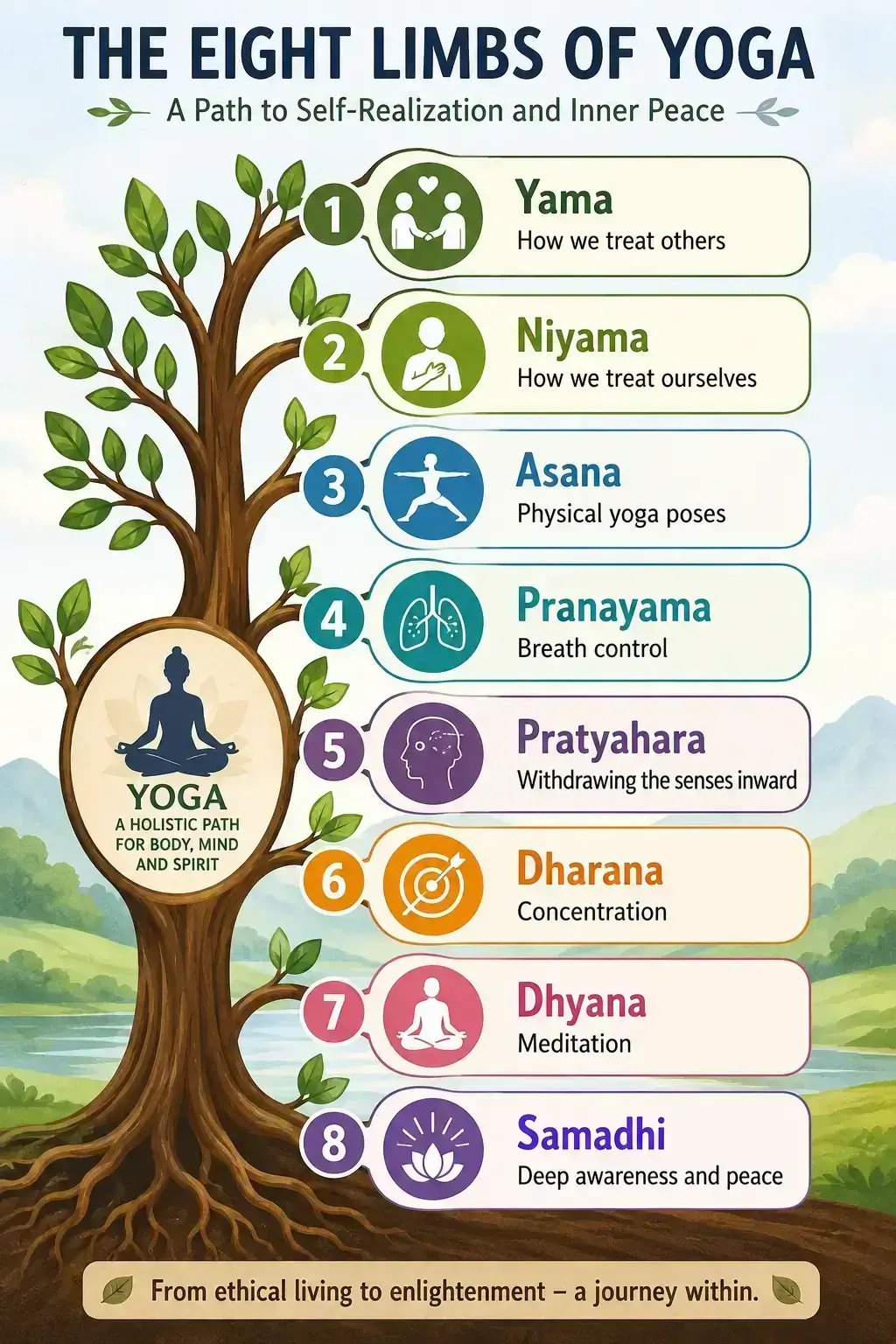
Now let's walk through each one.
Limb 1: Yama: How We Treat the World Around Us
Yama is basically a set of five ethical guidelines. Here, all five guidelines are given below:
- Ahimsa, or non-violence, is the first rule, which goes beyond not hitting someone or not punishing. It includes not hurting people with harsh words or abusing them and not being unkind to yourself either.
- Satya means truthfulness, both with others and with yourself, even when honesty feels uncomfortable also. You must remember your inner honesty policy
- Asteya is non-stealing, and this is not limited to only money. Wasting someone's time or taking credit for their ideas counts too. Anyone who is doing his/her work or any family members, he/she must kind to everyone in their surroundings.
- Brahmacharya which always asks us to use our energy wisely instead of getting pulled into every pleasure that comes our way. It means, if you face any situation, you must be determined with your positive energy, and always focus toward your goal.
- And Aparigraha, non-greed, is about not clinging to things, outcomes or people more than necessary.
Limb 2: Niyama: How We Treat Ourselves
If Yama looks outward, Niyama looks inward. These five personal habits help build a disciplined, content inner life.
- Shaucha means cleanliness, and cleanliness is not only physical, such as taking a bath. No, cleanliness means keeping calm and peace in your mind as well.
- Santosha is very common, and usually, this is the most difficult task for many people. But, for living happily, you all just need to be happy, whatever belongs to you.
- Tapas is self-discipline, the willingness to keep going even when motivation runs low.
- Swadhyaya means self-study, asking yourself honest questions like who you really are and what you actually want.
- And finally, Ishvara Pranidhana, surrendering to something greater than yourself, whether you call that God, the universe or simply a higher purpose.
Limb 3: Asana: The Limb Everyone Knows
Ask anyone what yoga means, and most people will picture someone bending into a pose. That's Asana, the third limb, and honestly, it's the one that gets the most attention in gyms and apps today.
But here's the part many people miss. Asana wasn't originally meant for fitness goals. In ancient times, it was practiced so the body could sit still and comfortable for long stretches of meditation. The Sanskrit word asana literally means "a seat." There are said to be over 84,000 yoga poses in total, though nobody seriously expects anyone to learn all of them. A handful, practiced with attention, is enough to build strength and stillness in the body.
Limb 4: Pranayama: Working with the Breath
Pranayama combines two words, prana (life energy) and ayama (control or expansion). In plain terms, it's the practice of breathing with awareness instead of letting it run on autopilot.
We take around 21,600 breaths a day, mostly without noticing a single one. Yet our breath and our mood are tightly linked. Notice how your breathing speeds up when you’re anxious, and slows right down when you're relaxed. Simple practices like alternate nostril breathing use this connection on purpose, calming the mind by first calming the breath.
Limb 5: Pratyahara: Pulling the Senses Inward
We live surrounded by notifications, noise and screens pulling our attention outward almost every second. Pratyahara is the practice of gently withdrawing from all that and turning attention back inside.
It doesn't need to be complicated. Closing your eyes for a few quiet minutes, or stepping away from your phone for a while, is pratyahara in action. This limb works like a bridge, preparing the mind for the deeper focus that comes next.
Limb 6: Dharana: Holding the Mind in One Place
Dharana means concentration, the act of fixing your attention on a single point and gently bringing it back whenever it wanders off, which it will, again and again. That's normal, not a failure.
People practice dharana in different ways, focusing on the breath, staring softly at a candle flame, or repeating a word or mantra. None of it needs to be fancy. The goal is simply training the mind to stay rather than scatter.
Limb 7: Dhyana: When Focus Becomes Effortless
Whenever you are trying to being concentrate on any work, wanted to focus on your goal, you must need Dhyana or meditation.
It's not about forcing the mind to be blank. It's about reaching a point where attention flows steadily, without strain, almost on its own.
While doing dhyana or meditation, a person stays aware, but not distracted, watching their own thoughts rather than getting swept up in them.
Limb 8: Samadhi: The Final Limb
Samadhi is the last and deepest limb, a state of complete absorption where the usual sense of "me" and "everything else" starts to fade. It cannot be rushed or forced into existence. It simply arrives, gradually, after sincere and steady practice of the limbs before it.
Quick Reference Table
| Limb | Sanskrit Name | What It Means |
| 1 | Yama | How we treat others |
| 2 | Niyama | How we treat ourselves |
| 3 | Asana | Physical yoga poses |
| 4 | Pranayama | Breath control |
| 5 | Pratyahara | Withdrawing the senses inward |
| 6 | Dharana | Concentration |
| 7 | Dhyana | Meditation |
| 8 | Samadhi | Deep awareness and peace |
Facts on International Day of Yoga
For students preparing for UPSC, SSC, banking or state-level exams, a few facts around Yoga Day often show up in current affairs sections:
-
Prime Minister Narendra Modi proposed June 21 as International Day of Yoga during his address to the UN General Assembly on September 27, 2014.
-
The United Nations General Assembly officially declared June 21 as International Day of Yoga on December 11, 2014.
-
The first International Day of Yoga was observed in 2015, and it is now marked in more than 190 countries.
-
June 21 was chosen because it is the summer solstice, the longest day of the year in the Northern Hemisphere.
-
International Day of Yoga 2026 is the 12th edition, with the theme "Yoga for Healthy Ageing." The main event for 2026 is being held in Kolkata.
-
The Ministry of Ayush runs a 100-day countdown campaign every year leading up to June 21, covering 100 cities and organisations.
Why are the Eight Limbs of Yoga Important Today?
Most of us reach for yoga only when stress builds up or the body feels stiff. But the eight limbs remind us that yoga was never meant to stop at the mat. Speaking honestly, staying content, breathing with awareness, even sitting quietly for five minutes, these are all yoga too.
This Yoga Day, instead of chasing the next pose, it might be worth picking just one limb and trying to live it for a week. That alone says more about yoga than touching your toes ever will.
The eight limbs of yoga were never meant to be rushed through like a to-do list. They grow together, the way the parts of a tree grow together, roots, trunk and branches all at once. As Yoga Day 2026 approaches, understanding these eight limbs gives us a fuller picture of what this ancient Indian practice was always meant to be, a complete way of living, not just a workout.
Prabhat Mishra is a Subject Matter Expert and digital journalist with an extensive background in the competitive exam landscape and over 4 years of experience in education, national and international news, and current affairs. Over his tenure with top knowledge platforms like Mentorship India, IAS BABA, IAS SARTHI, and now Jagran Josh, he has a deep understanding of government exams like UPSC and State PCS, including UP and Bihar, as he has already qualified for the UPPCS 2022 Mains and Bihar 68th Mains. With his core expertise in history, polity, geography & current affairs, he specialises in creating well-researched, aspirant-centric content and simplifying complex topics for competitive examinations.


