What is the Capital of Chile?
What is the Capital of Chile? The capital of Chile is Santiago which lies on the canalized Mapocho River. Read the article below to know the capital of Chile, its history, famous aspects, currency and population data.
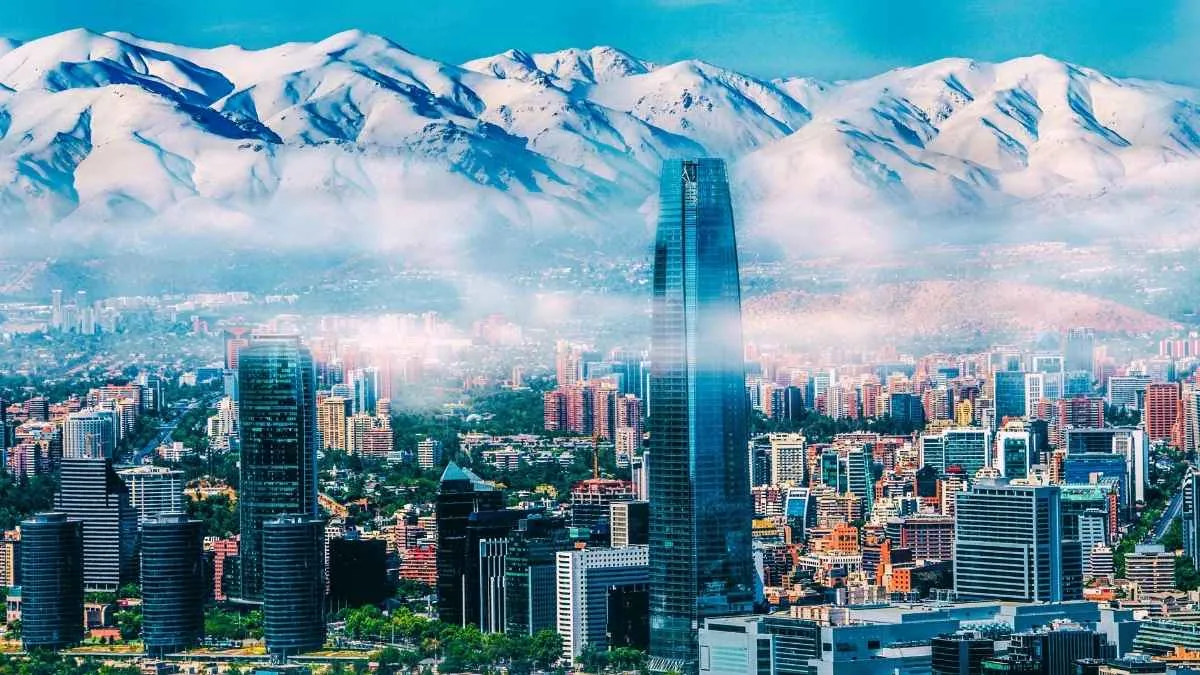
Chile is an elongated and narrow country located in South America, lying between the Andes Mountain range and the Pacific Ocean.
The country extends over 2700 miles, from Peru to South America’s Cape Horn. Chile is 110 miles wide, bounded by Peru and Bolivia on the north, Argentina on the east and the Pacific Ocean on the west.
Students wanting to learn about Chile, or candidates preparing for SSC, IBPS, and UPSC, should learn about the Capital of Chile. The capital of Chile is Santiago, also known as Santiago de Chile.
Chile capital, Santiago, is the largest city of Chile and lies on the canalized Mapocho River. It is also the most populous city, where the skyline is full of sleek and modern skyscrapers but views of high Andean peaks to the east.
What is the Capital of Chile?
Santiago or Santiago de Chile is the capital of Chile. It is the largest and most populous city of the country.
Santiago de Chile is located within the Central Valley of the country, surrounded on all sides by the towering snow-clad mountains of the Andes Mountains.
The capital of Chile, Santiago was established way back in 1541 AD by the Spanish Conqueror Pedro de Valdivia.
It is the capital of Chile because it acts as the political, cultural and economic hub of the country.
Why is Santiago, Chile Famous?
Santiago, Chile is famous for being a symbol of the colonial history of the country. It has a unique combination of state-of-the-art skyscrapers, scenic beaches along the coastside of the Pacific Ocean and clear view of Andes Mountains.
Santiago de Chile is the cultural capital of South America for having many well-known museums and arts areas.
Famous landmarks in the Capital of Chile include:
-
San Francisco Church (Iglesia de San Francisco) built in 1554, which is the oldest structure of the city.
-
Metropolitan Cathedral serves as the main cathedral of the Roman Catholic Church in Chile.
-
La Moneda Palace, also known as the “The Mint”, mainly constructed for mint for coin production but now serves as the Presidential residence and headquarters of several government ministries.
-
Cousiño Palace belonged to the wealthy Cousiño Goyenechea family who were known for their silver mines in the Atacama region of Chile.
-
The Gran Torre Costanera (completed 2014) is 984 feet tall, making it the tallest building of the city and also one of the tallest skyscrapers in Latin America.
What Currency is used in Santiago, Chile?
The official currency used in Santiago, Chile is the Chilean Peso. It is represented by the symbol $ or CLP$.
The official currency of the capital of Chile is regulated by the Central Bank of Chile which is located in the centre of Chile’s Capital.
What is the Population of Santiago, Chile?
The population of Santiago, Chile is estimated to be around 7 to 7.4 million citizens. Santiago’s population forms around 40% of the entire country’s population.
Below is the breakdown of population of Santiago de Chile:
-
Greater Santiago or the Urban Area has approximately 6.7 to 7 million residents.
-
Central Commune or the Santiago Centro is home to about 438,800 residents.
Conclusion
Santiago is the actual capital city of Chile, which is the final point in terms of history, politics, and economy of the country. The capital was established in 1541, and it has a population of about 7 million inhabitants using the Chilean Peso. These details should be remembered by students to help them succeed in world geography and economics exams.

Alisha Louis is a US content specialist with over 3 years of experience in journalism and storytelling. A graduate with a Bachelor’s degree in Journalism and Mass Communication (BJMC), Alisha has focused her career on covering trending news and major educational developments across the United States. Her sharp eye for detail, combined with a strong journalistic point of view, helps her break down complex American educational topics into accessible, engaging narratives for a global audience. Dedicated to delivering timely and trustworthy reporting, she brings a fresh and insightful perspective to the evolving US academic landscape.


