Show Key Points
Try to picture yourself living in a world where colors such as red and green are not bright but instead dull and dim. Sadly, there are some animals that are color blind, and are devoid of this natural phenomenon.
Being colour-blind simply means that these animals cannot see all the colors that humans can differentiate easily. According to a scientific journal article in PubMed, some animals, including dogs, cats, bulls, and sharks, are color-blind because they have few cone cells in their eyes.
Cone cells are essential for helping organisms see various colours, but having few of them limits the range, including blue, yellow, and even black and white. Rather than seeing the colors, these organisms use motion, light intensity, and sense of smell to survive.
List of 11 Animals that are Colour Blind
Let’s take a look at some common animals that have limited or color vision like humans. These animals rely mainly on movement, light, and other senses rather than color to survive in the world. Here is the list of some of the many colour blind animals on Earth:
| Rank | Name of Colour Blind Animal | Vision Category | Dominant Colors Perceived |
| 1 | Dog | Dichromatic | Yellow, Blue, Gray |
| 2 | Cat | Dichromatic | Blue, Yellow |
| 3 | Bull | Dichromatic | Yellow, Blue (No Red) |
| 4 | Shark | Monochromatic | Black, White, Gray |
| 5 | Seal | Monochromatic | Shades of Gray |
| 6 | Dolphin | Monochromatic | Grayscale (Uses Sound) |
| 7 | Horse | Dichromatic | Blue, Yellow |
| 8 | Rabbit | Dichromatic | Blue, Green |
| 9 | Raccoon | Monochromatic | Gray (Nocturnal focus) |
| 10 | Elephant | Dichromatic | Blue, Yellow |
| 11 | Owl | Monochromatic | Black and White |
1. Dog
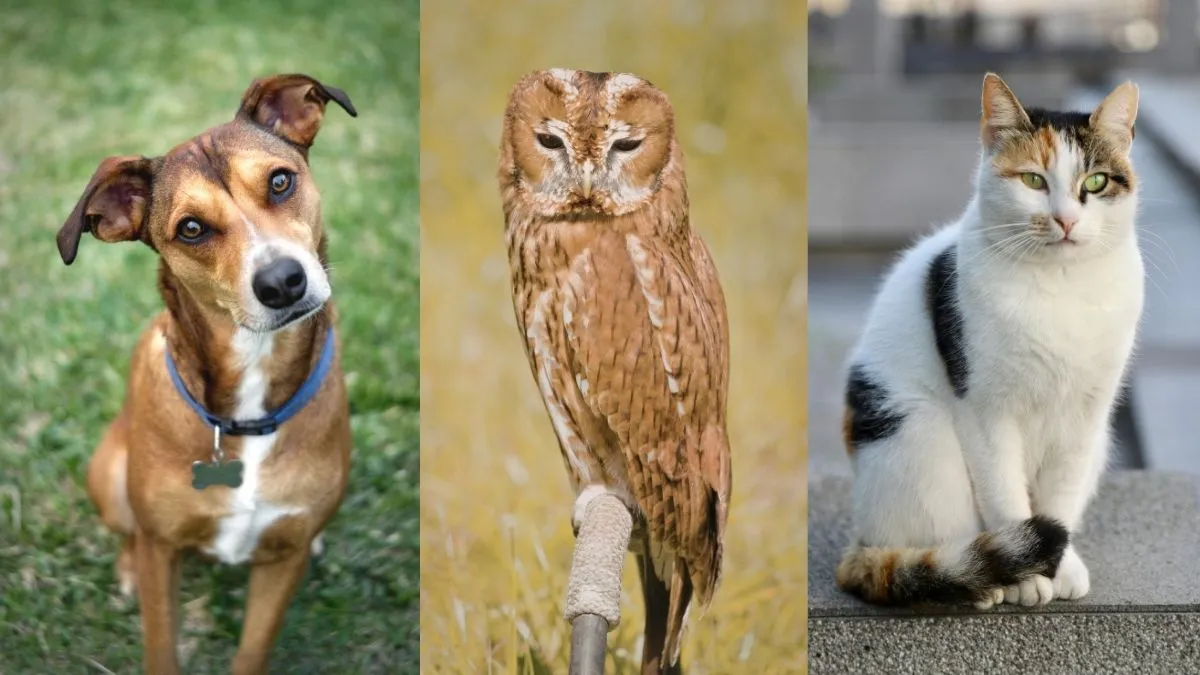
Dogs don’t have full-color vision. They can only perceive colors like blue and yellow, and shades of red and green appear dull and gray. They use motion and brightness to recognise objects rather than relying on color vision.
2. Cat
Like dogs, cats are unable to see many different shades of colors. They can only see the blue and yellow hues, just like dogs. An adaptation of a cat's vision allows them to hunt in the dark because of their enhanced ability to spot motion in low light.
3. Bull
Bulls do not dislike the color red; rather, it is a misconception. Bulls cannot distinguish between red and other colors. The response during a bullfight arises from movement perception, not any colors.
4. Shark
It is believed that sharks are colorblind, meaning they can only see in monochrome shades of black and white. It helps them detect movements and contrasting tones even in deep water.
5. Seal
Just like a shark, seals have very limited color vision. They cannot recognize most of the colors. As well as their color vision is limited to seeing shades of gray underwater.
6. Dolphin
Sound Over Sight. The dolphin is effectively color-blind and views the world in shades of gray. Because light doesn't travel well deep underwater, they have evolved to rely on echolocation, using sound waves, to "see" their surroundings and find food with precision.
7. Horse
Limited Pasture Palettes Horses possess a two-color vision system, meaning they can clearly see blue and yellow but are blind to red shades. This list of animals that are colour blind includes horses because their vision is tailored to detect movement across wide horizons rather than detail.
8. Rabbit
Vigilant Green-Blue Vision Rabbits have dichromatic vision, focusing mostly on blue and green shades. This limited range allows them to stay alert to predators. Their eyesight is specifically adapted to detect rapid changes in light or movement from almost any angle.
9. Raccoon
Nocturnal Gray Specialists. As primarily nocturnal creatures, raccoons are colour blind animals that see mostly in gray. Their eyes prioritize the "rod" cells that detect light, allowing them to navigate dark forests and suburban neighborhoods with ease during the night.
10. Elephant
Gentle Giants with Dull Vision Elephants have relatively poor color vision, perceiving mostly blue and yellow tones. They do not possess sharp eyesight and instead depend heavily on their powerful sense of smell and hearing to communicate and locate water sources.
11. Owl
High-Definition Grayscale The owl is a classic example of an animal that traded color for clarity. While they see only in black-and-white shades, their night vision is 10 to 100 times more powerful than a human's, making them the ultimate nocturnal predators.
Also Read - What is a Group of Owl Called?
Why Some Animals are Colour Blind?
Colour blindness in animals can be largely attributed to the structure of the eyes. The perception of colour requires the presence of specialized light-sensitive cells known as cones. Human beings have three types of cone cells, while animals like Dogs and Cats only have two.
Some animals, like sharks, may lack the cones entirely, thus being unable to see many colours. It can also be attributed to the adaptation of the species.
Animals like Owls, which spend most of their daytime sleeping and hunt at night, do not require the ability to perceive colour. Instead, their eyes have changed over time so that they can see light and movement better.
Check Out - List of Top 7 Animals that can Live Both on Land and in Water
The diverse visual systems across the animal kingdom highlight that "perfect" vision is a matter of survival needs. Whether it is a shark's grayscale focus or a dog's blue-yellow palette, these adaptations ensure that each species can master its environment. Understanding these visual limits offers a unique perspective on how life thrives beyond the human rainbow.



Comments
All Comments (0)
Join the conversation