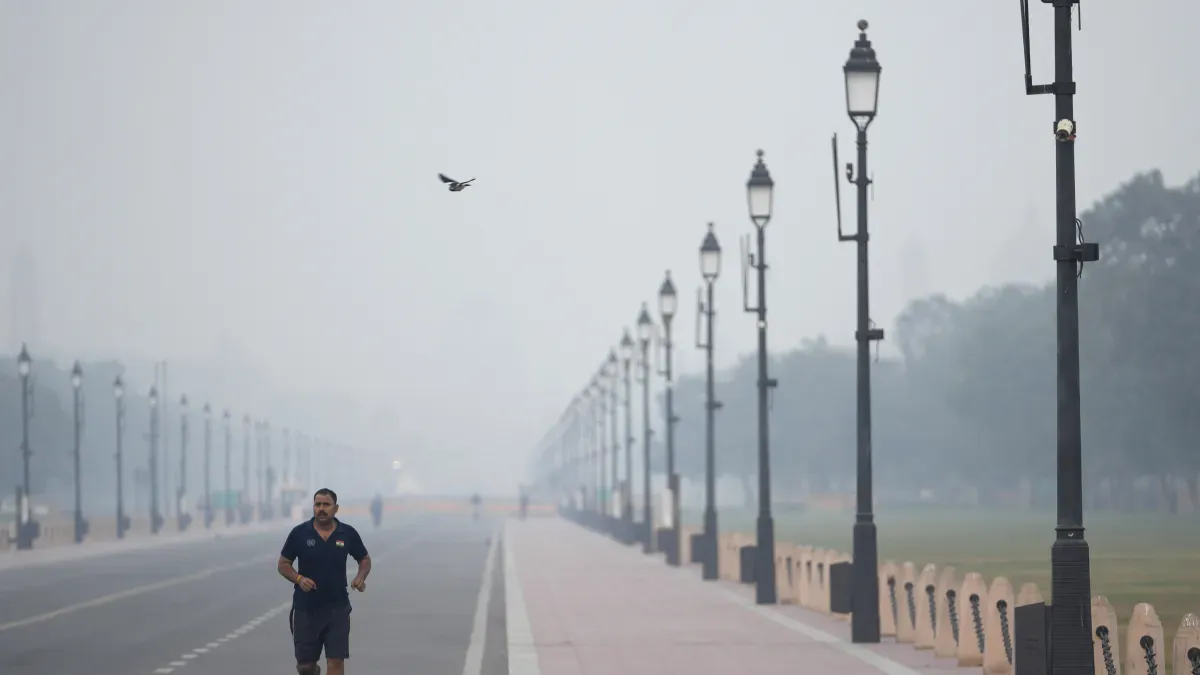
The Delhi government has initiated experiments on photocatalytic coatings with IIT Madras to address the problem of air pollution that is very severe, with the emphasis on the smog-eating surfaces on roads and buildings.
The project focuses on such major pollutants as nitrogen dioxide (NO2) and volatile organic compounds (VOCs) as the city's smog problems continue to persist.
What is the Initiative About?
A pilot study was signed on March 13, 2026, between the Delhi Environment Department and the IIT Madras in a Memorandum of Understanding (MoU) called Comprehensive Study on the Effectiveness of Photocatalytic Smog-Eating Surfaces. Environment Minister Manjinder Singh Sirsa stressed on identifying sustainable and cost-effective methods of implementing these coatings across the city rather than bans.
The project is based on the announcement in September 2025 of field trials, monthly updates, and the final report should be received in six months of the MoU.
How Does Technology Work?
The most common photocatalytic surfaces are based on titanium dioxide (TiO 2 ) which is a stable and cheap material and it is activated by sunlight to facilitate photocatalysis.
Passive purification of air and surfaces is carried out by dismantling of pollutants such as NO2 and hydrocarbons into harmless compounds such as water and CO2. It can be used on the road by spraying, in concrete/asphalt, or on roofs and streetlights panels.
Study Phases
-
The laboratory tests will begin in the smog chamber of IIT Madras to quantify the reduction of pollutants and then on the roads, pavements, buildings, metal and glass surfaces of Delhi, they will undergo field tests.
-
The Physics Department, IIT Madras, is headed by professor Somnath C Roy as the principal investigator who will determine the durability, efficiency, safety and cost.
-
Findings will inform the possible deployment in the high-pollution locations such as bus routes and markets in scale should it be successful.
Air Pollution Delhi Setting
Delhi experiences perennial smog caused by vehicle emissions, industry and weather with photochemical smog being the majorly experienced smog caused by sunlight reacting with NO₂ and VOCs.
Degrees tend to be over-safe, which affects health; this technology provides a 24x7 solution to the measures that are already in place.
This initiative is aligned with the environment action plan of the government that is to clean up urban air during the year-round.
Effective test projects would make the application on large scale during the peak winter smog reducing the gaseous pollutants throughout the heavy traffic areas. This can be achieved by implementing TiO2 on a large scale since it is compatible with infrastructure, which would enhance the level of public health and air quality. In searches no official government pronouncement was found, but the statements of ministers and details of MoU furnish official support.


-1774275151761_t.webp)


Comments
All Comments (0)
Join the conversation