

Key Points
- Schools must return to society, says Education Minister Dharmendra Pradhan
- Increasing public participation is a must in school management committees
- Nurturing the human capital for Viksit Bharat is a collective responsibility
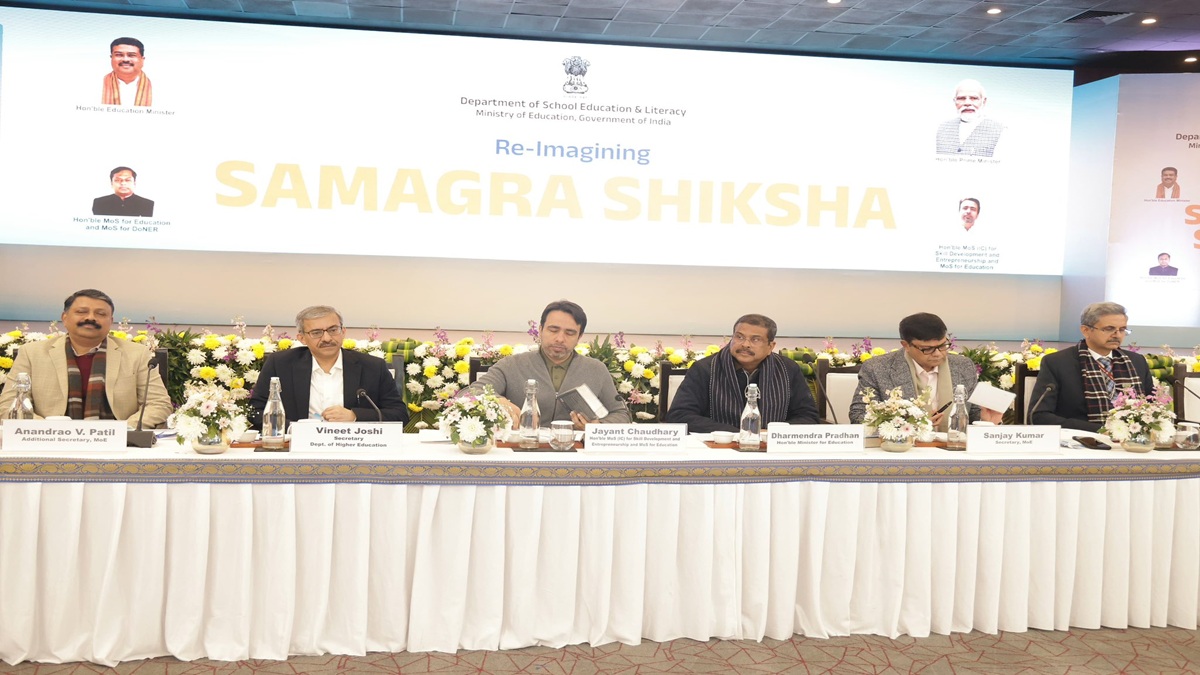
Samagra Shiksha: Union Education Minister, Dharmendra Pradhan, chaired a consultative meeting on January 9th with state governments and experts discussing the next phase of the Centre's Samagra Shiksha School Education Programme. The minister highlighted that it was essential to once again entrust schools to society so that the holistic development of students can be promoted and their access to knowledge can be expanded through meaningful integration of technology. The meeting was held in Delhi, co-chaired by Skills Development Minister Jayant Chaudhary, where discussions focused on best practices, emerging challenges and priority interventions needed to strengthen the school governance, infrastructure, teacher training and student entitlements.
Together with Shri @jayantrld ji co-chaired the Consultation Meeting for re-imagining Samagra Shiksha.
— Dharmendra Pradhan (@dpradhanbjp) January 9, 2026
Appreciate the enthusiastic participation and valuable suggestions of academic experts, senior officials of sectoral Ministries, @EduMinOfIndia and from the 11 participating… pic.twitter.com/E0CMSE3ijK
Samagra Shiksha is an integrated, centrally sponsored scheme for school education, which will include sections from pre-primary to senior secondary. The initiative was launched by Sarva Shiksha Abhiyan, Rashtriya Madhyamik Shiksha Abhiyan and Teacher Education Schemes, marking a shift towards a holistic and unified approach to school education. During the meeting, the education minister also suggested increasing public participation in school management committees while state representatives sought additional support for teacher training and capacity building as they faced difficulties achieving the state objectives of the ongoing second phase of the Samagra Shiksha Programme. Mr Pradhan also stated that while the salaries of teachers and systems should be the responsibility of the government, the operations of schools must be the responsibility of society.
“हमें स्कूलों को समाज को लौटाना होगा”
— Dharmendra Pradhan (@dpradhanbjp) January 9, 2026
'राष्ट्रीय शिक्षा नीति 2020' के क्रियान्वयन के पाँच वर्षों के उपरांत, वर्ष 2026-27 में हम 'समग्र शिक्षा' के एक नए प्रारूप की ओर बढ़ रहे हैं। आज हमारे सामने 'विकसित भारत' के अनुरूप शिक्षा व्यवस्था और मानव बल तैयार करना सबसे बड़ी चुनौती है।… pic.twitter.com/IMby81to2S
The Minister also added that five years after the implementation of the National Education Policy 2020, we are moving towards a new model of Samagra Shiksha preparation. He also pointed out that preparing an education system and human resources in line with Viksit Bharat is the biggest challenge.
“हमें स्कूलों को समाज को लौटाना होगा”
— Dharmendra Pradhan (@dpradhanbjp) January 9, 2026
'राष्ट्रीय शिक्षा नीति 2020' के क्रियान्वयन के पाँच वर्षों के उपरांत, वर्ष 2026-27 में हम 'समग्र शिक्षा' के एक नए प्रारूप की ओर बढ़ रहे हैं। आज हमारे सामने 'विकसित भारत' के अनुरूप शिक्षा व्यवस्था और मानव बल तैयार करना सबसे बड़ी चुनौती है।… pic.twitter.com/IMby81to2S
The Minister also stated that reducing learning gaps, drop-outs, improving learning and nutrition outcomes, capacity building of teachers, fostering design thinking and critical skills in every child, and bringing our Amrit Peedhi out of the Macaulay Mindset and nurturing a human capital for Viksit Bharat is a collective responsibility. He also added that focus must be give beying mere achievement of quality and equity and transform Samagra Shiksha from a board access scheme to an outcome-driven, quality-focused framework aligned with the objectives of NEP 2020. The minister also appealed to all academic experts, senior officials from sectoral ministries and participating States and Union Territories to create a holistic annual plan for the 2026-27 academic year



Comments
All Comments (0)
Join the conversation