Bar Council of India Orders Fresh Inspection of All Law Colleges, Gives Universities Six Weeks to Submit Reports


The BCI has directed universities to complete the entire exercise and submit a consolidated report within six weeks. It also warned that failure to carry out the inspections could affect the renewal of approval for law colleges.
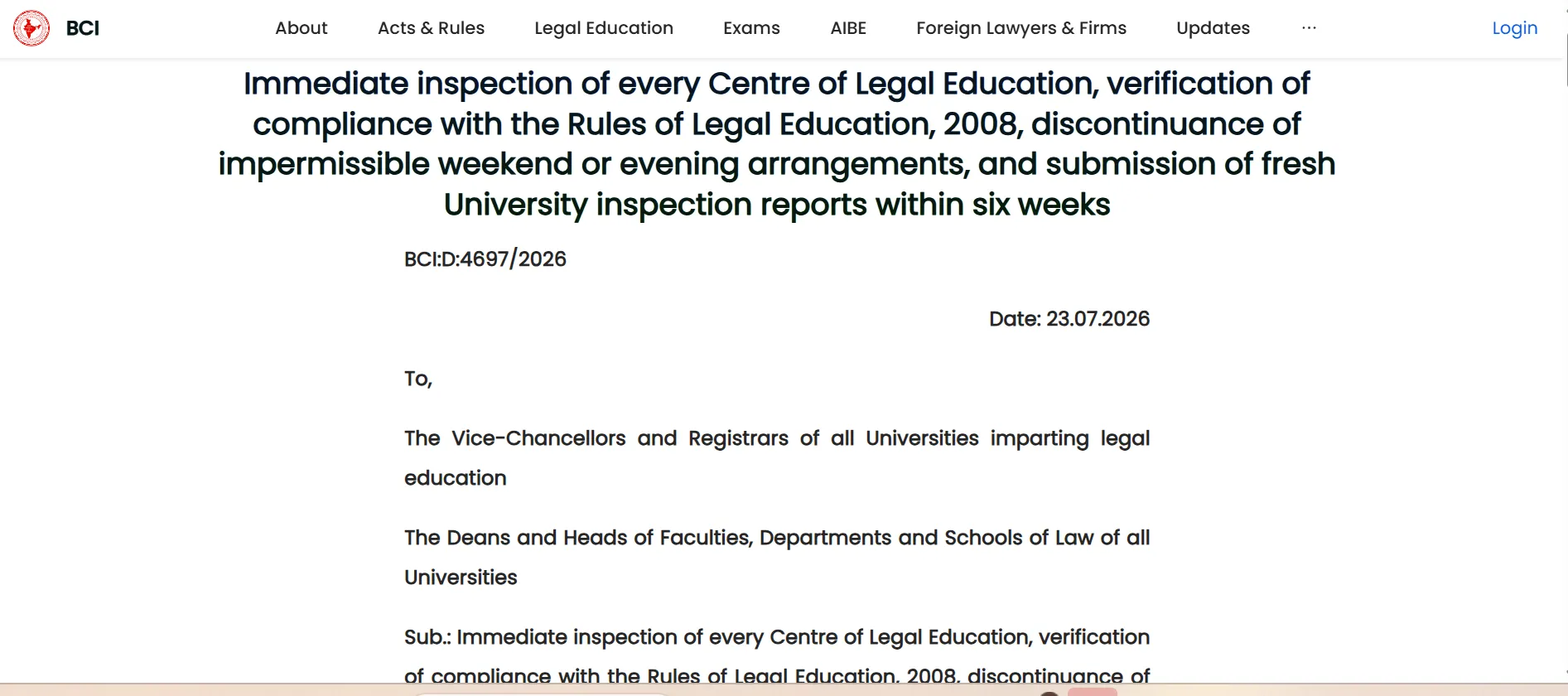
The Bar Council of India (BCI) has asked all universities offering legal education to carry out fresh inspections of every law college under their jurisdiction and submit detailed compliance reports within six weeks. The direction follows the Supreme Court’s reported oral observations in the K. R. Sudersan v. Bar Council of Tamil Nadu and Puducherry case, where concerns were raised over the quality of legal education and the functioning of deficient law colleges.
In a circular issued to vice-chancellors, registrars and heads of law departments, the BCI said universities cannot treat affiliation as a one-time exercise. It said they have a continuing responsibility to ensure that all constituent and affiliated law colleges comply with the Rules of Legal Education, 2008, and maintain the standards prescribed by the Council.
Inspection Teams To Visit Every Law College
The BCI has instructed universities to constitute inspection teams and physically visit every law college instead of relying on affidavits, photographs or documents submitted by the institutions. The inspections will cover classrooms, libraries, moot court halls, legal aid clinics, computer facilities, internet access, safety measures, sanitation and other infrastructure required under the rules.
Faculty Details, Shift Timings, Days To Be Assessed By BCI
The Council has also asked universities to carefully verify faculty details, including the presence of full-time teachers, their qualifications, appointment records, attendance, workload and salary payments. It reiterated that part-time or visiting faculty cannot be used as a substitute for the mandatory full-time core faculty.
Apart from infrastructure and faculty, universities have been told to check whether any law college is running weekend, evening or shift-based classes that do not meet the requirements of a regular law programme. According to the Rules of Legal Education, a regular law course must have at least five hours of teaching a day and a minimum of 30 working hours a week. The BCI has directed universities to stop any arrangement that violates these norms and not allow admissions to such programmes.
Deficiencies May Invite Affiliation Suspension Of Universities With BCI
If inspections reveal serious deficiencies in infrastructure, faculty, teaching hours or any other mandatory requirement, universities have been asked to initiate action to suspend or withdraw affiliation instead of granting routine approvals. They must also inform the BCI about cases involving false declarations, excess admissions, unapproved courses or other violations.
The BCI has directed universities to complete the entire exercise and submit a consolidated report within six weeks, classifying institutions as fully compliant, capable of immediate correction or seriously deficient. It also warned that failure to carry out the inspections could affect the renewal of approval for law colleges.
Sahil Behl is an education journalist at Jagran with over a year of experience in journalism. Prior to joining Jagran, he worked as a Sub-Editor in NDTV's Education department, where he was responsible for writing and editing education-related content as well as managing the department's social media presence. At Jagran, he covers a wide range of education topics, including board examinations, school updates, admissions, and job notifications, while leveraging his editorial expertise and strong understanding of digital content strategy.
Sahil holds a Bachelor's degree in Business Administration and has also completed an eight-month certification program in Data Science. Passionate about emerging technologies, particularly artificial intelligence, he closely tracks their growing role in journalism and explores how they are transforming shaping the future of the media industry.

![Kerala SAY +2 Result 2026 LIVE: [Link Active] Class 12 HSE Marks Memo Released; Check School-Wise Results at results.kite.kerala.gov.in](https://img.jagranjosh.com/images/2026/July/2572026/Kerala+2SAYResult2026out.webp)
