Show Key Points
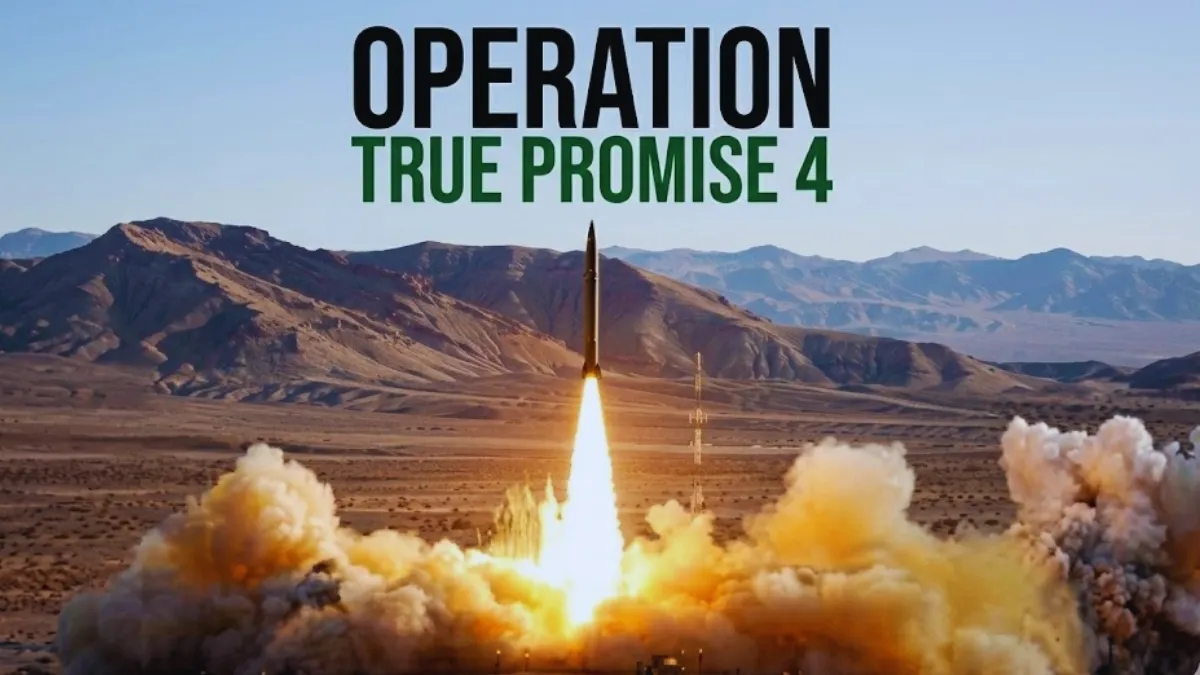
Operation True Promise 4: on February 28, 2026, It is a military operation launched by Iran amid rapidly escalating tensions in the Middle East., the operation was carried out by Iran’s Islamic Revolutionary Guard Corps (IRGC) as a massive retaliatory response to "Operation Epic Fury" (U.S.) and "Operation Lion’s Roar" (Israel). These joint strikes targeted Iranian nuclear sites, military infrastructure, and leadership, reportedly resulting in the death of Supreme Leader Ali Khamenei.
Operation True Promise 4 has intensified geopolitical concerns across West Asia and the Middle East by targeting U.S. naval bases, regional airfields, and Israeli cities, the IRGC has signaled a multi-front shift in the conflict. This guide breaks down the objectives, targets, and global economic consequences of this developing military campaign.
What Is Operation True Promise 4?
Operation True Promise 4 is the official codename for the Islamic Revolutionary Guard Corps (IRGC) massive 2026 missile and drone offensive against the United States and Israel. Launched on February 28, 2026, this operation serves as a direct retaliatory strike following the joint U.S.-Israeli campaign known as Operation Epic Fury and Operation Lion’s Roar.
This mission involves multiple waves of high-precision ballistic missiles and advanced suicide drone swarms like Shahed-238. It is characterized by a "no-red-line" strategy, expanding its geographical scope beyond the occupied territories to target strategic U.S. military installations across the West Asia region.
Who Launched Operation True Promise 4?
The operation was launched by the Islamic Revolutionary Guard Corps (IRGC), the branch of the Iranian Armed Forces. The IRGC’s aerospace division is the primary actor, utilizing advanced Qadr-380 missiles and long-range suicide drones. The Iranian Ministry of Defense has stated that the operation is a homeland defense mission supported by the regular army (Artesh) to repel U.S. and Israel aggression.
Why Did Iran Launch Operation True Promise 4?
The primary driver for Operation True Promise 4 was the February 28, 2026, joint assault by the U.S. and Israel.
-
Retaliation for "Operation Lion’s Roar": Israel launched pre-emptive strikes on Tehran and Isfahan to disrupt Iran's nuclear program.
-
Response to "Operation Epic Fury": The U.S. military engaged in "regime disruption" strikes targeting IRGC command centers.
-
Leadership Assassination: Reports of the death of Supreme Leader Ali Khamenei during the initial strikes triggered an immediate "all-out" retaliatory protocol from Tehran.
What Were the Targets of Operation True Promise 4?
The IRGC expanded its target list to include both Israeli territory and U.S. strategic assets in neighboring countries:
-
U.S. 5th Fleet Headquarters (Bahrain) a primary target for Iranian missile volleys.
-
Al Udeid Air Base (Qatar), reports indicate the destruction of an FP-132 radar system.
-
Israeli Cities, major strikes were reported in Tel Aviv, Haifa, and Ashdod, with over 220 missiles launched in the first 24 hours.
-
Regional Logistics like Abdullah Al-Mubarak Air Base (Kuwait) and Prince Sultan Air Base (Saudi Arabia) were targeted to disrupt U.S. supply lines.
Countries Involved in the Escalation
The conflict has moved beyond a bilateral struggle, involving several regional players:
-
Iran: The primary initiator of the counter-strike.
-
United States & Israel: The primary targets and initiators of the pre-emptive campaign.
-
Gulf Cooperation Council (GCC): Countries like Qatar, Bahrain, Kuwait, and the UAE have seen their airspace violated or their facilities hit.
-
Jordan: Intercepted several projectiles passing through its airspace toward Israel.
-
Yemen (Houthis): Announced renewed attacks on Red Sea shipping in solidarity with Tehran.
Impact on Global Oil Prices and West Asia
The economic shockwaves of Operation True Promise the immediate impoactsw:
-
Strait of Hormuz: Iran has threatened to close this vital chokepoint, through which 20% of the world's oil flows.
-
Oil Prices: Global crude prices spiked as shipping firms (including Japan's Nippon Yusen) halted operations in the region.
-
Aviation: Major carriers like Air India have cancelled dozens of international flights due to unsafe regional airspace.



Comments
All Comments (0)
Join the conversation