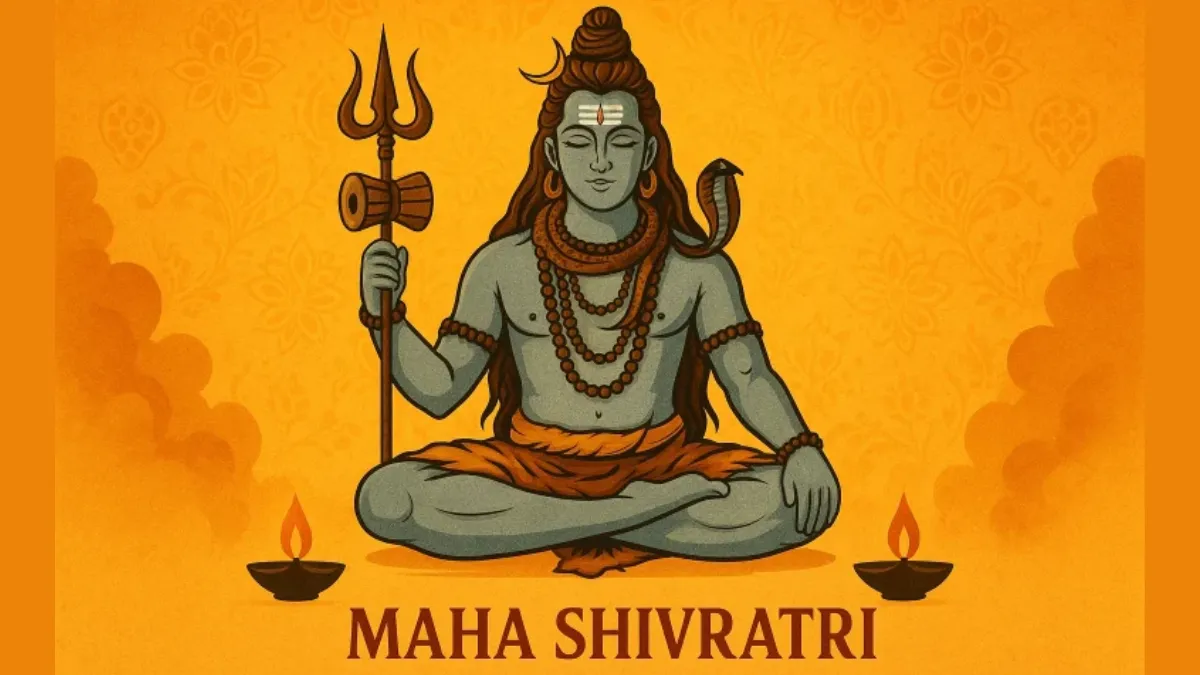
Mahashivratri is celebrated on the 14th (Chaturdashi) of the waning moon (Krishna Paksha) in the month of Phalguna (February-March). On February 15, 2026, it will be celebrated in New Delhi. Celebrations involve night long vigils and fasting in Shiva temples.
How Did Mahashivratri Originate?
The Mahashivratri is mentioned in the old puranas like the Shiva purana, linga purana and the skanda purana. The Shiva Purana (Koti Rudra Samhita) tells of a hunter by the name Gurudruha (or Lubdhaka) who by chance dropped bilva leaves on a Shiva linga and caused Shiva to appear.
This is dated to Puranic composition periods of about 8th-10th centuries CE, and later in 15th-century texts such as Siwaratrikalpa. The other source is associated with the manifestation of Shiva in the form of an unending blaze lingam (jyotirlinga) at dusk to end a conflict between Brahma and Vishnu.
Why is Mahashivratri Celebrated?
It is celebrated in the memory of the marriage of Shiva to Parvati, according to the legends in Shaivite sources. It is also an indication of the cosmic Tandava dance of Shiva which symbolizes the process of creating, preserving and destroying.
A third one is Shiva drinking the halahala poison when the ocean was churned by the Samudra Manathan and painted his throat blue (Neelkantha). These Puranic descriptions are the foundation with subsequent interpolations.
Forms of Shiva
Shiva is described as Astamurti, comprising eight forms (Ashta Murti) in texts like the Yajurveda and Shiva Purana. The forms are:
-
Sarva (earth element)
-
Bhava (water)
-
Rudra (fire)
-
Ugra (air)
-
Bhima (sky)
-
Pashupati (sun)
-
Ishana (moon)
-
Mahadeva (sacrificer or human)
These elemental associations link to the five gross elements (pancha mahabhuta) plus sun, moon, and sacrificer.
12 Jyotirlingas in India
The 12 Jyotirlingas are self-manifested lingas listed in the Shiva Purana's Śatarudra Saṁhitā (Chapter 42).
They originated from Shiva appearing as an infinite pillar of light to demonstrate supremacy over Brahma and Vishnu. Devotees visit these sites year-round, with increased activity on Mahashivratri.
| No. | Jyotirlinga Name | State | District/Location |
| 1 | Somnath | Gujarat | Gir Somnath, Prabhas Patan |
| 2 | Mallikarjuna | Andhra Pradesh | Srisailam, Nandyal |
| 3 | Mahakaleshwar | Madhya Pradesh | Ujjain |
| 4 | Omkareshwar | Madhya Pradesh | Khandwa (Mamaleshwar) |
| 5 | Baidyanath | Jharkhand | Deoghar |
| 6 | Bhimashankar | Maharashtra | Pune |
| 7 | Ramanathaswamy | Tamil Nadu | Rameswaram, Ramanathapuram |
| 8 | Nageshwar | Gujarat | Dwarka |
| 9 | Kashi Vishwanath | Uttar Pradesh | Varanasi |
| 10 | Trimbakeshwar | Maharashtra | Nashik |
| 11 | Kedarnath | Uttarakhand | Rudraprayag |
| 12 | Grishneshwar | Maharashtra | Chhatrapati Sambhaji Nagar |
Mahashivratri aligns with Phalguna Krishna Chaturdashi tithi, starting at sunset and lasting through the night. It differs from the 12 monthly Shivaratris observed on each Krishna Chaturdashi.
Common practices involve offerings of bilva leaves, milk, and water to lingas, based on the hunter legend. No specific scriptural mandate for rituals exists beyond vigil (jaagran).
GK Quiz on Krishna Janmashtami




Comments
All Comments (0)
Join the conversation