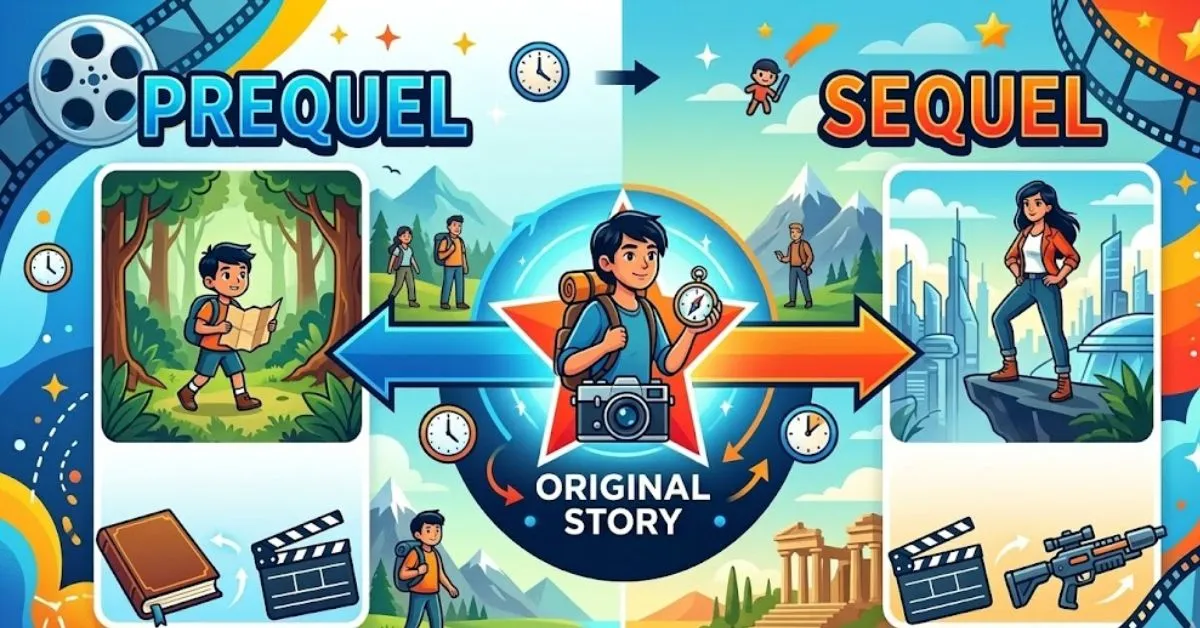
Language may be confusing in some cases whereby two words that seem to be alike and reflect related meanings, but used in different circumstances.
The words, Prequel and Sequel would be the best illustrations to present this. Both are widely used in the narration especially in films, television series and novels. However, they refer to different events in a narration.
The awareness of the differences between the two can guide the readers and the viewers to gain the insight as to how the stories grow with a greater impact as time passes.
What is the Origin of These Words?
The word Sequel has its name due to a Latin word, sequi, which means follow according to Online Etymology Dictionary. It is a centuries-old English word that is used in defining something that completes another event or story.
The Online Etymology Dictionary mentions: "consequence of an event or action, a corollary; that which follows and forms a continuation," from Old French sequelle, sequele (14c.) and directly from Late Latin sequela "that which follows, result, consequence," from sequi "to follow, come after, follow after, attend, follow naturally"
Prequel is a more modern adaptation of the pre-words, meaning before. It was used within the 20th century especially in the film industry to denote the published stories that are part of a former chronology of the narration under consideration.
The term prequel is a more up-to-date modification of pre, which means before, and sequel. This came into usage in the 20th century, particularly in the film industry to refer to the released stories that belong to a past timeline of the story that is being told.
Prequel vs. Sequel: Key Differences
On the outside, the two terms may appear to have a relationship to one another as they simply evolve an already existing story. However, the difference is in the time of events depicted in the story. Here is a simple comparison:
| Aspect | Prequel | Sequel |
| Meaning | A story precedent to the original story | A story consequent to the original story |
| Timeline | Previous events in the plot | Subsequent events in the plot. |
| Purpose | Explain the back story | Continues the story and shows what happens next |
| Release Order | Usually released after the original story | Published after the life of the original story |
| Example | A film showing the childhood of a main character | A film showing the character’s life after the first story |
What is a Prequel?
One that builds up on events that came before the original plot is known as a prequel. Even though it was published later than the main story, it shows what has already been said in the story plot.
Prequels may be created to offer the audience a more in-depth understanding of the characters, their motifs, or the theme of the major events.
There are various filmmakers and writers who apply prequels to increase the fictional universe and which answers those questions that may have been left to the audience post viewing the original narrative.
Different filmmakers and writers have been applying the usage of prequel with the intention of expanding the fictional universe and which may respond to the questions that may have been left to the audience after watching the original story.
What is a Sequel?
The Sequel is the story of the first work. It reveals the destiny of the characters and the world once the first story is done.
Films, novels and major television series are quite fond of sequels as the authors have a chance to develop an efficient plot.
To conclude, it is quite simple that both prequels and sequels develop a story, though they go in different directions in the sequence.



Comments
All Comments (0)
Join the conversation