Who is known as the Father of Surgery?
Who is known as the Father of Surgery? Learn about Maharishi Sushruta, his life, the Sushruta Samhita, surgical innovations, and contributions to modern medicine and Ayurveda.

Recently, a bronze statue of Maharishi Sushruta, who is widely recognised as the “Father of Surgery”, was unveiled at the prestigious Royal College of Surgeons of Edinburgh, the capital city of Scotland, in the United Kingdom.
The 90-kg statue of Maharishi Sushruta was created traditionally using the lost-wax method, one of the oldest techniques, made at Swamimalai in Tamil Nadu, with the help of Ragavanantham Sthapathi and his team.
Let’s explore in detail about the Maharishi Sushruta, the father of Surgery.
About Maharishi Sushruta, the father of Surgery
Maharishi Sushruta, known as the Father of Surgery, was a pioneering figure in ancient Indian medicine.
Around 600 BCE in the historical town of Kashi (now Varanasi), he flourished with many holistic techniques in different fields of medicine, including Shalya Tantra, which is a surgical science, anatomy, beauty and reconstructive surgical treatment, gynaecology, ophthalmology, orthopaedics, traumatology, and pharmacology.
Early Life & Education
He was born in the 6th century BCE and is widely recognised as the “Golden Age of Indian Medicine” in the town of Kashi.
As per the National Library of Medicine, Maharishi Sushruta was the disciple of the God of Ayurveda, Lord Dhanwantri.
In ancient India, medicine was traditionally taught through “Guru Shishya Parampara”, where knowledge was passed from the teacher to his student orally.
His education was deeply rooted in the traditional way of Ayurveda, which is called the science of life. These types of practices help him to balance the body, mind and spirit.
Foundation of Sushruta’s Surgical Mastery and Innovation
With his great contribution in the field of surgery, like cataract surgery and rhinoplasty, with the treatment of fractures, he pioneered in the art of suturing.
His mastery in surgery and innovations are given in “Sushruta Samhita".
About Sushruta Samhita
Sushruta Samhita was composed over 2500 years ago, and it contained a detailed instruction manual of surgery and medicine.
It was composed of 184 chapters and more than 300 surgical procedures. Under this samhita, there are 121 surgical instruments.
Under this, there are 6 types of blunt instruments and 20 types of sharp instruments.
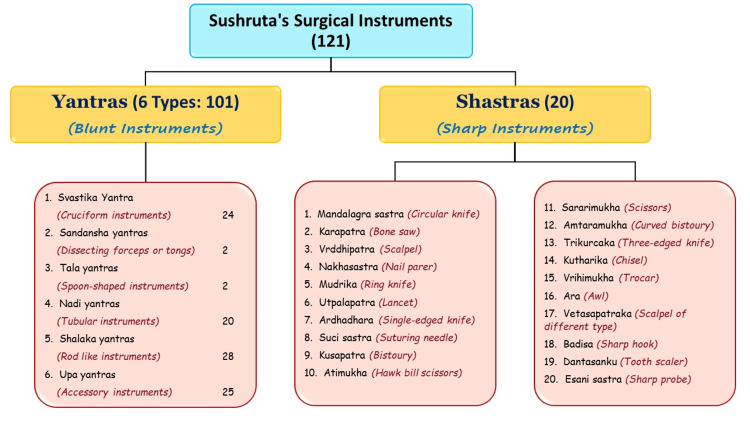
Source: pmc
With all these, Sushruta Samhita also provides details on toxicology, pediatrics, pharmacology, and many other branches of indian traditional medicine, which is also known as Ayurveda.
He had also developed many unique and traditional operations like, such as rhinoplasty (the repairing or remaking of nose), or removal of dead fetus.
His systemised and detailed surgical mastery gave a new future in the medical era. His approach toward the surgery, use herbal, and post-operative cares always been the foundation of surgical practices.
His surgical techniques and surgical instruments is spread not only in India, but also in the world, which helps in the shaping of reconstructive surgery, orthopaedics, ophthalmology, and many other fields in the medical science.
Prabhat Mishra is a Subject Matter Expert and digital journalist with an extensive background in the competitive exam landscape and over 4 years of experience in education, national and international news, and current affairs. Over his tenure with top knowledge platforms like Mentorship India, IAS BABA, IAS SARTHI, and now Jagran Josh, he has a deep understanding of government exams like UPSC and State PCS, including UP and Bihar, as he has already qualified for the UPPCS 2022 Mains and Bihar 68th Mains. With his core expertise in history, polity, geography & current affairs, he specialises in creating well-researched, aspirant-centric content and simplifying complex topics for competitive examinations.


