Show Key Points
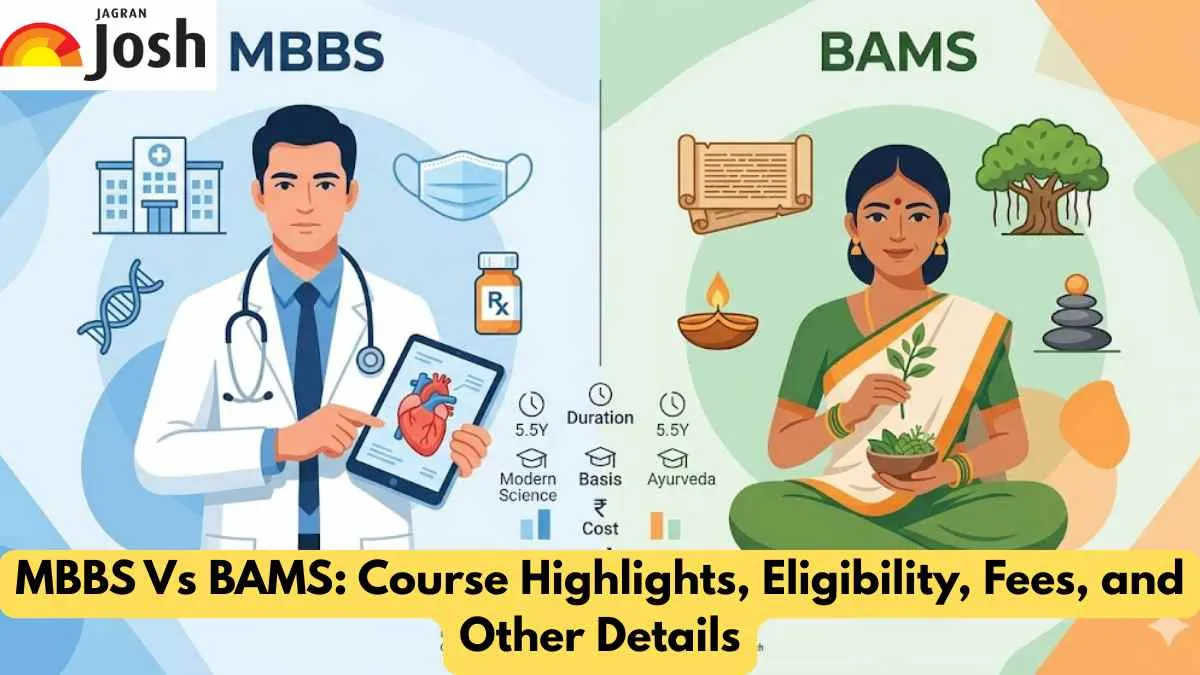
MBBS vs BAMS: For those who want to become doctors, choosing between MBBS (Bachelor of Medicine, Bachelor of Surgery) and BAMS (Bachelor of Ayurvedic Medicine and Surgery) is a crucial decision because both programs provide different approaches to healing. Modern allopathy is the foundation of MBBS, which emphasizes complex surgery, medication therapies, and evidence-based clinical diagnosis. It is the gold standard for people who want to specialize in neurology or cardiology or work in high-intensity hospital settings.
BAMS, on the other hand, is based on Ayurveda, an ancient holistic system that prioritizes natural remedies, lifestyle modifications, and preventive care. For people who are enthusiastic about ancient wisdom and long-term wellness, BAMS practitioners, also known as Vaidyas, treat the underlying causes of illnesses by balancing the body's internal energies.
The disparities in logistics are similarly striking. The financial commitment and competitive pressure differ, even though both programs last 5.5 years and require an internship. In private schools, MBBS can command outrageous tuition fees ranging from ₹10 lakhs to over ₹25 lakhs per year, and it usually requires a much higher NEET-UG percentile. In terms of cut-off scores, BAMS is typically more accessible and has a more reasonable cost schedule.
In terms of employment, MBBS graduates frequently experience greater starting earnings and international mobility, but BAMS graduates are seeing an increase in demand as a result of the government's AYUSH programs and the global shift toward integrative medicine. In the end, the "better" path will depend on whether your concept of healthcare incorporates the holistic, tried-and-true art of Ayurvedic rehabilitation or contemporary surgical precision.
MBBS Vs BAMS: Course Highlights
Choosing between MBBS and BAMS is a significant decision that depends on your interest in modern allopathic medicine versus traditional Ayurvedic healing. Both are respected undergraduate degrees in India, but they differ greatly in their approach, cost, and career trajectories.The following table summarizes the core highlights for both courses to help you compare them side-by-side:
| Feature | MBBS (Bachelor of Medicine, Bachelor of Surgery) | BAMS (Bachelor of Ayurvedic Medicine and Surgery) |
|---|---|---|
| Core Focus | Modern Allopathic Medicine, Clinical Surgery, and Pharmacology | Ayurveda, Herbal Medicine, Holistic Healing, and Yoga |
| Duration | 5.5 Years (4.5 Years Academics + 1 Year Internship) | 5.5 Years (4.5 Years Academics + 1 Year Internship) |
| Eligibility | Class 12 (PCB) with 50% (Gen) or 40% (Reserve) | Class 12 (PCB) with 50% (Gen) or 40% (Reserve) |
| Entrance Exam | NEET-UG (High Cut-off) | NEET-UG (Moderate to High Cut-off) |
| Key Subjects | Anatomy, Biochemistry, Pathology, Surgery, Pediatrics | Rachana Sharira (Anatomy), Kayachikitsa, Panchakarma, Shalya Tantra |
| Avg. Govt Fees | ₹5,000 – ₹50,000 per year | ₹10,000 – ₹40,000 per year |
| Avg. Private Fees | ₹10 Lakhs – ₹25 Lakhs per year | ₹2 Lakhs – ₹6 Lakhs per year |
| Starting Salary | ₹6 Lakhs – ₹12 Lakhs per annum | ₹3.5 Lakhs – ₹7 Lakhs per annum |
| Career Scope | Surgeon, Physician, Medical Officer, Scientist | Ayurvedic Doctor, Wellness Consultant, Research Officer |
MBBS Vs BAMS: Eligibility and Fees
-
To apply for either course, candidates must have passed their Class 12 board examination with Physics, Chemistry, and Biology as compulsory subjects from a recognized educational board in the country.
-
For the General category, a minimum of 50% aggregate in PCB is required, while SC, ST, and OBC candidates need 40% to meet the essential qualifying criteria for medical admission.
-
Applicants must be at least 17 years old by December 31, 2026, and must qualify for the NEET-UG entrance exam, which serves as the mandatory single gateway for all medical admissions.
-
Because MBBS government college costs are so low, typically between 5,000 and 1,000,000 rupees per year, these seats are quite competitive for students seeking an affordable, top-notch modern medical education.
-
Private MBBS schools, on the other hand, charge far more tuition, typically between 10 and 25 lakhs annually, which can result in a total course cost of more than one crore rupees.
-
Private Ayurvedic colleges usually charge between 2 lakhs and 5 lakhs per academic year, whereas government institutions charge between 10,000 and 50,000 rupees.



Comments
All Comments (0)
Join the conversation