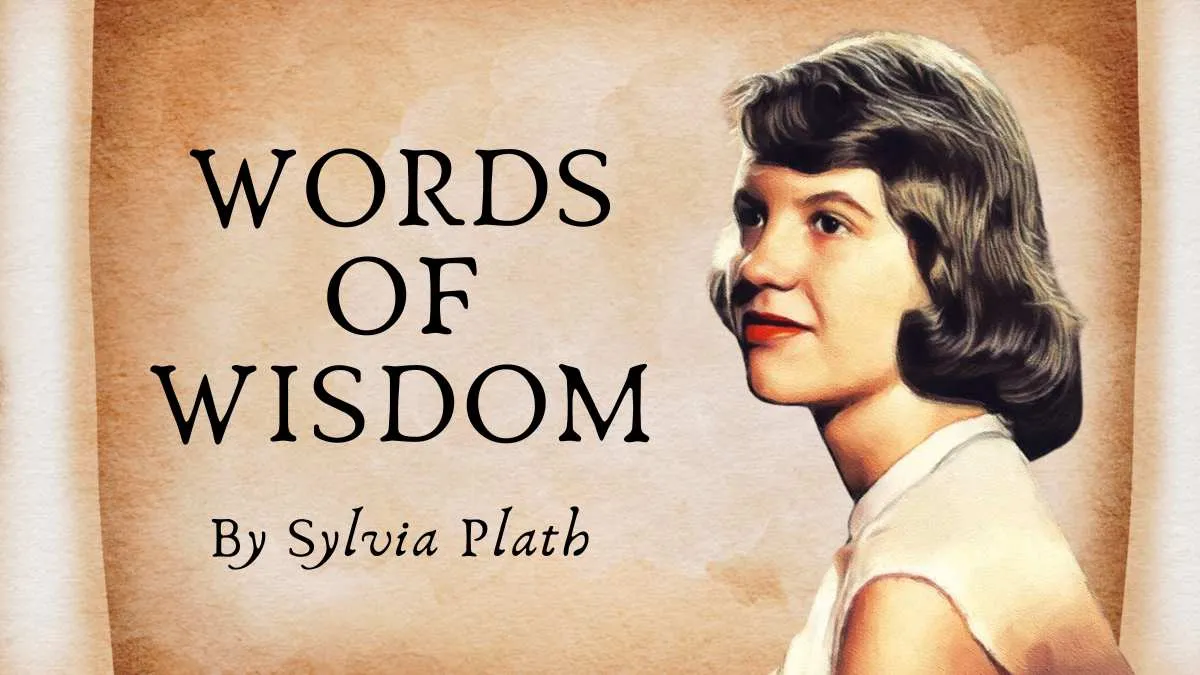
Your Words of Wisdom for Today is a chance to take a break and think about a quote that has a meaning beyond just a single sentence.
As we race through our work days from one thing to another, we rarely take the time to examine the emotions and ideas that create our emotional landscapes.
Sometimes, one line of wisdom can provide just as much or even more insight into a situation than lengthy explanations can provide clarity where there was once confusion and provide perspective where there was once none.
Today's quote was chosen specifically because it encourages slow thoughtfulness regarding what it communicates about desire, emptiness, and human emotion.
Take the time to reflect upon its meaning, sit with it, and notice how it relates to your own experience and understanding of life.
Check Out: Personality Test: Pick a Key to Discover Your Problem-Solving Approach
Words of Wisdom For the Day by Sylvia Plath
Today’s Words of Wisdom provide thoughtful comments for pause and reflection in the hurried pace of our daily lives; thoughtful comments can help provide clarity, inspiration and perspective.
Read this one line and take some time to read the lines after that to reflect on his comments. Consider how they can help you through your day tomorrow.
“Perhaps when we find ourselves wanting everything, it is because we are dangerously close to wanting nothing.”
Words of Wisdom by Sylvia Plath Explained
Sylvia Plath's quote illustrates the duality of want and finding one's self empty. The person who is longing for all the good things like success, love, experience, meaning has an intense desire to get them.
However, this may be the result of dissatisfaction internally. This desire may also represent an internal void or a lost direction.
If one is trying to fill the empty feeling with material or other outside elements, the more unfulfilled they may become.
That may mean an abundance of wanting is not a solution or answer, but rather a potential warning sign of ethereal or internal issues that should be reflected on, examined, and reconnected to that which is truly vital.
Interesting Facts About Sylvia Plath

Here are five noteworthy facts regarding Sylvia Plath:
1. Exceptional Writer Early On
At a very early age, Sylvia Plath began producing poetry and short stories.
By the time she reached her teenage years, she had begun to publish works in magazines, receive accolades, and show remarkable ability and ambition prior to her entry into professional writing.
2. Awarded Posthumously
After her death in 1963, Sylvia Plath received the Pulitzer Prize for Poetry in the category of Collected Poems (1982).
Due to her accomplishments, she is regarded as one of the best poets in the 20th century, though her works received widespread acclaim only after her passing.
3. Author of the Bell Jar
The Bell Jar is Plath's lone novel (1963), but its content is semi-autobiographical.
Plath had originally published The Bell Jar under the name of "Victoria Lucas," and it has since become an emblematic example of contemporary literature.
4. Studied at Cambridge and Received Fulbright Scholarship
Plath attended Smith College in the United States and enrolled at Cambridge University in England, using a Fulbright Scholarship.
While in England, Plath met and eventually married poet Ted Hughes, whose influence was significant to both her personal and literary development.
5. Importance of Personal Journals
Her many journals and letters give great insight into her inner thoughts, feelings, and creative processes.
Published after her death, these works have been extensively studied for the great depth and complexity of her poetry and their roots in the overlay of a very personal and introspective worldview.