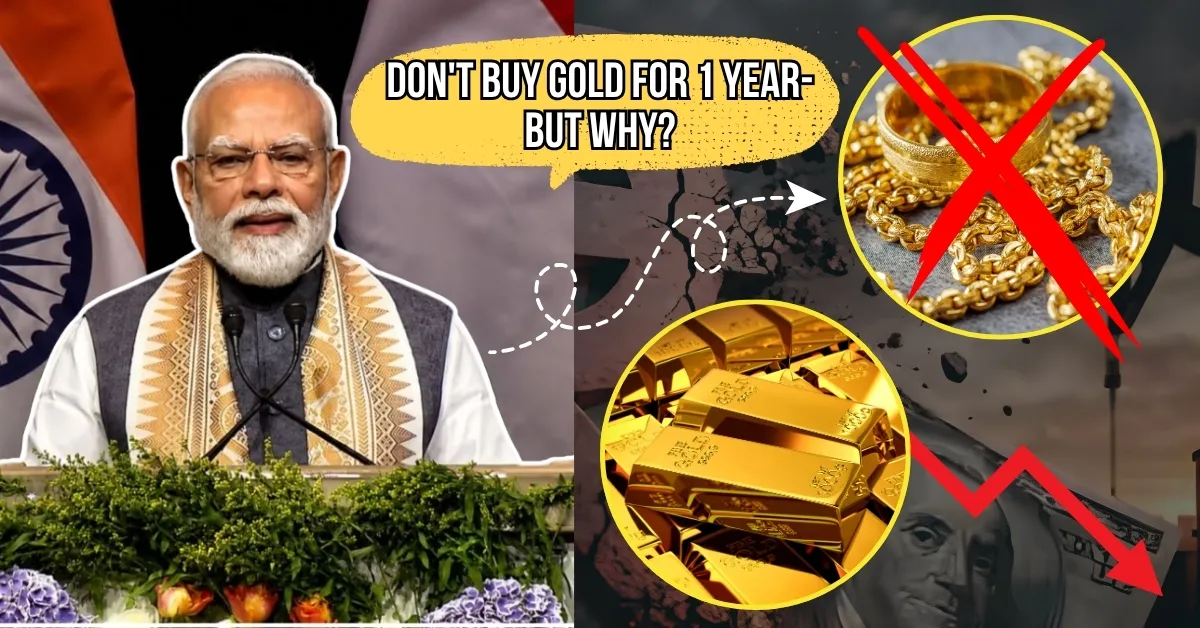
Why Has PM Modi Asked Indians Not to Buy Gold For 1 Year? What Does It Mean For India's Economy?
Amid geopolitical crises and surging oil costs, PM Modi urged a one-year gold moratorium to conserve vital foreign-exchange reserves. Since India imports 90% of its gold in US dollars, pausing purchases protects the economy and stabilises the rupee.
Have you ever wondered why there are so many valuable elements present on Earth, like silver, diamonds, platinum, rhodium, lithium, uranium, and more – even metals far rarer than gold – yet gold is still above them all?
The reason why gold is king is that when a country is experiencing inflation or under geopolitical or economic instability, it can trade its gold for instant trust and stability when its own paper money becomes worthless.
When things go sideways—think runaway inflation or war—gold is the one thing that doesn't lose its value overnight. Gold is the only currency universally accepted by every nation and central bank on Earth.
If a country's in trouble, it can swap or pawn its gold stash to get its hands on dollars or euros fast. That means it can buy food, medicine, or whatever else it desperately needs and pay off bills before the whole economy goes off a cliff.
Also, the gold owned by a country is called 'gold reserves’. These reserves are kept under the supervision of the country’s central bank in underground vaults, where they are securely locked.
Sometimes, countries even store their gold reserves in the vaults of other trusted global central banks (such as the Federal Reserve Bank of New York or the Bank of England) to make international trade easier.
But the real question arises: why has Narendra Modi, the prime minister of India, requested Indians to avoid buying gold for one year? What impact would it have on India's economy? Let's discover why the prime minister of India himself is urging people not to buy gold for 1 year.
Why Has PM Modi Asked Indians Not to Buy Gold for 1 Year? Where Does Gold Come From?
वैश्विक संकट के इस समय में हमें कर्तव्यों को सर्वोपरि रखते हुए कुछ संकल्प लेने होंगे और उन्हें पूरा करना ही होगा। इसे लेकर मेरा यह विशेष आग्रह… pic.twitter.com/9XvcczYdyl
— Narendra Modi (@narendramodi) May 10, 2026
India holds 880 tonnes of gold reserves, ranking 8th globally, and these are strictly managed by the RBI (Reserve Bank of India). And here is surprising information for you: around 17.5% of the foreign reserves (approximately ⅕) are made up entirely of gold.
India, once called the country of gold (sone ki chidiya), now has only a few gold mines, so it buys gold from countries such as Switzerland (the largest major supplier of gold to India), the UAE, South Africa, Australia, Peru and many more.
The country is the largest consumer of gold, importing approximately 700 to 800 tonnes of gold each year to meet 90% of consumer demand. In the financial year 2025-26, India spent around $71.98 billion, marking a 24% increase from the previous year.
But we are all aware of the US-Iran war, which has driven up crude oil prices. Now, crude oil is priced at approx $110.73 (roughly ₹9,600) per barrel. Just before the 2026 US-Iran war, crude oil prices ranged from about $70 to $80 per barrel.
Now, not only India but also many other countries are grappling with the increased pricing of crude oil. India is facing serious challenges because it imports over 88% of its crude oil, and the recent rise in global oil prices has had a big effect. The rupee has also fallen sharply against the US dollar in recent weeks.
Here’s why PM Modi Has Requested to Avoid Buying Gold:
- At a BJP rally in Hyderabad, PM Modi asked people not to buy gold for 1 year, mainly to save foreign exchange and reduce pressure on India's economy during a global crisis.
- Prime Minister Narendra Modi has asked Indians to cut costs by avoiding buying gold, delaying foreign trips, and working from home, as the country deals with the economic impact of the Iran-US war and rising oil prices.
- In simple words, gold imports, fuel imports, and foreign travel all cost dollars, and the government wants to reduce that outflow.
Why Only Gold?
- India imports a lot of gold, so heavy gold buying increases the demand for foreign currency.
- At the same time, global oil prices were rising because of tensions in West Asia, which already put pressure on India’s import bill.
- By asking people to delay gold purchases, the goal is to protect foreign exchange reserves and support the rupee.
- The idea is simple: to help India save dollars and reduce economic pressure.
Other things he asked people to do:
- Avoid foreign travel for 1 year.
- Reduce fuel use, especially petrol and diesel.
- Use public transport, the metro, and carpooling more often.
- Bring back work-from-home where possible.
- Avoid unnecessary destination weddings abroad and other luxury spending.
- Use more electric vehicles and rail transport.
Why Buying Gold Puts Heavy Pressure On India's Economy?
Buying gold puts pressure on India's economy because India buys most of its gold from abroad, so every extra kilogram means more dollars leave the country.
In 2025-26, India's gold imports hit a record USD 71.98 billion, which was more than 9% of India’s total imports and added pressure to the trade deficit and current account deficit.
Why gold hurts the economy
- Gold is mostly imported.
- India is the world's second-biggest gold consumer after China, and the jewellery industry drives much of the demand.
- Imports need dollars. When India buys gold from overseas, it must pay in foreign currency, mainly US dollars, which increases foreign exchange outgo.
- It widens the trade deficit. India's merchandise trade deficit reached USD 333.2 billion in 2025–26, and higher gold imports were one reason.
- It affects the current account deficit (CAD).
- RBI-linked data showed India's CAD at USD 13.2 billion, or 1.3% of GDP in the December quarter, with a higher trade deficit a major factor.
- It can pressure the rupee.
- When more dollars leave for gold imports, the rupee can face downward pressure because demand for dollars rises.
- It reduces room for other imports.
- India also needs dollars for crude oil, machinery, electronics, medicine, and industrial inputs, so heavy gold imports compete with those needs.
The big numbers
- Gold imports in FY26: USD 71.98 billion.
- Gold imports in FY25: USD 58 billion.
- Gold imports in FY24: USD 45.54 billion.
- India’s total imports in FY26: USD 775 billion.
- Foreign exchange reserves: around USD 697-703 billion in April 2026.
- India's forex reserves also touched an all-time high of USD 728.494 billion in February 2026.
What Happens If India Stops Buying Gold For 1 Year?
दुनियाभर में आज जो चुनौतियां आई हैं, हमें उन्हें परास्त करना होगा। विदेशी मुद्रा बचाने के लिए जो भी रास्ते अपना सकते हैं, हमें उन्हें अपनाना होगा। pic.twitter.com/vyNUQNzFLF
— Narendra Modi (@narendramodi) May 10, 2026
- Big foreign exchange savings. If gold imports were stopped completely, India could save close to USD 72 billion in a year based on FY26 import levels.
- The trade deficit would improve. Fewer gold imports mean fewer dollars leaving the country, so the trade gap would narrow.
- Rupee may get some relief. Lower dollar demand can reduce pressure on the rupee, though the rupee also depends on oil prices, capital flows, and global markets.
- CAD could improve. A smaller gold import bill would help reduce current account pressure, especially if exports stay stable.
- The jewellery sector would slow down. Short-term demand for jewellery, bullion, and related retail would fall.
- Inflation may not fall much. Gold itself is not a major consumer item like food or fuel, so stopping gold purchases would help the external account more than day-to-day inflation.
What would be the downside?
- Jewellery businesses would suffer. Retailers, artisans, and related supply chains would see lower sales.
- Households may shift to other assets. Some buyers may move money to property, fixed deposits, or financial assets instead of gold.
- Smuggling risk can rise. When legal imports are restricted too much, illegal channels can become more attractive, which is why the government has often balanced duties and curbs carefully.
Final Verdict
Let's be real: trying to make sense of India's economy can feel like reading a manual in another language. All those complicated terms make it sound like we're on the edge of disaster. But here's the simple version: when we buy gold, we're basically shipping a pile of India's dollars out of the country.
Do that too much, and suddenly there's not enough left for other important things. That's why the government wants us to cool it on the gold shopping.
It’s a quick fix to take some pressure off the economy. If India paused gold buying for a year, we'd save around $72 billion. That would take some weight off the rupee and help with the trade deficit.
Vocabulary For You:
| Economic Term | Meaning | Everyday Analogy |
| Foreign Exchange Reserves (or Forex reserves) | A country's emergency savings funds are held in globally accepted currencies (such as US Dollars or Euros). It is used to pay for imports and keep the local economy stable during global crises. | A family's emergency savings account is kept in cash for unexpected medical bills or major repairs. |
| Gold Reserves | The physical bars of gold that a country's central bank locks away in high-security vaults. It acts as the ultimate financial insurance policy because gold never loses its value, even if paper money fails. | A family keeping a few physical gold biscuits or heirloom jewellery in a bank locker as a final, absolute backup plan if everything else goes wrong. |
| Merchandise Trade Deficit | "Merchandise" refers to physical goods (such as oil, cars, or smartphones). A "Deficit" means you spent more than you earned. So, this happens when a country spends more money buying physical goods from other nations than it makes by selling its own goods abroad. | If you spend ₹50,000 buying clothes and gadgets this month, but only earn ₹40,000 from your job, you have a ₹10,000 personal shopping deficit. |
- Reserves = Savings
- Deficit = A shopping bill that is higher than your income

Kriti Barua is a skilled content writer with 4+ years of experience in creating clear, engaging, and informative content. She began her writing journey as a Creative Writer Intern at Wordloom Ventures. She holds a BA degree from Delhi University and has completed a one-year diploma in TV Production and Journalism, which adds depth to her research and reporting style.
Kriti has worked across brand writing, marketing content, and digital media, building strong expertise in articles that connect with readers and perform well online. At Jagran New Media, she writes for the GK section, covering national news, international stories, and query-based articles that answer what people actively search for. Her work focuses on easy language, reliable information, strong keywords, and reader-friendly storytelling, making her content both helpful and search-friendly.


