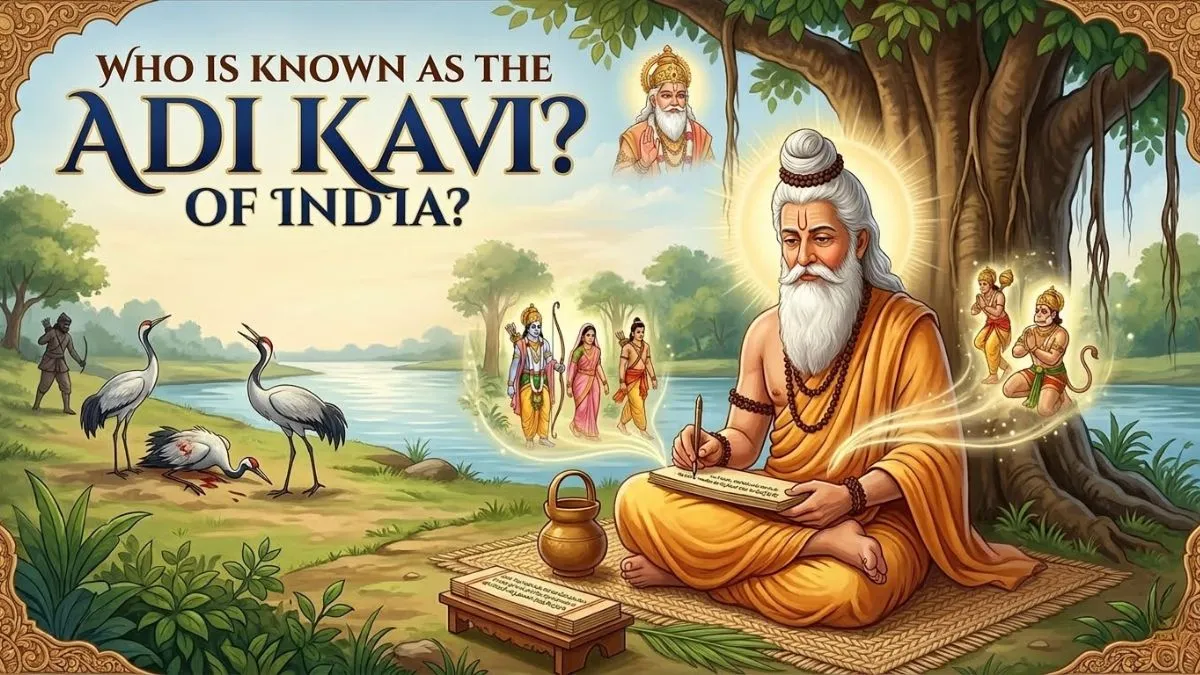
Maharishi Valmiki, a great saint and visionary, is widely known as "Adi Kavi" (the First Poet) of India.
He earned this title because of composing the Ramayana, the ancient epic poem of India, which was originally written in the Sanskrit language.
He lived around the first millennium BC, and he was the originator of the Hindu “Sloka”, which is a verse form in which most of the great epics, such as Ramayana, Mahabharata, Puranas, and other works are composed.
Beyond his literary genius, his life is a profound story of transformation—from a forest-dwelling robber to a venerated sage who defined the moral and poetic fabric of ancient India.
But the question arises here as to why Maharishi Valmiki is known as the Adi Kavi of India, and how his life has transformed from a forest-dwelling robber to a venerated sage.
Let’s explore in detail Maharishi Valmiki, the Adi Kavi of India.
Who is Maharishi Valmiki?
Maharishi Valmiki was a great Hindu sage who lived around the beginning of the first millennium B.C. He is referred to as the "Adi Kavi" because he was the original creator of the "Shloka"—a specific verse form used to compose the world’s greatest epics, including the Mahabharata and the Puranas.
Valmiki’s life is a testament to spiritual upliftment. Originally born into the lineage of Bhrigu, he was raised in a family of robbers. However, through the guidance of the Saptarsis (Seven Sages) and the sage Narada, he transitioned from a life of sin to a state of supreme sainthood. He was even a contemporary of the heroes of the Ramayana, providing shelter to Mata Sita and raising her sons, Luv and Kush, in his hermitage.
How Did He Get the Name "Valmiki"?
Before he became a saint, he was known as Ratnakar. After being initiated by Sage Narada to meditate on the name of "Rama," he sat in a poised state of penance for thousands of years. His meditation was so intense and long-lasting that a "Valmika" (an anthill) grew over his entire body. When he finally emerged from the anthill, he was reborn as a Maharishi and given the name Valmiki.
Why is Maharishi Valmiki called the "Adi Kavi" of India?
Valmiki is called the "First Poet" because of a spontaneous outburst of emotion that changed literature forever.
1. The Invention of the First Shloka
One day, while bathing in the river Tamasa, Valmiki saw a pair of cranes (Kraunch) mating in total bliss. Suddenly, a hunter shot the male bird. When the female bird cried in agony and passed away in sorrow, Valmiki experienced an outburst of deep sorrow (Shoka). and he in his heart, cursed the hunter:
"Oh hunter, may you find no rest for aeons, for you killed an innocent bird in the midst of love."
To his surprise, this curse emerged as a perfectly metrical composition—the first Shloka in Sanskrit.
2. Lord Brahma’s Divine Command
Following this incident, Lord Brahma appeared to Valmiki. He commanded the sage to use this newly discovered meter to write the life story of Lord Rama, as told to him by Narada.
Brahma granted Valmiki a divine vision to see every secret and incident connected to Rama’s life, leading to the creation of the 24,000-verse masterpiece: The Ramayana.
Valmiki’s Life Before Transformation
During his childhood, he was a robber called Ratnakkardah. He exonerated his crimes by stating that he was working in the support of his family. His view however changed after meeting Sage Narada. Narada told him: Wilt thy family exist To pay thy sins With thy stolen wealth?
The reality came to him when his family denied him sharing his sins. He ran back to Narada, and besought to be saved, and now started on the hard road of penance that resulted in his enlightenment.
Key Milestones at a Glance
| Aspect | Details |
| Original Name | Ratnakar (a robber and soldier) |
| Spiritual Guide | Sage Narada and the Saptarsis |
| Major Work | The Ramayana (24,000 verses) |
| The First Shloka | Born from Shoka (sorrow) at the Tamasa River |
| Role in Epic | Sheltered Sita; Mentor to Luv and Kush |
| Core Philosophy | Purity, penance, and dedication to Dharma |
Conclusion
Maharishi Valmiki is the Adi Kavi of India since he did not merely write a story; he created the form of expression of Indian culture, where Indian culture can tell you about its most important values. Turning himself into a positive example of life and bringing into verse the Ideal Man (Rama), he made sure that the quest to find the truth and righteousness would be immortalised.



Comments
All Comments (0)
Join the conversation