Which City Is Known As The City Of Paper?
Do you know which historic European town is nicknamed the "City of Paper"? It revolutionised writing by inventing the watermark and the hydraulic mill in the 13th century. Let’s discover the fascinating story behind the true paper capital of the world.

Show Key Points
Think about it: if we never bothered to write anything down, how much of our own story would we actually remember? Not much. That's why the invention of paper wasn't just a neat trick; it gave us a way to lock in our history and science, so they didn't vanish when the people who knew them died.
The whole thing started in China back around 105 CE. A court official named Cai Lun basically threw mulberry bark, hemp, old rags, and literal fishing nets into a pot, mashed them into a pulp, and invented the world's first real paper. He showed his recipe to the Emperor, and just like that, history changed.
For a long time, China kept the process under lock and key. But secrets that big always leak. It took centuries, but the technology eventually bled into Europe between the 1200s and 1400s, with Spain and Italy setting up the continent's first paper mills.
In fact, one specific European town became so ridiculously good at making the stuff that it earned the nickname the "City of Paper". Any guesses on which one? If you're drawing a blank, let's take a look at the town that essentially became the paper capital of the world.
Which City Is Known As The City Of Paper?
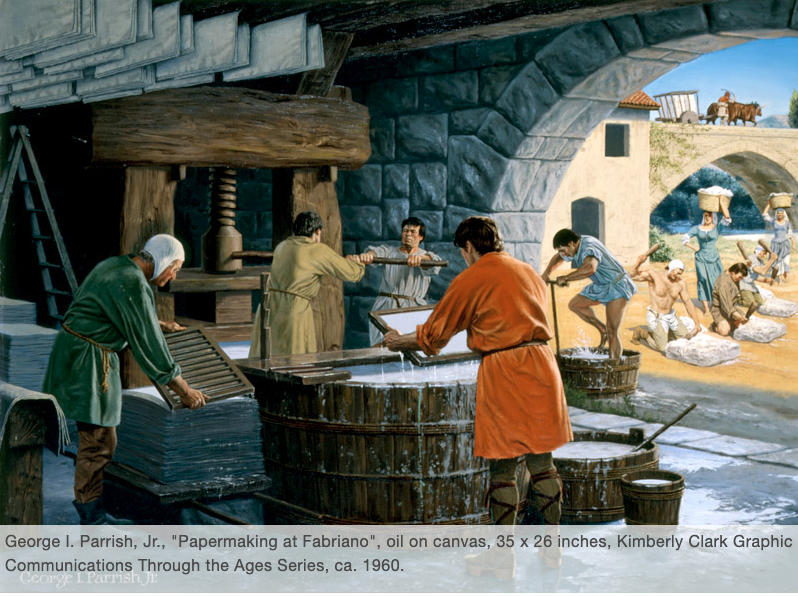
Source: History of Information
If you want to know where Western paper really got its start, forget the usual suspects and head straight to Fabriano. This little Italian town, hidden away in the Marche region, took what China started and ran with it. By the 1200s, Fabriano was basically the Silicon Valley of paper, earning itself the nickname 'City of Paper'.
Fabriano didn’t just make paper—they flipped the whole process on its head with three wild innovations. First up: the hydraulic stamp mill. Instead of endless hand-mashing, they harnessed water power to blitz through pulp much faster than anyone could dream of.
Second, instead of using animal fat that made paper spoil quickly, they introduced gelatin sizing. This coating made the paper durable, smooth, and resistant to ink blots. Artists like Michelangelo absolutely loved it.
And then there’s the watermark. Fabriano came up with the idea of stamping secret designs right into the wet pulp, so every sheet was basically a signature—no copycats allowed. Even now, Fabriano still wears the crown as the world’s paper capital.
5 Amazing Facts About the Paper Capital of the World
- When the Euro needed a paper tough enough to outsmart counterfeiters, guess who got the call? Fabriano. Their mills have been perfecting the art of secure paper for centuries, so it only made sense to trust them with the job.
- Michelangelo himself was a fan. He didn’t just talk up Fabriano paper in his letters—he actually used it for his own sketches and notes back in the 1500s.
- UNESCO put Fabriano on its Creative Cities list in 2013, and for good reason. This place has been making paper the old-school way for 800 years straight.
- Way before anyone thought of using wood pulp, Fabriano’s papermakers were out gathering old linen and hemp rags from hospitals and neighbours. That’s what went into their legendary paper.
- Back in 1282, Fabriano came up with watermarks—not just for looks, but as the world’s first real trademark and quality check for anything made by hand.
Complete Historical Timeline of the Paper City of the World

Source: History.com
Here is the complete historical timeline of how Fabriano transformed from a medieval Italian town into the undisputed paper capital of the Western world.
| Year / Period | Historical Event & Milestone | Significance to the "Paper Capital" Status |
| 1264 | First official mention of papermaking in Fabriano in the local notary archives. | Marks the official entry of Fabriano into the historical record as a papermaking hub, learning the craft via Arab trade routes through Sicily and Spain. |
| 1268–1276 | Invention of the Hydraulic Stamp Mill. | Replaced manual stone mortars with waterwheel-powered hammers. This mechanised the shredding of rags, drastically lowering costs and skyrocketing production volume. |
| 1282 | Invention of the Watermark. | Artisans pressed wire designs into wet pulp. This created the world's first anti-counterfeiting trademark, ensuring buyers knew they were getting genuine, high-quality Fabriano paper. |
| Mid-14th Century | Introduction of Gelatin Sizing (using animal collagen). | Replaced the Arab method of using wheat starch, which attracted insects and caused paper to rot. Gelatin made the paper smooth, ink-resistant, and incredibly durable. |
| 1300s–1400s | Monopolisation of the European market. | Thanks to these three innovations, Fabriano paper became cheaper, tougher, and more reliable than parchment or any other European paper, establishing absolute market dominance. |
| 1500s | High-profile artistic adoption (e.g., Michelangelo). | Renaissance masters explicitly requested Fabriano paper for its texture and durability, cementing its reputation as the premium medium for fine art. |
| 1782 | Pietro Miliani founded Cartiere Miliani Fabriano. | Miliani unified the scattered, struggling local workshops into a massive, industrialised powerhouse, saving the town's heritage during a period of economic decline. |
| 1900s | Expansion into Security and Banknote Paper. | The mills shifted toward high-security government printing, becoming the trusted manufacturer for complex watermarked papers, bonds, and various national currencies. |
| 2002 | Acquisition by the Fedrigoni Group. | Integrated Fabriano into a global luxury paper network, scaling up industrial production while strictly preserving the ancient, handmade tini (vat) techniques. |
| 2013 | Designated a UNESCO Creative City. | The UN officially recognised Fabriano under the "Crafts and Folk Art" category, solidifying its historical and living legacy as the world's paper capital. |
Although the invention of paper and the basic fundamentals of papermaking originated in China, it was the city of Fabriano that revolutionised the European papermaking industry.
The city is the cradle of three important inventions: The watermarking technique, the sizing of paper with animal gelatin, and the multiple-hammer water mills. These developments made paper a durable and premium art material instead of a fragile commodity.

Kriti Barua is a skilled content writer with 4+ years of experience in creating clear, engaging, and informative content. She began her writing journey as a Creative Writer Intern at Wordloom Ventures. She holds a BA degree from Delhi University and has completed a one-year diploma in TV Production and Journalism, which adds depth to her research and reporting style.
Kriti has worked across brand writing, marketing content, and digital media, building strong expertise in articles that connect with readers and perform well online. At Jagran New Media, she writes for the GK section, covering national news, international stories, and query-based articles that answer what people actively search for. Her work focuses on easy language, reliable information, strong keywords, and reader-friendly storytelling, making her content both helpful and search-friendly.


