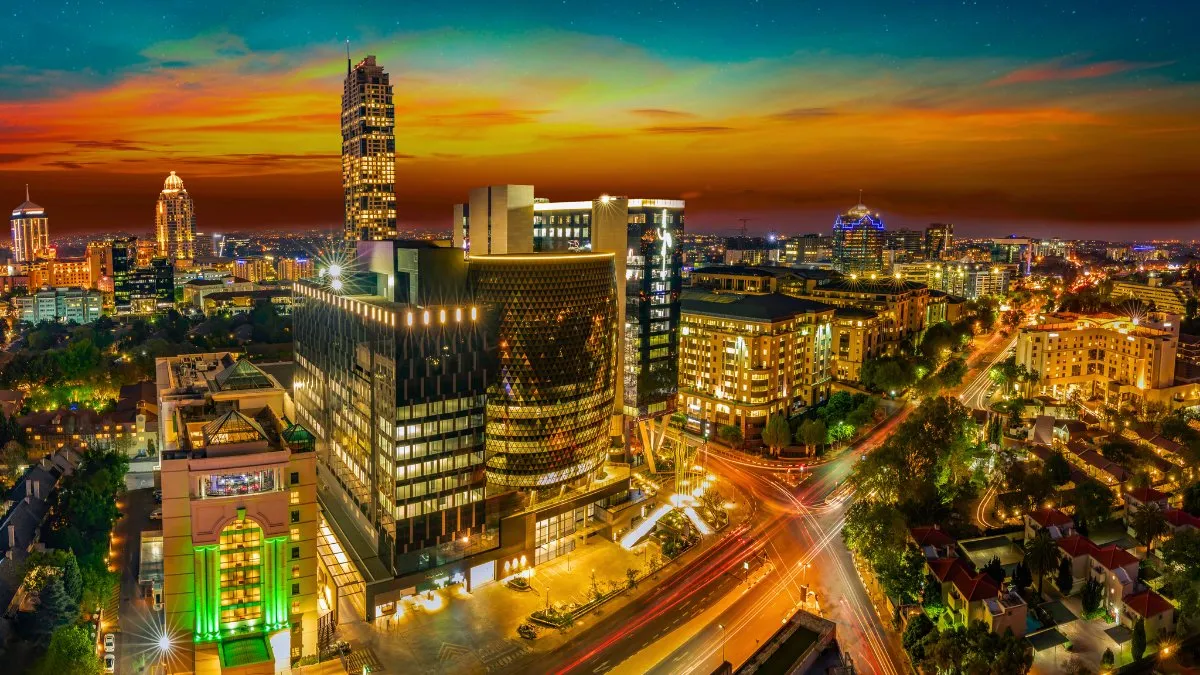
Johannesburg, also known as Joburg or Jo'burg, is the largest city in South Africa. Johannesburg has earned its nickname of "the City of Gold" after gold was discovered in the area in 1886. This city has grown into a huge metropolis from a humble agricultural settlement to the center of finance for the continent.
Whereas most cities were founded because of their proximity to a reliable source of water, Johannesburg stands out as one of the few cities that were established because of the discovery of gold in the latter part of the nineteenth century.
The discovery of gold by miners led to the emergence of Johannesburg in 1886. Johannesburg is the biggest city in South Africa, where almost five million people live from around the world, and, hence, one of the busiest cities in South Africa.
One might think that such a rich history is mirrored by the number of names used to refer to Johannesburg, as well as "Jozi," "Jo'burg," and "Joeys"; it is also known under the name of "eGoli," translated from isiZulu as "the City of Gold." IsiZulu or Zulu is one of the twelve official languages of South Africa.
Johannesburg: The City of Gold
Johannesburg is referred to as "the City of Gold" because its establishment occurred in 1886 after the discovery of gold at Witwatersrand. This event triggered a gold rush that brought thousands of people to this city and contributed to the fast-growing gold mining in Africa.
Gold Discovery in 1886
The discovery of gold in Witwatersrand played a very vital role in turning Johannesburg into the most important town in South Africa.
The gold discovery started with Jan Gerrit Bantjes, who in June 1884 discovered the gold in the area around the farm called Vogelstruisfontein. The next to discover gold was Struben Brothers, who found the other gold reef in proximity to Roodepoort and it was called Confidence Reef.
It was the discovery of George Harrison in July 1886 in the farm Langlaagte that triggered the Witwatersrand Gold Rush.
The mining camp developed very quickly and was estimated to have a population of about 3,000 people in August 1886.
Not long after that, the diggings became quite successful and on 3rd October 1886, the town received its name Johannesburg.
The settlement was originally founded in Fordsburg as Ferreira's Town under the supervision of Ignatius Ferreira. It was considered a temporary venture since all mining towns ceased to exist within a short period of time.
Gold ore deposits being vast and profound, as well as the availability of MacArthur-Forrest's cyanide process from 1890 guaranteed high productivity of deep mining.
Geographical Location and Importance of Johannesburg
One of the youngest megacities in the world is Johannesburg. It was established in 1886 due to gold deposits found nearby. Back then, the area where Johannesburg is now situated belonged to Transvaal – an independent Boer state. Today, Johannesburg belongs to Gauteng province, meaning “place of gold” in Setswana language. It can be easily observed how Johannesburg's urban plan reflects its historical segregation up until the apartheid era (1948-1994).
This contradiction of Johannesburg is why the city can be considered a megacity. In case of Johannesburg, there are high-rise buildings as well as poor slums, elite universities and disadvantaged neighborhoods.
According to the latest census statistics, in the year 2011, there were about 9.5 lakh inhabitants in Johannesburg, whereas 44 lakh individuals lived in the conurbation of Johannesburg. As per the figures, the current population of the municipality stands at 48 lakh.
Johannesburg: An Economic Center of South Africa
Being one of the leading economic centers of the world, it acts as the economic capital of South Africa. The contribution of the GDP of Johannesburg towards that of the country is around 16%, while, for the province of Gauteng, it is almost 40%. The city of Johannesburg was placed in the list of business cities across the globe according to the MasterCard organization in 2008.
At the beginning stage of its economy, the city of Johannesburg relied on the mining industry of Witwatersrand; however, with the exhaustion of the natural resources, its contribution has decreased and the city also houses other industries such as manufacturing, services, and others. The head offices of the mining industry are situated here.
Other significant economic sectors include banks, IT, real estate, media, health, retail, and many more. It also comprises Johannesburg Stock Exchange, which is the biggest stock exchange market in Africa. There is an important transportation system present in the region of City Deep, which is also considered the largest dry port in the world.
Check out some more interesting articles from the general knowledge section to boost your knowledge of national and international topics. Stay connected with Jagran Josh for more topics like this.


-1776701151439_t.webp)

