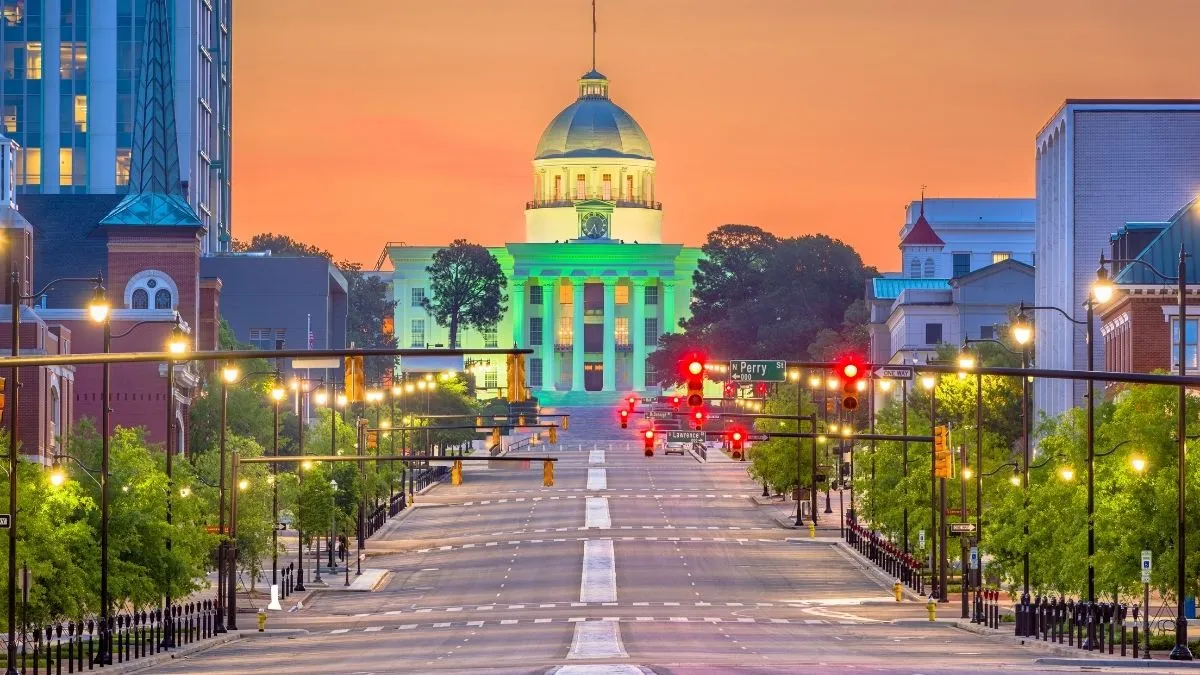
Montgomery continues to solidify its status as the definitive capital of Alabama, blending its poignant Cradle of the Confederacy and Birthplace of the Civil Rights Movement legacies with a modern economic surge.
Recent data from the City of Montgomery confirms the metro area is experiencing a revitalization, recently becoming a finalist for the prestigious 2026 All-America City Award. With a population of approximately 193,703, this Alabama capital city is no longer just a site for legislative sessions; it is a burgeoning tech hub, recently seeing the launch of Meta’s $1.5 billion AI data center.
Whether you are searching for Montgomery facts or the city's latest legislative updates, the capital remains Alabama's most vital intersection of past and progress.
What is the capital of Alabama?
Montgomery became the capital of Alabama in 1846, following stints in St. Stephens, Huntsville, Cahaba, and Tuscaloosa. Its central location along the Alabama River made it a strategic choice for trade and governance. Today, the Alabama State Capitol, a National Historic Landmark, serves as the working office for the Governor and a museum of state politics.
Quick Facts about Montgomery
| Feature | Detail about Montgmery |
| Established as the capital | 1846 |
| County | Montgomery County |
| Key Industries | Government, Military (Maxwell AFB), Tech, Manufacturing |
| 2026 Recognition | All-America City Award Finalist |
| Major Landmarks | Legacy Museum, Civil Rights Memorial, Riverwalk Stadium |
Also Read - All About Alabama: Flag, Map, Capital, Geography, History, Education, and Economy
What is Alabama known for?
Alabama is a unique state that has been able to capture attention because of its historical significance, culture, and nature. Below are some things that make Alabama well-known:
1. Civil Rights Movement
A lot of progress was made regarding the Civil Rights Movement in Alabama. One could name the cities of Montgomery and Birmingham, which became the centers for organizing protests held by such notable people as Martin Luther King Jr.
2. Space and Rocket Research
Huntsville earned the nickname of Rocket City as it was related to NASA's projects and space research done by the latter.
3. College Football
Alabama has numerous college football teams that have made great achievements. Some of them include such well-known teams as the Alabama Crimson Tide.
4. Music Tradition
Alabama claims its rich history regarding the making of music, with genres including blues, country, and soul being played there.
5. Beautiful Nature
Alabama can boast of the beauty of its nature, with beaches found in the southern part of the state, along with mountains, rivers, and lakes.
6. Southern Culture and Food
The state also prides itself on its Southern culture and cuisine. Among the traditional foods, one can find fried chicken, barbecue, and many others.
Check Out - Who is the Governor of Alabama? Check Political Party, Term Limits, and Prior Public Experience
History of Alabama
Alabama has a long-standing history linked with the larger narrative of the United States. Before the arrival of Europeans, the territory was inhabited by various Indian tribes, including Creeks, Cherokees, and Choctaws, who possessed advanced civilizations and flourishing trades.
In the 16th century, the area was explored by Spanish explorers before becoming subject to the colonization of the French and British, who fought for control of Alabama. After gaining independence from Britain in the American Revolution, the territory joined the nation and became the 22nd state in 1819.
The economic development of Alabama was very significant during the 19th century because of the plantation-based production of cotton that needed slaves' work. In other words, the state became part of the Cotton Kingdom because of such economic activity. Nevertheless, due to disputes regarding the necessity of slavery, Alabama became part of the Confederacy, and Montgomery served as the capital of the Confederate States for a short period during the Civil War.
Also Read - Which US State is Known as the ‘Heart of Dixie’?
In the post-war period, Reconstruction took place in Alabama, followed by segregation under Jim Crow laws. Alabama became one of the key centers for conducting the Civil Rights Movement in the 1950s and 1960s