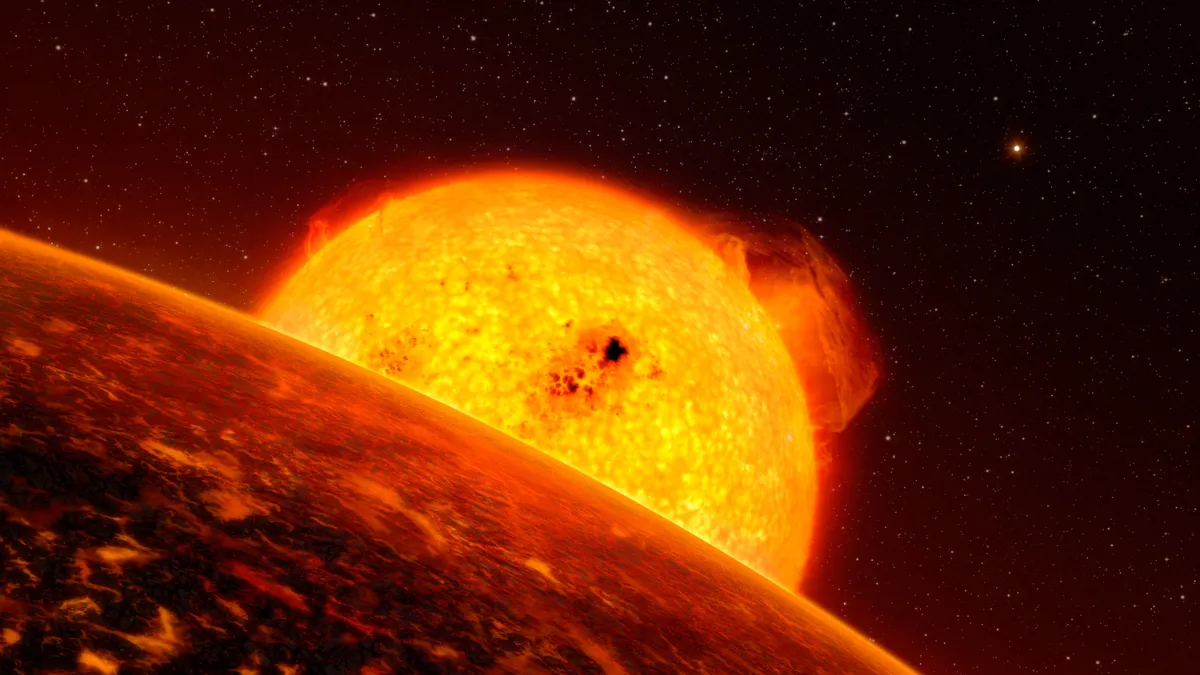
A molten planet is a planetary object; a surface or deep interior of which is mostly or wholly in a liquid-rock (magma) form as opposed to solid rock. This situation may happen in two distinct forms, either when, in the hot conditions of early planetary formation, a planet is enveloped by a planetary-wide magma ocean, or on current-day exoplanets that are sufficiently close to their stars that the surface of the planet is partially or fully liquid long periods of time.
The study of molten planets aids researchers to investigate the formation of rocky planets, cool them, and transform in or out of habitable states.
What does a Molten Planet mean?
A molten planet is a world in which a large part of the interior or the surface is made of molten rock, as a rule silicate lava or metallic melts. This also in most models includes planets which previously possessed a global magma ocean, a deep, worldwide mass of flowing rock in their early past. It is also used to refer to certain very hot exoplanets, in which even solid rock cannot exist, leaving the planet a true lava world or a magma-ocean planet.
These planets are different not only in temperature but also in the mode of transportation of heat and the way material is segregated by creating core, mantle, and crust.
How Do Molten Planets Form?
Planets that are molten tend to be formed using one or more of the following conditions:
-
Accretion and impacts: Planets crash together and form massive bodies, the energy produced by the gravitation creates a tremendous amount of heat, sufficient to melt a large part of the forming planet.
-
Core formation and differentiation: Heavy elements like iron will sink into the center releasing heat, which causes further melting and convection.
-
Strong stellar heating (in exoplanets): The planets in very close orbits are exposed to a lot of radiation that warms their daytime surfaces exceeding a thousand degrees, keeping an ocean of magma constantly moving.
-
Conduction is not able to carry away the heat fast enough in these regimes, and thus the interior of the regime remains molten over long periods, even millions of years.
Was the Earth Ever a Planet Molten?
Many people believe that most of the earth was molten soon after its formation, and the earth had a magma ocean on its surface with a very hot interior.
The latter was the result of the synergies between recurring hits of giants, their compression during the growth process and the disintegration of short-lived radioactive isotopes.
The topmost layer of this molten shell solidified downward forming the first thin solid crust, as the planet slowly cooled down.
The more inward region was hot enough to undergo convection thus facilitating chemical separation: iron and nickel fell to form the core, with the light silicate minerals soaring up to make the mantle and the initial crust.
The solid crust of Earth formed the basis of subsequent tectonics, oceans, and life following the transition of the molten planet to a solid one.
ALSO READ: Which River is Known as the Chocolate River?
Even nowadays there are a lot of rocky planets which are not entirely solid. An example of this is the Earth, which consists of an inner rocky core and an outer liquid core of molten iron-nickel, and a solid rocky mantle which is still hot enough to flow slowly over millions of years.
This partially molten core is essential: the outer core is liquefied and convection creates a magnetic field in the earth that protects the earth surface against cosmic and hostile solar radiations.
Mars could also have a layer of molten rock that is found at the bottom of its mantle which is based on geophysical and seismic data. Venus and Mercury also have hot, partially molten cores, but the surface geology and magnetic field are quite different because of the difference in cooling and composition. In every such instance, molten is typically applied to the internal, not the surface which is solid.
What are Exoplanets and “Lava Worlds"?
Outside of the solar system, astronomers have found a group of hot molten-planet-like rocky exoplanets. Other of these worlds, as they spin about their stars at very short distances, are considered to possess world-encompassing magma oceans under a dense, frequently sulphurous, atmosphere.
It has been observed and modeled that these planets can even be a little larger in radius than solid-rock planets of that mass, as molten silicate rock is less dense than its solid counterpart.
As an example, exoplanets that are Earth-mass, with short periods, are found to be approximately 5 per cent larger than solid bodies, which gives a major observational lever in detecting molten exoplanets.
These lava worlds contribute to the test of the ideas regarding the extreme heating of the atmosphere-surface interaction, the rate at which cold surfaces could cool down once the activity of the star declined or when the planets shifted outwards.



Comments
All Comments (0)
Join the conversation