Suez Canal from North to South: History, Lakes and Key Geography Facts
The Suez Canal is an artificial waterway in Egypt, extending from Port Said to Suez, connecting the Mediterranean Sea with the Red Sea. Explore the correct north-to-south order of the Suez Canal lakes from Lake Manzala to the Bitter Lakes along with its rich history and recent global shipping updates.
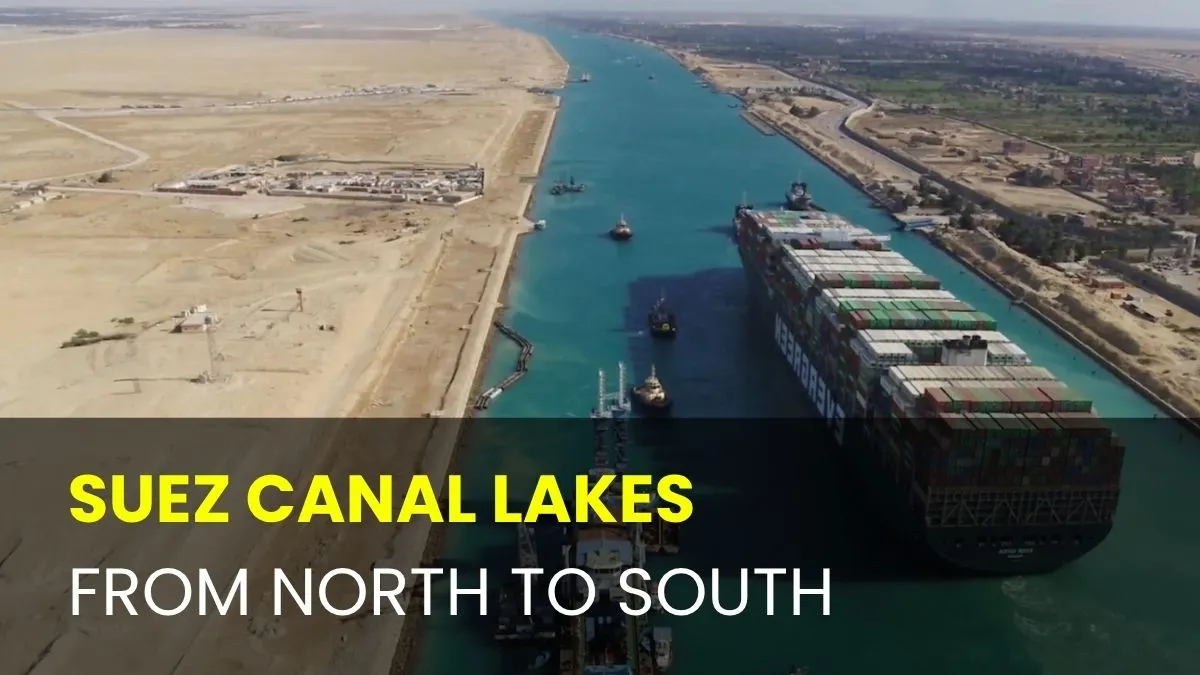
The Suez Canal is a 193-km artificial sea-level waterway in Egypt, extending from Port Said to Port Tewfik near the Suez, connecting the Mediterranean Sea with the Red Sea. The canal divides Africa and Asia and the Sinai Peninsula from the rest of Egypt.
The canal is one of the world's major global trade routes, handling approximately 12 per cent of world trade, including oil, natural gas, and consumer goods. The canal functions without locks. In 2015, a parallel channel was added to increase the capacity.
The canal reduces the journey distance from the Arabian Sea to London by approximately 8,900 kilometres. The canal serves as a pivotal chokepoint and shortest maritime route for energy, commodities, and trade from Asia and the Middle East to Europe.
History of Suez Canal
The concept of the canal itself (the joining of the Mediterranean sea and the Red Sea) has its roots in ancient Egyptian civilization when waters were constructed to connect Nile delta with the Red Sea. However, the modern project began in 1859 when French diplomat Ferdinand de Lesseps led the creation of the canal.
In a span of ten years, this difficult task was accomplished and the canal opened in 1869 changing the nature of maritime trade and allowing to do fewer kilometers of journey.
Throughout its existence (over a hundred years). The canal has been an arena of important political events in its history:
- Nationalization of the Suez Canal and the Suez crisis of 1956: On July 26, 1956, Egyptian president Gamal Abdel Nasser nationalized the Suez Canal Company starting the Suez Crisis resulting in a military intervention conducted by the UK, France and Israel but after the outside pressure the countries were forced to retreat from the area and leave the canal under Egyptian control.
-
The Eight Years Closure and Yellow Fleet (1967-1975): After the Six-Day War (1967), Egypt closed the Canal and strengthened the area. These events led to the emergence of 15 ships that were trapped in this body of water for the course of 8 years, and thus these ships were nicknamed Yellow Fleet as sand covered their decks.
-
Recent Expansion (2015): In order to accommodate recent big ships and minimize wait times for ships, Egypt opened the New Suez Canal in 2015 introducing a new 35-kilometer parallel channel that allowed two-way traffic.
Geographical Characteristics of the Suez Canal
- Location and Borders: Connected through the Suez Isthmus situated in northeastern Egypt. The canal is the geographical boundary line distinguishing Africa from Asia (i.e., the division between the mainland Egypt and the Sinai Peninsula).
- End Points: The passageway stretches from Port Said located on the Mediterranean in the north, down to Port Tewfik close to the town of Suez on the Red Sea.
- Dimensions: The Suez Canal is approximately 193.3 kilometers (120 miles) long, 24 meters (79 feet) deep and more than 300 meters wide at the surface.
- End Points: The Suez Canal acts as a sea-level canal and does not need lock systems since both sea bodies are at almost the same vertical levels.
- Lakes Connected: Various natural saltwater shallow lakes including Manzala, Timsah, the Great and Little Bitter Lakes are part of the route making the passage possible for vessels.
What are the lakes in the Suez Canal from north to south?

The lakes in the Suez Canal from north to south are Lake Manzala, Lake Timsah, the Great Bitter Lake, and the Little Bitter Lake.
Lake Manzala is a shallow, brackish lake, sometimes also called a lagoon. It is located in the northeastern Egypt on the Nile Delta near Port Said. The lake is 47 km long and 30 km wide.
Lake Timsah is a shallow, saltwater lake in Ismailia, Egypt, on the Nile Delta. Lake Timsah is also know as Crocodile Lake. The lake gets its name from the time when the lake was inhabited by Nile crocodiles although now they are not spotted as the lake is now a saltwater body.
Great Bitter Lake is a large saltwater lake in Egypt, part of the Suez Canal. Before the existence of the canal, the lake was a dry salt valley. The ships use this lake as a the 'passing lane'. The lake is filled with water from both the Red and Mediterranean Seas.
Little Bitter Lake is a saltwater lake, a part of the Suez Canal. It is located south of the Great Bitter Lake, connected through the canal system. The Little Bitter Lake is famous for the 'Yellow Fleet' when 14 ships were stranded there for eight years following the 1967 Six-Day war.
The current state and Impotance of the Suez Canal
Recently, an event such as the six-day blockage of the container ship Ever Given in 2021 and trouble with security in the Red Sea proved how much shipping depends on the canal not being closed down. Rerouting ships through Africa takes around two weeks and raises costs.
Currently, the Suez Canal is important as it:
1. Handles almost 12% of all world trade and 30% of global container shipping.
2. Serves as the shortest way of transportation between Asia and Europe cutting almost 8,900 km in every trip.
3. Transfers important supplies of energy like oil and gas as well as raw materials and food products.
4. Serves the main source of income for Egypt and earns foreign currency as well.
The Suez Canal is still one of the most important maritime shortcuts in the world, connecting the eastern and western parts of the world through networks of ancient lakes. From its beginnings in the past through modern history in trade and politics, the Suez Canal is still an important economic source for Egypt and the world.

Roopashree Sharma is an experienced broadcast journalist with over 7 years of experience, specialising in beats including geopolitics, defence, and general awareness. She has worked in the roles of correspondent and producer for leading media houses, including Zee, WION, and Economic Times. Currently serving as Deputy Manager – Editorial at Jagran New Media, she produces explainer articles and videos for the General Knowledge (GK) section of the Jagran Josh (English) portal. For inquiries, contact her at roopashree.sharma@jagrannewmedia.com.





![[OUT] BPSC TRE 4 Notification 2026 LIVE: 32,388 पदों पर शिक्षक भर्ती का नोटिफिकेशन जारी, यहां देखें पूरी डिटेल](https://img.jagranjosh.com/images/2026/August/1882026/bpsc-tre-4.jpg)