Solar Water Heater vs Electric Geyser: Which Is Better and Why?
Solar water heater vs electric geyser: Compare cost, electricity use, efficiency, weather performance, maintenance, and benefits to choose the best option.
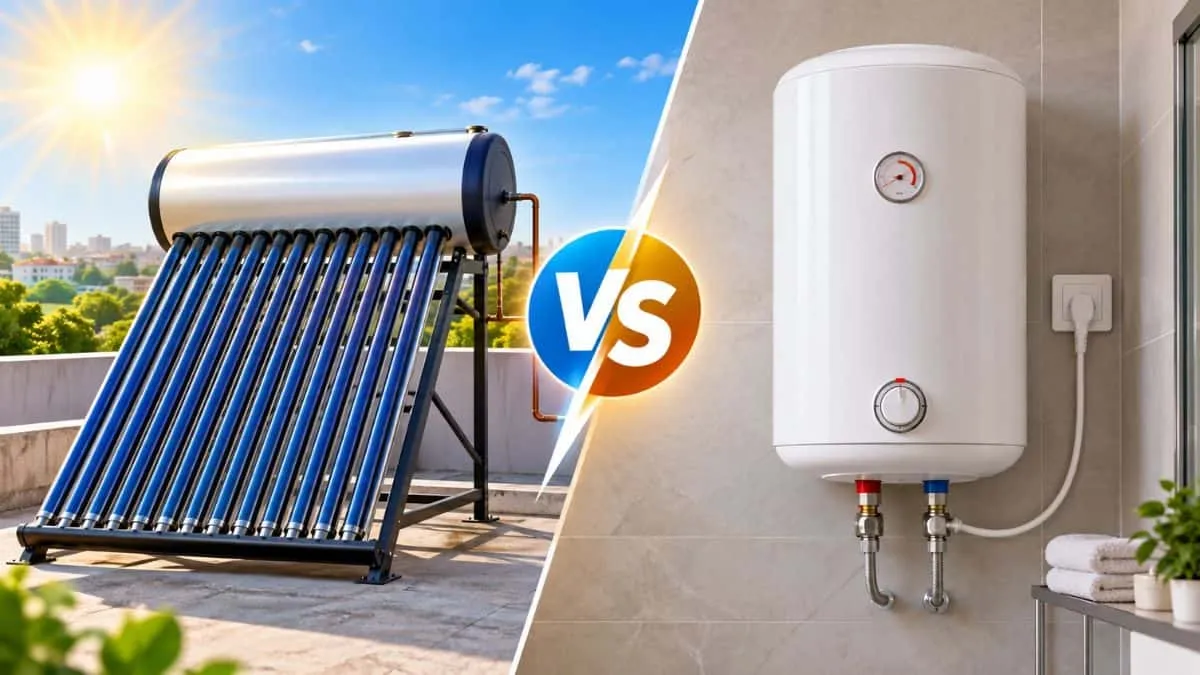
Hot water is a requirement in daily life in many households in India, particularly during the winter months. The electric geyser has been the most popular method of water heating for many years. Another alternative is gaining popularity: the solar water heater.
Then which is better and why?
The answer is simple: it depends on your uses, as generally, a solar water heater is preferable in houses that receive a significant amount of sunlight and consume a large volume of hot water. An electric geyser can be better when you need hot water anytime, have a limited roof area, or you reside in a location with poor sunlight exposure.
That's not the only consideration, however. Consider electricity costs, maintenance, installation, weather, available space, and the number of people using hot water, as well.
What Is a Solar Water Heater?
A solar water heater uses the heat of the sun to heat water.
It generally has three important parts:
- Solar collector – collects heat from sunlight.
- Water storage tank – stores the heated water.
- Pipes – carry water between the collector and tank.
The Ministry of New and Renewable Energy (MNRE) describes solar water heaters as a mature solar-thermal technology that uses the sun's energy to provide hot water and can significantly reduce electricity bills. MNRE says domestic systems commonly come in capacities of about 100 to 500 litres per day (LPD).
How does it work?
Think of it like this:
Sunlight → Solar Collector → Water Gets Heated → Hot Water Stored in Tank → You Use It
During the day, sunlight heats the water. The hot water can then be stored for later use.
That means the sun is doing much of the heating work instead of an electric heating element.
What Is an Electric Geyser?
An electric geyser uses electricity to heat water.
A typical storage geyser has:
- a water tank,
- an electric heating element,
- a thermostat,
- insulation and safety controls.
When you switch it on, electricity heats the element, and the element heats the water.
The basic process is:
Electricity → Heating Element → Water Gets Heated → Hot Water Stored → You Use It
Electric geysers are convenient because they don't depend on sunlight.
For example, if you want hot water at 6 AM, 10 PM or on a rainy day, an electric geyser can heat it whenever electricity is available.
Solar Water Heater vs Electric Geyser
| Feature | Solar Water Heater | Electric Geyser | Winner |
| Initial price | Higher | Usually lower | Geyser |
| Running cost | Very low in good conditions | Higher | Solar |
| Electricity consumption | Low for solar heating | Higher | Solar |
| Dependence on sunlight | Yes | No | Geyser |
| Night-time use | Depends on stored hot water | Easy | Geyser |
| Cloudy weather | Performance can reduce | Works normally | Geyser |
| Long-term savings | High potential | Lower | Solar |
| Installation | More involved | Easier | Geyser |
| Roof requirement | Yes | No | Geyser |
| Environmental benefit | High | Lower | Solar |
| Large family | Very suitable if sized correctly | Suitable | Solar |
| Small apartment | May be difficult | Usually easier | Geyser |
| Convenience | Good, but weather matters | Excellent | Geyser |
| Energy efficiency | Uses solar heat | Depends on model | Solar |
Which Uses Less Electricity?
A solar water heater is consumed les electricity thren the .
This is the greatest benefit of a solar water heater.
The solar water heating system primarily relies on the sun's free heat instead of the electrical energy required to generate the heat.
Significant savings in electricity bills is one of the benefits mentioned by MNRE for solar water heating.
In the case of the electric geyser, it consumes electricity whenever it is operating its heating element.
The real consumption of electricity is influenced by such as:
Which Has a Lower Purchase Cost?
Electric geyser Has a Lower Purchase Cost.
An electric geyser is generally easier and cheaper to install because you mainly need:
-
a suitable wall/floor location,
-
water connections,
-
electrical connection,
-
proper safety protection.
A solar water heater normally requires:
-
a suitable roof or terrace,
-
solar collectors,
-
a storage tank,
-
piping,
-
mounting structure,
-
plumbing work.
Therefore, the initial investment for a solar water heater is generally higher.
Which Works Better During Cloudy or Rainy Weather?
During cloudy or Rainy Weather, Electric geyser works better.
A solar water heater needs sunlight.
It can still receive some solar energy on cloudy days, but its performance can be lower than on a bright sunny day.
During long periods of rain or heavy cloud cover, you may not get enough hot water from the solar system alone.
An electric geyser does not have this problem.
If electricity is available, it can heat water regardless of whether the sky is:
-
sunny,
-
cloudy,
-
rainy, or
-
dark.
What About Winter?
This question is especially important in northern India.
In winter, the air becomes colder and the water entering the system may also be colder. However, winter sunlight can still provide useful solar heat.
The result depends on:
-
location,
-
sunlight available,
-
collector type,
-
system size,
-
tank insulation,
-
water usage,
-
weather conditions.
So, winter does not mean a solar water heater stops working.
But on very cold or cloudy days, an electric backup can be useful.
Solar Water Heater: Advantages and Disadvantages
Advantages
-
Uses free solar energy.
-
Can greatly reduce electricity used for water heating.
-
Can lower long-term running costs.
-
Good option for homes with plenty of sunlight.
-
Useful for families with regular hot-water demand.
-
Reduces dependence on electrical heating.
Disadvantages
-
Higher initial investment.
-
Needs roof or terrace space.
-
Needs good sunlight.
-
Hot-water output can fall during cloudy/rainy weather.
-
Requires proper installation and maintenance.
-
Backup heating may still be useful.
Electric Geyser: Advantages and Disadvantages
Advantages
-
Usually lower initial cost.
-
Easy to install.
-
Works during the day and night.
-
Does not depend on sunlight.
-
Convenient during rainy and cloudy weather.
-
Suitable for homes with limited roof space.
Disadvantages
-
Uses electricity for heating.
-
Can increase electricity bills.
-
Running cost continues throughout its life.
-
Old or inefficient models can waste more energy.
-
Storage models can also lose some heat while water sits in the tank.

Prabhat Mishra is a Subject Matter Expert and digital journalist with an extensive background in the competitive exam landscape and over 4 years of experience in education, national and international news, and current affairs. Over his tenure with top knowledge platforms like Mentorship India, IAS BABA, IAS SARTHI, and now Jagran Josh, he has a deep understanding of government exams like UPSC and State PCS, including UP and Bihar, as he has already qualified for the UPPCS 2022 Mains and Bihar 68th Mains. With his core expertise in history, polity, geography & current affairs, he specialises in creating well-researched, aspirant-centric content and simplifying complex topics for competitive examinations.




![[OUT] EMRS Tier 2 Result 2026 Live: Download PRT, TGT and PGT Result PDF at nests.tribal.gov.in](https://img.jagranjosh.com/images/2026/August/3182026/EMRS-Tier-2-Result-2026.jpg)