Rakhigarhi: The Largest Site of the Indus-Saraswati Civilisation in the Ghaggar-Hakra Basin
Learn about Rakhigarhi, the largest Indus-Saraswati Civilisation site in the Ghaggar-Hakra Basin, its location, excavations, discoveries, and Harappan heritage.

Key Takeaways
- Rakhigarhi is the largest site of the Indus-Saraswati civilisation which is spread over 550 hectares.
- It is situated in the Ghaggar-Hakra Basin of Hisar District in Haryana.
- It possesses 9 mounds (RGR-1 to RGR-9) one of which is used for the burial ground, Mound RGR 7.
Rakhigarhi is the largest site of the Indus-Saraswati civilisation, which is located on the Ghaggar-Hakra Basin.
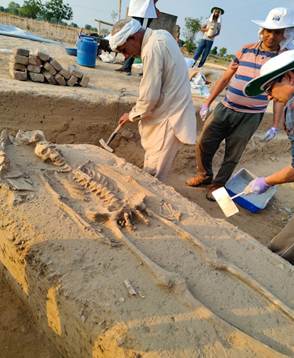
According to the PIB, recently, human skeletal remains have been excavated from the archaeological site of Rakhigarhi in Haryana and have been formally handed over by the Archaeological Survey of India (ASI) to the national research institute, Anthropological Survey of India (AnSI), under the Ministry of Culture, for detailed scientific investigation.
Located in Hisar (Haryana), Rakhigarhi is the largest known archaeological site of the Indus-Saraswati Civilisation, spanning approximately 550 hectares, significantly larger than both Harappa and Mohenjo-daro.
— Ministry of Culture (@MinOfCultureGoI) June 27, 2026
Major excavations at the site have revealed advanced urban planning,… pic.twitter.com/72t9GuaJJC
Let’s explore in detail the Rakhigarhi, the largest site of the Indus-Saraswati Civilisation.
About Rakhigarhi
Rakhigarhi is the ancient site of the Indus-Saraswati Civilisation, which is a very large city of the Bronze Age.
This site is also one of the largest urban settlements in the Indus civilisation.
This site is continuously excavated to study the human remains from the pre-Harappan period to the mature Harappan period.
Location of Rakhigarhi
Rakhigarhi, which is about 150 km northwest of Delhi, is situated in the Narnaud tehsil of Hisar district in Haryana. It is situated in the fertile area of Ghaggar-Hakra Basin along with dried up river Saraswati.
Major excavations and discoveries at the Rakhigarhi site
Initially, the Rakhigarhi site was identified by the Archaeological Survey of India (ASI) in 1960, with the help of Professor Suraj Bhan in 1963.
Major Excavations:
Dr Amarendra Nath (ASI): He was responsible for the excavations from 1997 to 2000, in which case, he discovered the proper settlement and early burial site in the metropolitan scale as per the Rare Books Society of India.
Source: PIB
Professor Vasant Shinde (Vice Chancellor of Deccan College): According to the Indian National Trust for Art & Culture Heritage, Professor Vasant Shinde and his team studied the ancient skeletons to recover the Harappan DNA to reconstruct the human faces, and disclosed the pre-Harappan civilisation about their appearance, hairstyle, and origin.
Major Discoveries
Urban Feature: There was a planned settlement under the Rakhigarhi site, there were mud-brick houses, burnt brick houses with a drainage system.
Trade: Uses of a cylindrical seal with a symbol of an alligator.
Large Public Granary: A large public granary was also built, consisting of seven large rectangular chambers and mud-brick.
Major industry for trade: The ceramic industry was represented by red ware, which was the centre of the craft production.
Performs rituals on fire altars (triangular and circle) and burial grounds.
Industrial Manufacturing Hub: A total of 9 mounds, out of which one was used for dyeing cloths (oldest method of textile colouring), firing terracotta, and gold trade was found, with unpolished semi-precious gemstones amounting to 3000 in number.
Prabhat Mishra is a Subject Matter Expert and digital journalist with an extensive background in the competitive exam landscape and over 4 years of experience in education, national and international news, and current affairs. Over his tenure with top knowledge platforms like Mentorship India, IAS BABA, IAS SARTHI, and now Jagran Josh, he has a deep understanding of government exams like UPSC and State PCS, including UP and Bihar, as he has already qualified for the UPPCS 2022 Mains and Bihar 68th Mains. With his core expertise in history, polity, geography & current affairs, he specialises in creating well-researched, aspirant-centric content and simplifying complex topics for competitive examinations.

-1782626290094_t.webp)

