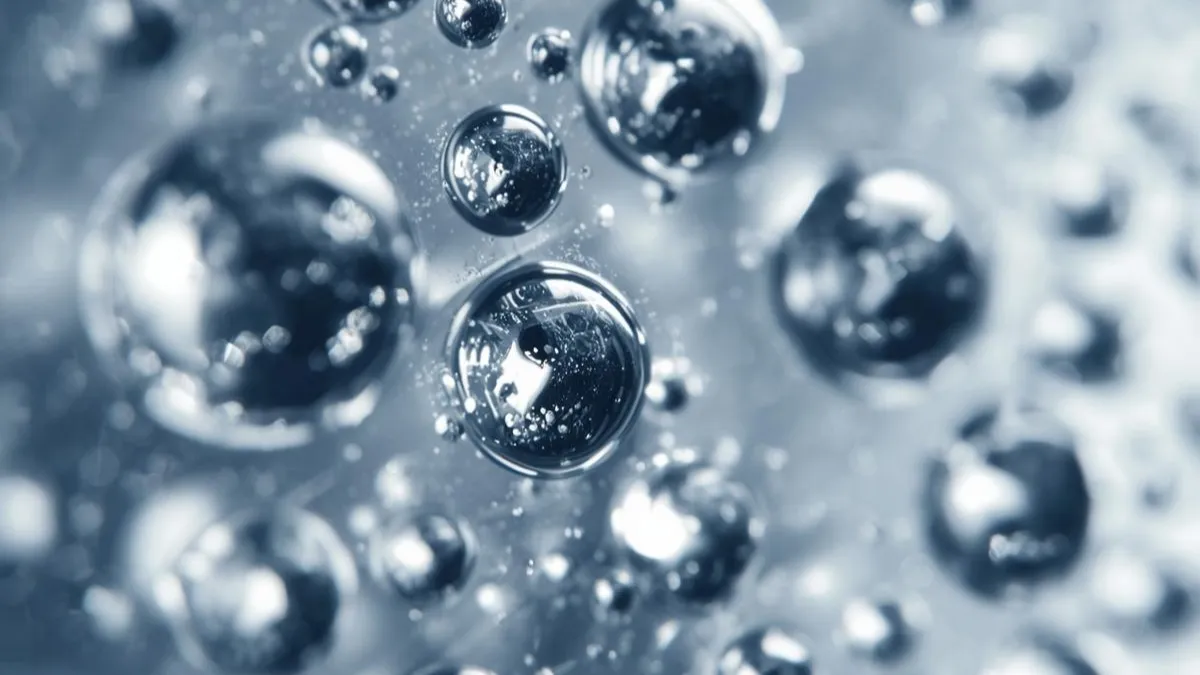
Mercury is one of the most fascinating elements on the periodic table while we typically associate metals with being solid, heavy, and structurally rigid, mercury breaks all the rules by flowing like water.
Here is a deep dive into the science, properties, and unique characteristics of this "quicksilver" element, backed by chemical principles and safety guidelines from official sources like the Royal Society of Chemistry and the EPA.
Which Metal is Liquid at Room Temperature?
The metal that is liquid at room temperature is Mercury (Hg) known historically as "quicksilver," mercury is the only metallic element that remains in a liquid state at standard room temperature and pressure.
On the periodic table, it sits at atomic number 80. While most metals require intense heat to melt, mercury has an incredibly low melting point of -38.83°C (-37.89°F).
Why is Mercury the Only Liquid Metal at Room Temperature?
The reason mercury stays liquid while its neighbors (like gold or thallium) are solid comes down to quantum mechanics and relativistic effects.
-
Electron Speed: In mercury atoms, electrons move at incredibly high speeds roughly 58% the speed of light. According to Einstein’s theory of relativity, this causes the electrons to gain mass and pull closer to the nucleus.
-
Weak Atomic Bonding: Because the outermost electrons are pulled so tightly toward the center, they do not "share" or bond easily with neighboring mercury atoms.
-
The Result: In most metals, atoms share electrons in a "sea" that holds them in a rigid, solid lattice. In mercury, the attraction between atoms is so weak that the thermal energy at room temperature is enough to keep them sliding past one another in a liquid state.
What are the Properties and Uses of Mercury?
Mercury possesses a unique set of physical and chemical properties that have made it invaluable and dangerous throughout history.
-1775222899279.jpg)
Mercury Properties:
-
High Density: It is 13.6 times denser than water. To put that in perspective, a solid iron cannonball would actually float on the surface of a pool of mercury.
-
Thermal Expansion: It expands and contracts at a very constant rate when temperature changes.
-
Surface Tension: It has extremely high surface tension, causing it to form distinct, silver beads rather than soaking into surfaces.
Mercury Uses:
-
Scientific Instruments: Due to its predictable expansion, it was the gold standard for thermometers, barometers, and blood pressure cuffs.
-
Electronics: Used in "tilt switches" (which turn off a heater if it falls over) and mercury vapor lamps.
-
Industrial Chemistry: It acts as a catalyst in various chemical manufacturing processes.
-
Dentistry: Historically used in dental amalgams (fillings), though this is being phased out in many countries due to health concerns.
-
Environment Safety: The Environmental Protection Agency (EPA) classifies mercury as a potent neurotoxin. Exposure to its vapors can lead to serious health issues, which is why many household mercury products are being replaced by digital alternatives.
Are There Other Metals That Can Become Liquid Near Room Temperature?
While mercury is the only metal liquid at a standard room temperature of 20°C (68°F), there are a few "near-misses" that melt just slightly above that point:
-
Gallium (Ga): This metal melts at 29.7°C (85.5°F). If you hold a piece of solid gallium in your hand, your body heat is enough to turn it into a silver puddle.
-
Cesium (Cs): With a melting point of 28.4°C (83.1°F), it is liquid in a warm room, but it is highly reactive and must be kept in sealed glass vials.
-
Francium (Fr): Estimated to melt at 27°C (80°F), though it is so rare and radioactive that it is almost never seen in bulk liquid form.
-
Rubidium (Rb): This metal melts at 39.3°C (102.7°F), which is just slightly above human body temperature.
The only metal that exists in liquid form at room temperature and standard atmospheric pressure is Mercury. Unlike most metals, which are solid due to strong metallic bonding, mercury has weak interatomic forces, allowing it to stay liquid.



Comments
All Comments (0)
Join the conversation