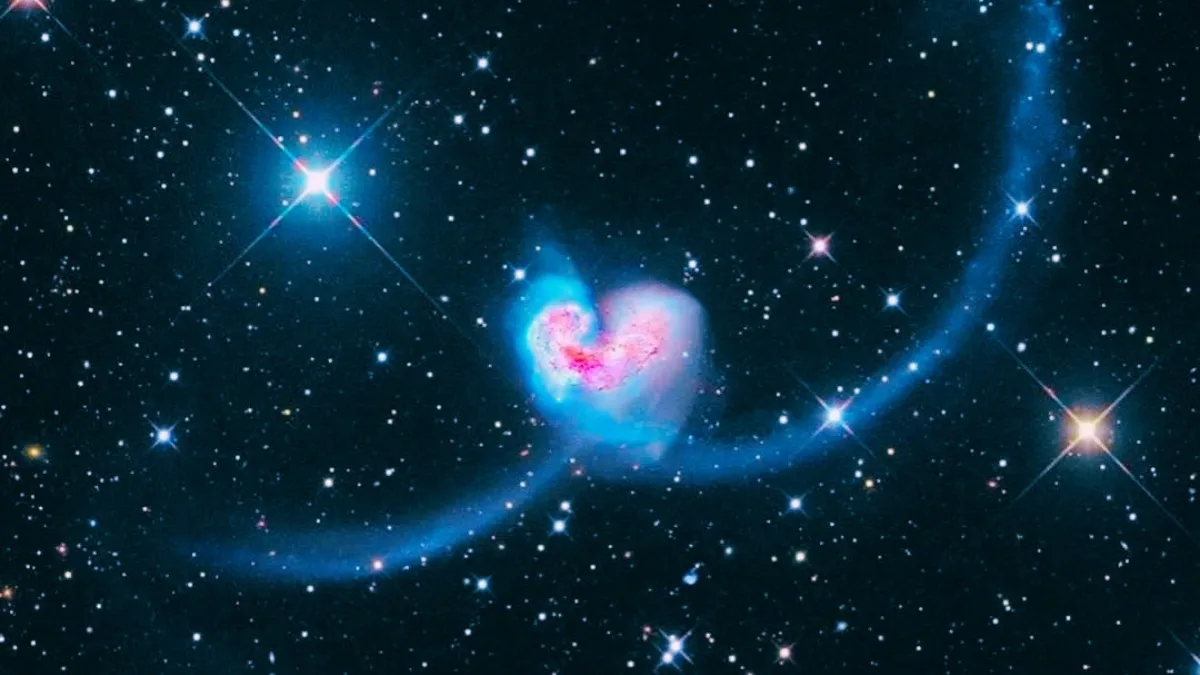
Scientists have discovered a rare heart‑shaped galaxy formed when two galaxies crash into each other in deep space.
From Earth, this structure looks like a glowing cosmic heart, but it is really the product of a massive collision billions of years in the making.
Such galaxy collisions are common in the evolving universe and help scientists understand how galaxies grow and change over time.
According to NASA, the heart‑like system known as the Antennae Galaxies sits about 60 million light‑years away and has been interacting for roughly a billion years, creating huge bursts of new star formation.
NASA Scientists Discover Rare Heart‑Shaped Galaxy After Cosmic Collision
Scientists discover a rare heart‑shaped galaxy after cosmic collision refers to a famous pair of galaxies called NGC 4038 and NGC 4039, also known as the Antennae Galaxies.
Over millions of years, their slow collision has twisted their shapes into a pattern that looks like a giant heart in space.
This “cosmic heart” is about 60 million light‑years away from Earth, which is relatively close by intergalactic standards.
The two galaxies have been gravitationally attracted to each other for about a billion years, and their dance is still shaping stars and structures today.
The heart shape comes from stretched streams of gas, dust, and stars that extend outward as the galaxies pull on each other.
These glowing pink regions in telescope images are areas where new stars are being born as clouds of gas slam together and collapse.
Images from powerful telescopes such as the Hubble Space Telescope show that the merged system may form a single, larger galaxy in the distant future, after billions of years of further interaction.
What is a Galaxy Collision?
A galaxy collision is when two whole galaxies pass close enough that their gravity pulls stars, gas, and dust together.
Despite the name, these events are not like car crashes; individual stars rarely hit each other because the space between them is so vast.
What does change is the gas and dust: when clouds smash together, they get squeezed and compressed, which triggers the birth of many new stars.
This can make the colliding region extremely bright and create unusual shapes, such as long tails or, in this case, a heart‑like pattern.
Galaxy collisions are a normal part of how the universe evolves. Observations show that many galaxies, including our own Milky Way, have grown or will grow over time by merging with smaller neighbours.
Conclusion
Scientists discover rare heart‑shaped galaxy after cosmic collision describes a beautiful example of two galaxies—NGC 4038 and NGC 4039—slowly merging into a heart‑like structure 60 million light‑years away.
This cosmic “heart” shows how galaxy collisions can reshape space, spark new stars, and help us understand how galaxies grow and change over billions of years.