List of Top 10 Largest Fish In The World
Can you guess which is the largest fish in the world? It isn't a whale, but a gentle giant that grows up to 60 feet long and eats tiny plankton. Let's discover the top 10 world's biggest fish.

Did you know that there are more than 34,000 different kinds of fish swimming in our oceans and rivers today? That is a lot of fish! Some of them have funny nicknames too, like the "living fossil" for the coelacanth or the "firefox of the sea." From tiny minnows to massive ocean creatures, the variety is just mind-blowing. But do you know which is the largest fish in the world? It's not what you think. Most people guess it is the blue whale, but whales are actually mammals, not fish! In this article, we'll take a look at the massive giants that actually hold the titles for the biggest fish in the world.
List of Top 10 Biggest Fish In The World
Scientists use data like body length and weight to rank these underwater giants. Many of these species are sharks, which are a special type of fish with skeletons made of cartilage instead of hard bones. Let's look at the 10 biggest fish found across our global waters.
| Fish | Length | Found In | Scientific Name | Also Known As |
| Whale Shark | 18 - 61.7 feet | Tropical Oceans | Rhincodon typus | Gentle Giant |
| Basking Shark | 26 - 33 feet | Temperate Oceans | Cetorhinus maximus | Bone Shark / Sunfish |
| Great White Shark | 15 - 20 feet | Coastal & Open Oceans | Carcharodon carcharias | White Death |
| Tiger Shark | 10 - 14 feet | Tropical and Subtropical Waters | Galeocerdo cuvier | Sea Tiger |
| Giant Oceanic Manta Ray | 15 - 23 feet (wingspan) | Tropical & Warm Waters | Mobula birostris | Devil Fish |
| Ocean Sunfish | 10 - 11 feet | Tropical & Temperate Oceans | Mola mola | Common Mola |
| Sharptail Mola | 9 - 11 feet | Warm and Tropical Seas | Masturus lanceolatus | Sharp-tailed Sunfish |
| Southern Sunfish | 10 feet | Southern Hemisphere Oceans | Mola alexandrini | Bumphead sunfish |
| Beluga Sturgeon | 11 - 16 feet | Caspian & Black Sea basins | Huso huso | Great Sturgeon |
| Pacific Sleeper Shark | 12 - 14 feet | North Pacific Ocean | Somniosus pacificus | Mud Shark |
1. Whale Shark

Source: Galapagos Whale Shark Project
The whale shark is the largest fish in the world, with a recorded length of up to 61.7 feet. Despite their scary size, their prey consists of tiny plankton, krill, and small fish larvae. They live in warm, tropical oceans worldwide.
The whale shark is a filter feeder, which means it eats by swimming with its giant mouth wide open. It gulps in huge amounts of ocean water packed with tiny creatures like plankton and krill. Special mesh-like filters inside its gills trap the food so the shark can swallow it, while the water flows safely back out into the sea.
Their mating process is still a big mystery to scientists because no one has ever filmed it. We do know they have internal fertilisation and give birth to live young.
Sadly, they are listed as Endangered on the IUCN Red List because their population has declined by more than 50% over the last 75 years. A cool, lesser-known fact is that the white spots on their skin are completely unique, just like human fingerprints.
2. Basking Shark

Source: BioDB
The Basking Shark takes the number two spot, regularly reaching lengths of 26 to 33 feet. Just like the whale shark, it is a peaceful filter feeder. Its main prey is zooplankton, which it scoops up by swimming with its massive mouth wide open. They prefer living in cool, temperate coastal waters.
Their mating process involves a unique courtship ritual called a "torus," where groups swim in tight, concentric circles near the surface before descending into the deep ocean to mate.
The basking shark is currently listed as endangered due to historical overfishing. A fascinating piece of info is that they sometimes shed their entire lining of gill rakers in the winter, effectively going on a fasting period until the spring plankton returns.
3. Great White Shark
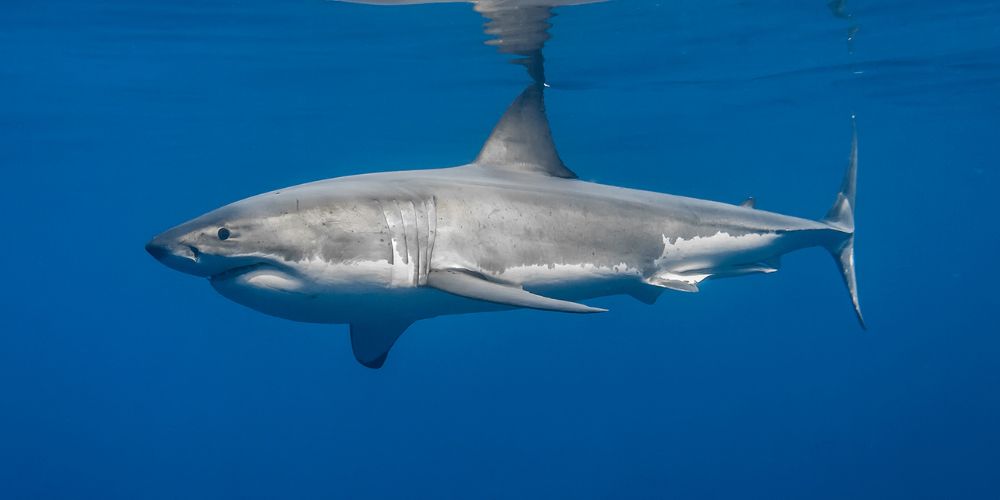
Source: Oceans Research
The Great White Shark is the largest predatory fish on Earth, growing between 15 to 20 feet long. Unlike the top two filter feeders, its prey includes marine mammals like seals, sea lions, and small whales. They live in cool, coastal waters all over the globe, especially near South Africa, Australia, and California.
The great white shark is an apex predator, meaning it sits right at the top of the ocean food chain. Instead of filtering water for tiny creatures, it hunts large prey. Its favourite meals are fat-rich marine mammals like seals and sea lions, but it also eats large fish like tuna and halibut to get the high energy it needs to swim.
Their mating process is rarely seen, but males use pelvic appendages called "claspers" to fertilise the female internally. The IUCN status for the Great White Shark is Vulnerable, with numbers dropping due to commercial fishing nets and ocean pollution.
A lesser-known study on tracking in 2026 reveals they can dive deeper than 3,900 feet into pitch-black waters to hunt, proving they aren't just surface predators.
Conclusion
Exploring the largest fish in the world shows us how amazing our ocean ecosystems really are. From the filter-feeding whale shark to the apex predator, the great white, these giants keep our marine environments in perfect balance. However, many of these massive species face serious threats today. With population declines hitting over 50% for certain species, international conservation laws are more important than ever. Protecting these incredible sea creatures ensures that our oceans stay healthy and vibrant for future generations to study and enjoy.

Kriti Barua is a skilled digital journalist and communications professional with 4+ years of experience, currently writing for the General Knowledge section at Jagran New Media. She has established herself as a subject matter expert in History, Geography, Trending National and International News, Sports, Science, and Defence, producing clear, reliable, and search-optimised content that connects with readers worldwide.
Kriti holds a BA degree from Delhi University and a one-year diploma in TV Production and Journalism, an academic background that adds research depth and strong storytelling instincts to her writing. Her experience spans brand writing, content marketing, and digital media, giving her a sharp understanding of what makes content both helpful to readers and visible in search.
At Jagran New Media, she applies this expertise to national and international news coverage, query-based articles, and in-depth pieces across her specialist subject areas. Her content is defined by easy language, factual accuracy, strong keyword strategy, and reader-friendly storytelling.


