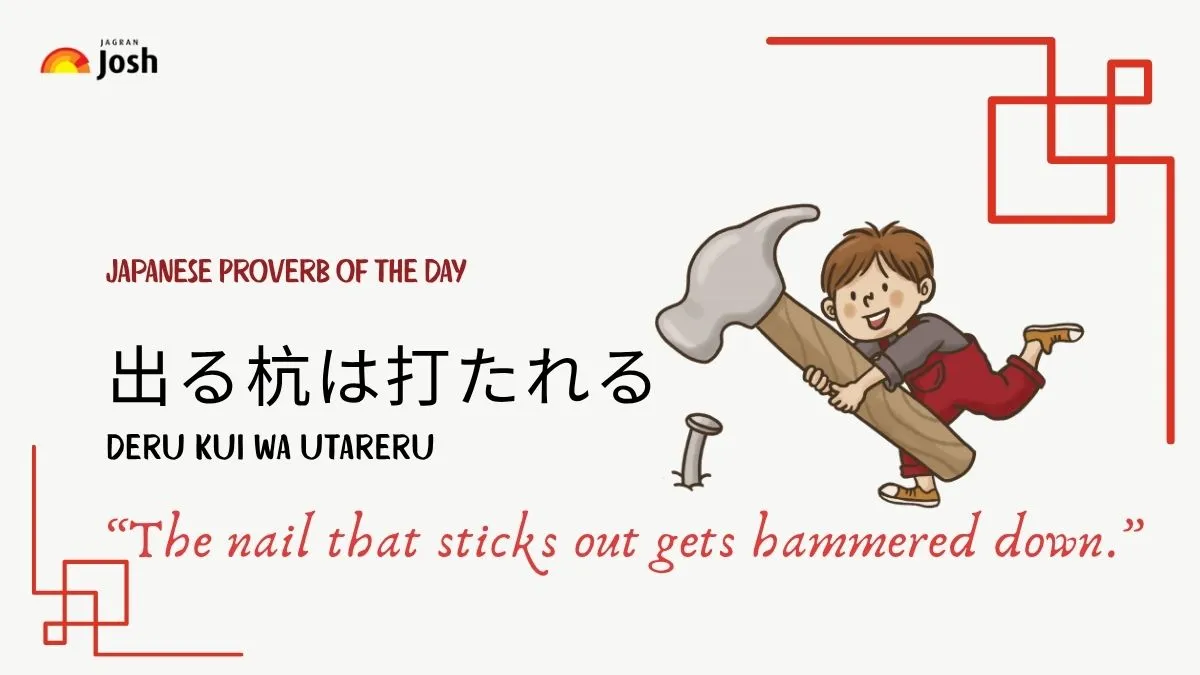
Individuality is often marketed as a modern virtue, yet the social machinery of 2026 remains remarkably efficient at flattening dissent. This tension is perfectly captured in today’s Japanese proverb of the day: Deru kui wa utareru (出る杭は打たれる). Translated as "the nail that sticks out gets hammered down," it serves as a sobering reminder that excellence or eccentricity often invites correction. In an era where "personal branding" is mandatory yet cancel culture is swift, understanding this proverb is no longer just a linguistic exercise; it is a survival strategy.
Japanese Proverb of the Day
Japanese Proverb: Deru kui wa utareru (出る杭は打たれる)
Literal English Translation: "The nail that sticks out gets hammered down."
Meaning of "The Nail that Sticks Out gets Hammered Down” Japanese Proverb
In Japanese society, the proverb is a foundational lesson in wa (social harmony). To be the "nail" is to prioritize your singular ego over the stability of the group.
-
The Structural Metaphor: A kui isn't a small nail in a wall; it is a structural stake. If it protrudes, it isn't just unsightly; it threatens the integrity of the entire build.
-
The Passive Strike: The verb utareru (to be hit) implies that the hammering is an inevitable, almost natural response from the environment. It suggests that resistance to your uniqueness isn't always personal; it is systemic.
-
The Dual Nuance: While often seen as a warning to conform, it is also a quiet acknowledgement of the nail's strength. To stick out, you must first be taller than your peers.
Everyday Lessons from this Japanese Proverb in Modern-Day?
How does an Edo-era warning apply to a digital-first workforce?
| Context | 2026 Real-Life Application | The Hammer Effect |
| Professionalism | Proposing Human-Only creative zones in an AI-saturated agency. | Peer skepticism or being labeled anti-progress. |
| Social Dynamics | Refusing to participate in a viral, polarizing trend. | The hammer of algorithmic invisibility or social exclusion. |
| Innovation | Solving a problem through a non-traditional, "inefficient" method. | Management is correcting your workflow back to the standard SOP. |
| Education | Students are challenging a dominant pedagogical theory. | Academic pushback to maintain the curriculum's status quo. |
What is the Origin History of this Japanese Proverb?
The proverb traces its philosophical lineage to the Edo Period, a time of rigid social stratification. However, its roots are deeper, tied to the agrarian necessity of the Muromachi era.
"In the rice paddy, the success of the harvest depends on every hand moving in unison. To act alone was to risk the survival of the village." — Historical Records of Japanese Folk Wisdom.
This collective mindset was later codified into the Bushido code, where the samurai's loyalty to the lord superseded personal ambition. In this historical context, the hammer was often the legal or social expulsion from the community (known as mura hachibu).
Also Read - Chinese Proverb of the Day: "Crooked trees live out their full lives; straight trees are cut down first."
What is the Hammer in the Age of Digital Conformity?
Is the proverb still a warning, or has it become a badge of honor? In 2026, we see a paradox: we are told to be ourselves, yet social media algorithms reward those who mimic trending sounds and filters. When you deviate, the "hammer" is the drop in engagement or the loss of followers.
Modern wisdom suggests that if you are going to be the nail that sticks out, you must ensure your "steel" (your skill and character) is tempered enough to survive the strike.
Did You Know?
The word Deru (出る) means "to exit" or "to emerge." It is the same kanji used in deguchi (exit). This implies that the nail hasn't just grown taller; it has actively stepped out of its designated place. Linguistically, the proverb doesn't judge the nail; it merely describes the physics of social order.
Read More Japanese Proverbs and Their Meanings Here!
"If you do not enter the tiger's cave, you will not catch its cub."
“Fall Seven Times, Stand Up Eight.”
"A Frog in a Well Knows Nothing of the Great Ocean."
“Tomorrow’s Wind will Blow Tomorrow."
"Even monkeys fall from trees."
The Japanese proverb of the day reminds us that the path of the individual is paved with resistance. Use this wisdom not to hide, but to prepare. If you choose to stand out today, stand firm. Join us tomorrow for more timeless insights.