Census 2027: Full List of 33 Questions To Be Asked In The First Phase
India's Census 2027: Check the complete list of 33 questions for the first phase, covering household details, housing, basic amenities, assets, digital collection, self-enumeration and key differences from 2011.
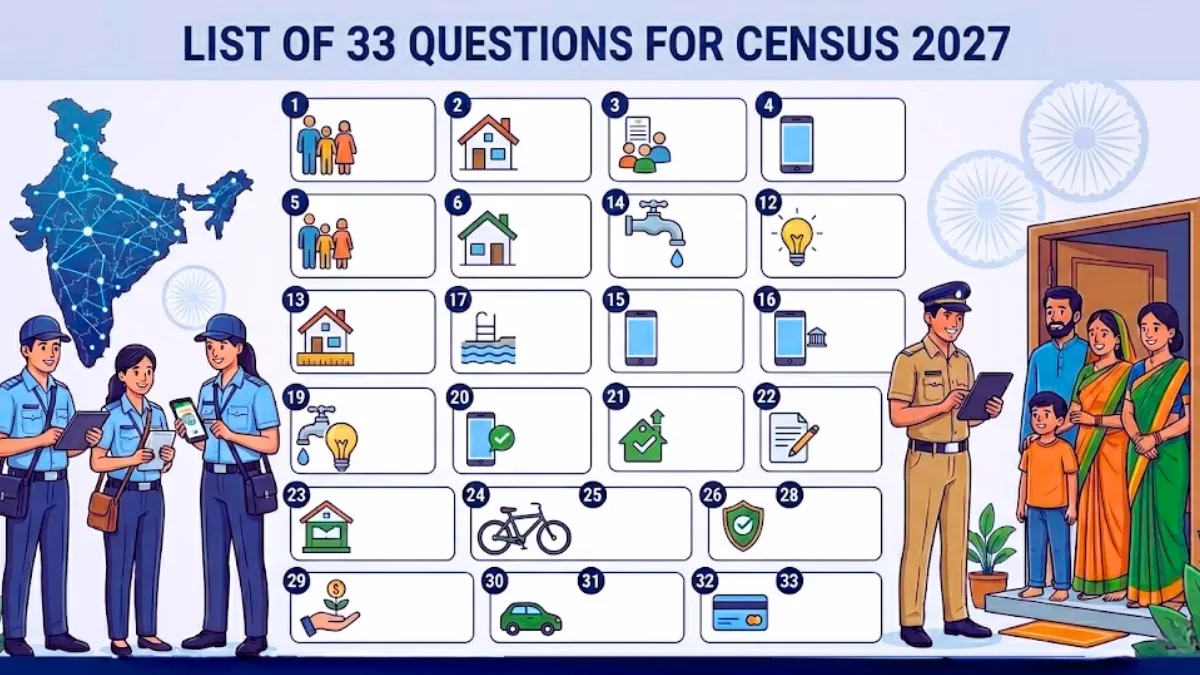
Full List Queations for First Phase of Census 2027: For the India's first digital census the governmnet of India has notified a set of 33 questions for the first phase or House Listing and Housing Census. These questions are designed to collect the socio-economic staus and data of households by focusing on living conditions, access to basic amenities like drinking water and electricity and ownership of assets.
The Registrar General and Census Commissioner of India (RG&CCI) under the Ministry of Home Affairs has officially notified the questionnaire for the first phase of Census 2027.
What are the 33 Questions for the Census 2027?
According to a gazette notification issued by the Registrar General and Census Commissioner of India (RG&CCI), the first phase will comprise houselisting and a housing census.
The government has transitioned to a digital-first approach to ensure higher accuracy and faster data processing, for the first time, citizens will have the option for self-enumeration to ensure a smooth process. It is impotanat for every citizen to be aware of the full list of 33 questions. Here is the full list of 33-Questions
-
Building number (Municipal or local authority or census number).
-
Census house number.
-
Predominant material of floor of the census house.
-
Predominant material on the wall of the census house.
-
Predominant material of roof of the census house.
-
Ascertain use of census houses.
-
Condition of the census house.
-
isHousehold number.
-
Total number of persons normally residing in the household.
-
Name of the head of the household.
-
Sex of the head of the household.
-
Whether the head belongs to Scheduled Caste/Scheduled Tribe/Other.
-
Ownership status of the census house.
-
Number of dwelling rooms exclusively in possession of the household.
-
Number of married couple(s) living in the household.
-
Main source of drinking water.
-
Availability of drinking water source.
-
Main source of lighting.
-
Access to latrine.
-
Type of latrine.
-
Waste water outlet.
-
Availability of bathing facilities.
-
Availability of kitchen and LPG/PNG connection.
-
Main fuel used for cooking.
-
Radio/Transistor.
-
Television.
-
Access to the internet.
-
Laptop/Computer.
-
Telephone/Mobile Phone/Smartphone.
-
Bicycle/Scooter/Motorcycle/Moped.
-
Car/Jeep/Van.
-
Main Cereal consumed in the household.
-
Mobile Number (for census related communications only).
Note: The data collected is protected under the Census Act of 1948, ensuring that personal details remain confidential and are used only for statistical and developmental planning.
Key Highlights of the Census 2027:
-
Timeline: Phase I will be conducted between April 1 and September 30, 2026. Each State and Union Territory will choose a specific 30-day window within this period.
-
Two-Phase Process:
-
Phase I (2026): House Listing and Housing Enumeration(a 30-day window per state)
-
Phase II (2027): Population Enumeration (scheduled for February 2027).
-
Digital Innovation: For the first time, data will be collected via mobile applications (Android and iOS) and featuring geo-tagging of residential structures to enhance disaster response and urban planning.
-
Self-Enumeration: Citizens will have a 15-day self-enumeration window to fill in their details online before the enumerator’s visit.
-
Mascots: the government has unveiled two official mascots for Census 2027: "Pragati" and "Vikas"
-
Pragati (Female): Symbolises the progress and empowerment associated with data-driven development.
-
Vikas (Male): Represents the overall growth and reach of the nation’s administrative efforts.
Why this matters: Including the mascots adds a visual and human element to your article, making it feel like a modern campaign rather than just a government mandate.
-
Census 2027 vs Census 2011
India's first digital census 2027 introduces many new features including self-enumeration, digital data collection and caste enumeration. The Census is conducteding in two phases and will be officially released in 2027. here are the key difference between the census 2027 and 2011
| Feature | Census 2011 | Census 2027 |
| Census Type | Paper-based | Digital-first census |
| Data Collection | Paper schedules filled by enumerators | Mobile app and digital devices for enumerators |
| Self-Enumeration | Not available | Citizens can complete self-enumeration online |
| Caste Enumeration | SC/ST data | Caste enumeration to be included along with regular census data |
| Technology | Manual data entry | Digital collection with faster processing |
| Number of Phases | Two phases | Two phases |
| Reference Year | 2011 | 2027 |
Census 2027 is India's first digital census introduces online self-enumerationand includes caste enumeration unlike the paper-based Census 2011. Eligible households can use self-enumeration portal while enumerators will also collect data digitally during field visits. Shifting from manual paper based schedules to mobile applications and digital devices accelerates data collection and processing times.

Aishwarya Samant is a journalist with over 4 years of experience navigating the fast-paced corporate media landscape. She specializes in decoding business news, world economy, personal finance, and stock market trends, often adding a subtle touch of political perspective to keep things interesting.
Having worked with reputed organizations like ZEE, TV9, News24, and NewsX, she is no stranger to the newsroom hustle and the demands of real-time storytelling. Her writing style is fast-paced, engaging, and crafted to connect seamlessly with diverse audiences across platforms. She approaches every story from the reader’s point of view, breaking down complex topics into clear, relatable narratives backed by solid facts and credible sources. While she’s confident in expressing strong viewpoints, she ensures balance with insights. Sharp, fact-driven content that informs, engages, and keeps readers coming back for more.