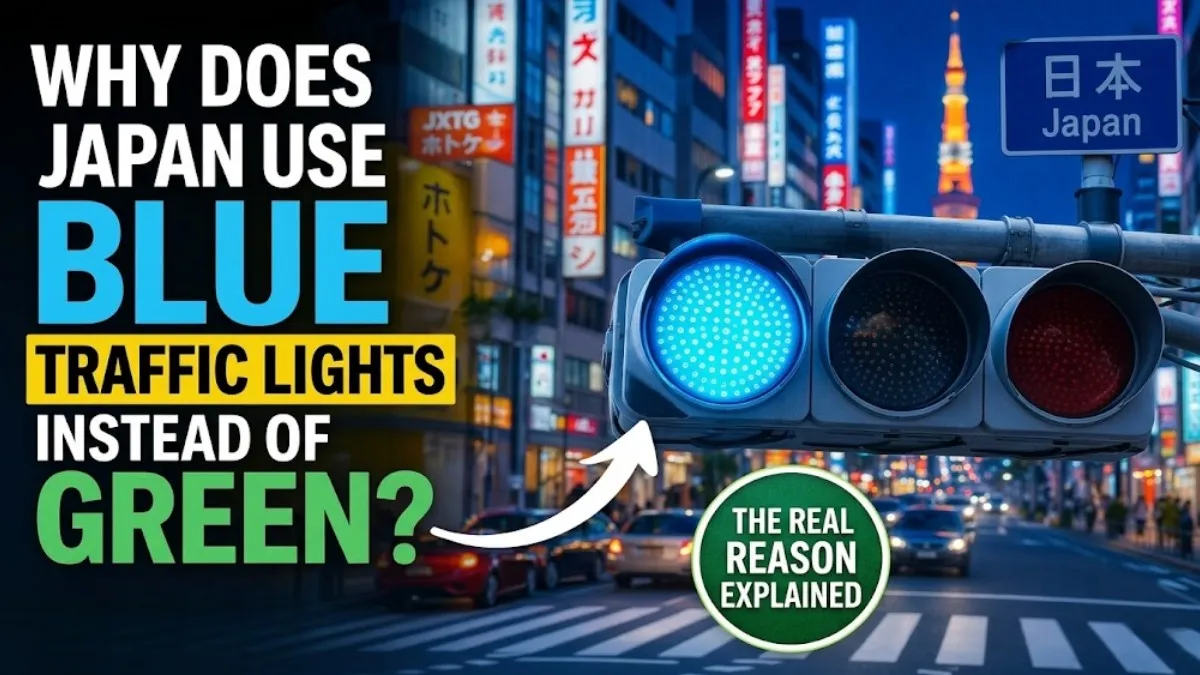
When you ever see streetlights in Japan (in Tokyo, in a town), you will see something different. The go signal can be blue and not necessarily green. The “go” signal often appears blue instead of green. For many travellers and internet users, this question comes to their mind: Why does Japan Use Blue Traffic Lights Instead of Green? Is Japan using a completely different traffic system?
The answer to this question is very simple. Japan’s “blue traffic lights” instead of green are the result of a unique language history, cultural tradition and government control. Although the rest of the world is strict in compliance with the red-yellow-green system, Japan has managed to make it close to language and traditions without violating international standards.
In this article, we explain the real reason behind Japan’s blue traffic lights, backed by verified facts and presented in a clear, easy-to-understand way. This is not just a quirky fact—it’s a perfect example of how language can shape everyday life.
Quick Answer: Why Does Japan Use Blue Traffic Lights Instead of Green?
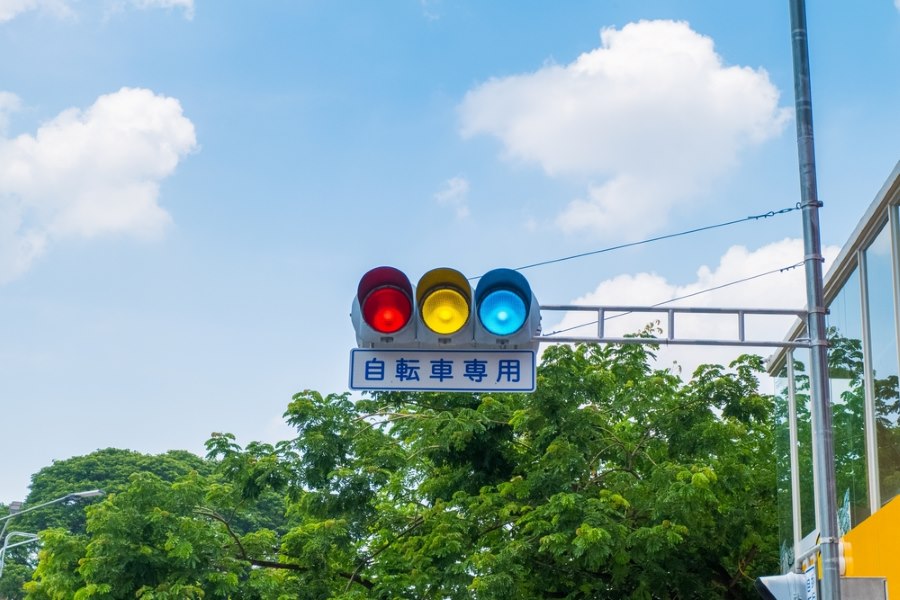
Japan does not use pure blue traffic lights. The “green” signal is deliberately designed as a bluish-green shade because traditionally, the Japanese word “ao” was used to describe both blue and green colours.
Why Does Japan Use Blue Traffic Lights Instead of Green?
Source: shutterstock
The reason behind Japan’s use of blue traffic lights instead of Green is given below :
1. Language History: One Word for Blue and Green
The primary reason lies in the Japanese language itself.
-
Historically, “ao (青)” referred to both blue and green
-
The word for green, “midori (緑)”, developed later as a separate term
-
Even today, older linguistic usage still influences modern speech
Examples still used in Japan:
-
“Blue apple” → refers to an unripe green apple
-
“Blue leaves” → refers to green leaves
Because of this, when traffic lights were introduced, people naturally called the green signal a “blue light” (ao shingō).
2. Cultural Continuity: Language Shapes Behaviour
Even after “midori” became the standard word for green:
-
The term “ao” continued in daily use
-
Traffic signals were still commonly described as “blue”
-
Schools, media, and public communication reinforced this usage
This reflects a deeper reality:
Cultural habits often persist even after language evolves.
3. Government Policy: The “Bluest Possible Green”
Japan faced a unique challenge—balancing international traffic rules with local linguistic identity.
-
Global standards require green = go
-
But Japanese culture associated the signal with “blue”
Solution (1973 regulation):
-
Signals must remain officially green
-
But the shade should be the “bluest possible green”
This is why modern Japanese traffic lights appear:
-
More turquoise or aqua
-
Less like the standard green used in other countries
4. Science of Perception: Why It Looks Blue
The human eye plays a role in this phenomenon.
-
Bluish-green shades can appear more blue under certain lighting
-
LED signals enhance this effect
-
Background contrast (sky, buildings, night lighting) influences perception
So while the light is technically green, it often appears blue to viewers.
What is the Evolution of the "Blue" Traffic Light in Japan?
Here is the Historical Timeline is given in tabular format showing the evolution of the "Blue" Traffic Light in Japan:
| Period / Year | Key Development | Cultural & Legal Context |
| Ancient Japan | Four primary colours: kuro (black), shiro (white), aka (red), and ao (blue/green). | No separate word for green existed; ao covered the entire cool-colour spectrum. |
| Heian Period (794–1185 CE) | The word midori (緑) emerges specifically for green. | Midori remained secondary; ao continued to be the go-to term for nature and vitality. |
| 1930 | Japan's first traffic light was installed at Hibiya Crossing, Tokyo. | Despite being a standard green light from the U.S., newspapers and the public immediately labelled it ao shingō. |
| 1947 | Post-WWII Road Traffic Act revision. | Ao shingō officially becomes the legal term, replacing the short-lived midori-iro shingō. |
| 1968 | Vienna Convention on Road Signs and Signals. | Standardised green for "go" globally. Japan did not sign, choosing to keep its unique terminology. |
| 1973 | Japanese government issues a cabinet order regarding light shades. | Required traffic lights to use the bluest possible shade of green to reconcile international standards with Japanese linguistics. |
| Today | Modern LED installations and licensing. | Lights range from emerald to turquoise. All are called ao, and driver’s license tests specifically check for blue vision. |
Note: This is why you’ll see "blue" lights in Japan that look distinctly turquoise or cyan. It’s a clever compromise: the light is green enough to satisfy international safety intuition, but blue enough to justify calling it ao.
Why Japan Uses Blue Traffic Lights Instead of Green: A Perfect Balance of Culture and Compliance
To understand why Japan uses bluish-green traffic lights instead of the standard green, it is important to look at the key factors that influenced this unique decision. The table below highlights how cultural traditions, language, and international regulations shaped Japan’s approach.
| Factor | Japan’s Approach |
| International law | Maintain a green signal |
| Language tradition | Keep “blue” identity |
| Final outcome | Bluish-green traffic lights |
Japan did not break the rules—it reinterpreted them culturally.
So, in conclusion, we can say that Japan’s “blue traffic lights” are not a mistake or myth. They are a thoughtful blend of language, culture, and regulation. Linguistically rooted in the word “ao” Culturally preserved over centuries. Technically compliant with global standards. In simple terms: They are green by law, but blue by tradition.
FAQ
Q1. Why does Japan use blue traffic lights instead of green?
Because historically, the Japanese word “ao” referred to both blue and green, influencing how signals are perceived.
Q2. Are Japanese traffic lights actually blue?
No, they are bluish-green but designed to appear closer to blue.
Q3. When did Japan adopt bluish-green signals?
In 1973, Japan standardized traffic lights to the bluest possible shade of green.



Comments
All Comments (0)
Join the conversation